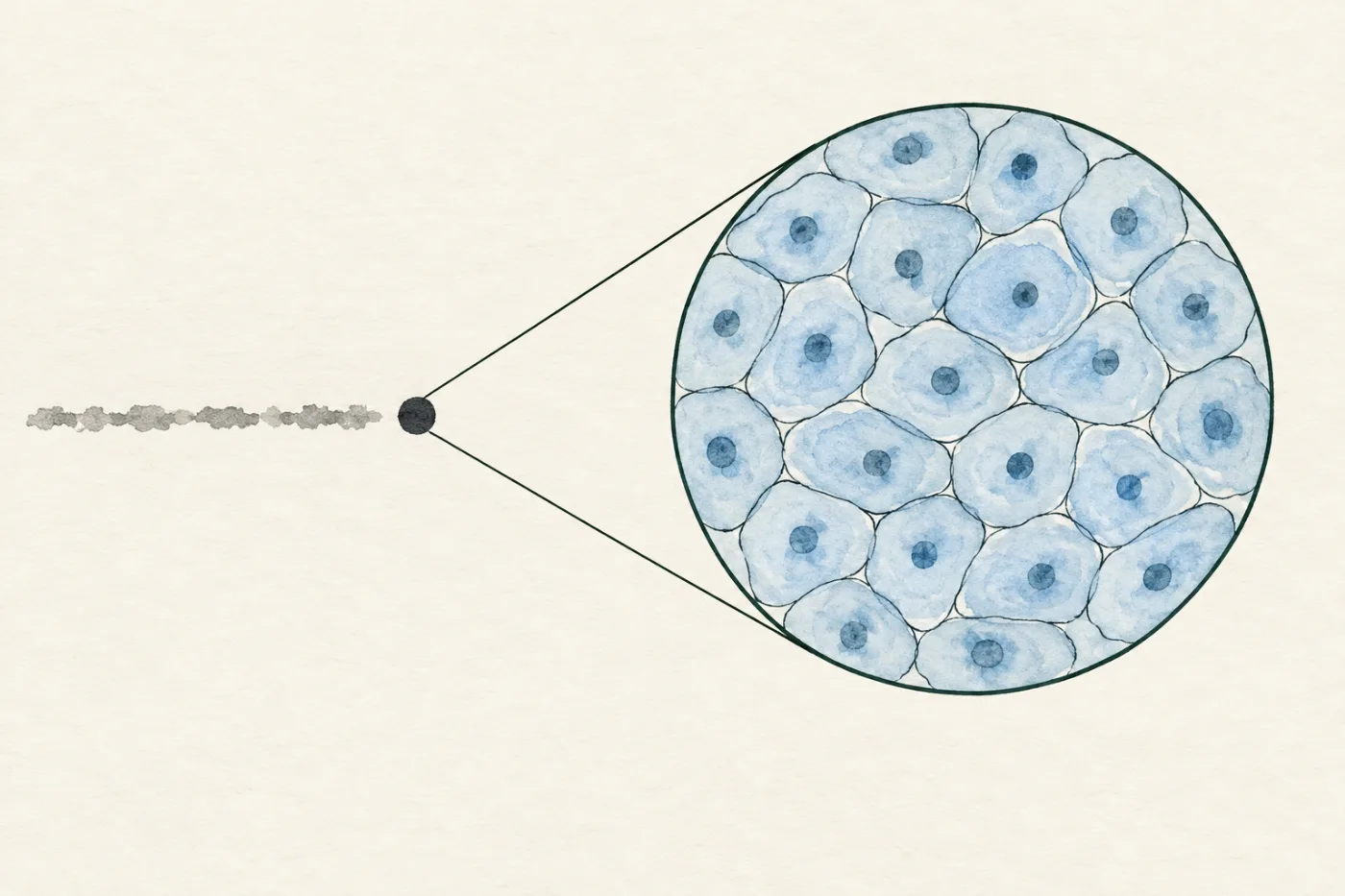
A full stop on this page is about half a millimetre across, and five or six of your cheek cells would fit across it. A blue whale weighs as much as thirty elephants, yet its cells are about as small as yours: the whale simply has far more of them. Why do living things build big bodies out of tiny cells, instead of a few big ones? In this part you soak cubes of jelly in acid and time how long the acid takes to reach their centres.
 (enlarge)
Particles on the move
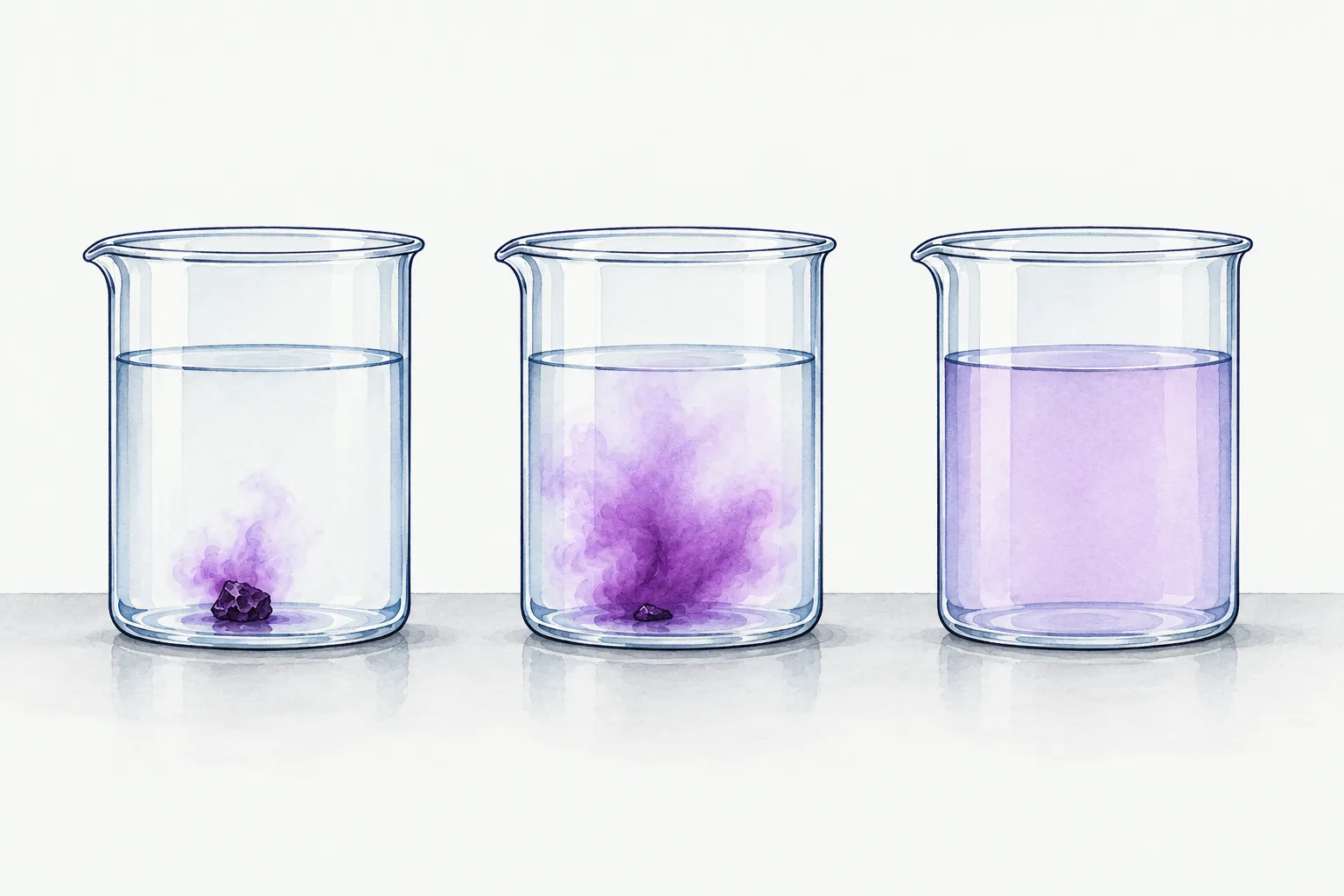
Drop a crystal of purple potassium manganate(VII) into still water and leave it. Nobody stirs, yet the purple slowly spreads until all the water is pale purple. The particles of the dissolved substance are always moving, at random, in every direction. They bump into water particles and change direction all the time. Where there are many of them, more of them happen to move away than move back, so the colour spreads out.
 (enlarge)
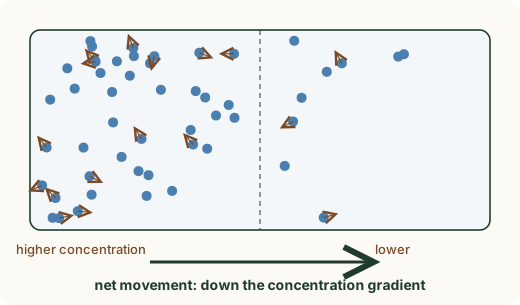
This spreading is called diffusion: the net movement of particles from a region of their higher concentration to a region of their lower concentration, down a concentration gradient, as a result of their random movement. "Net" means overall: particles still move both ways, but more go one way than the other. The energy for diffusion is the kinetic energy of the moving molecules and ions themselves; no extra energy is needed. (In Chemistry, the module on diffusion follows the particles in a gas.)
 (enlarge)
Trap: "Diffusion stops when the particles are spread out evenly." The particles keep moving at random. Once the concentration is the same everywhere, as many move one way as the other, so there is no net movement.
Acid soaking into jelly
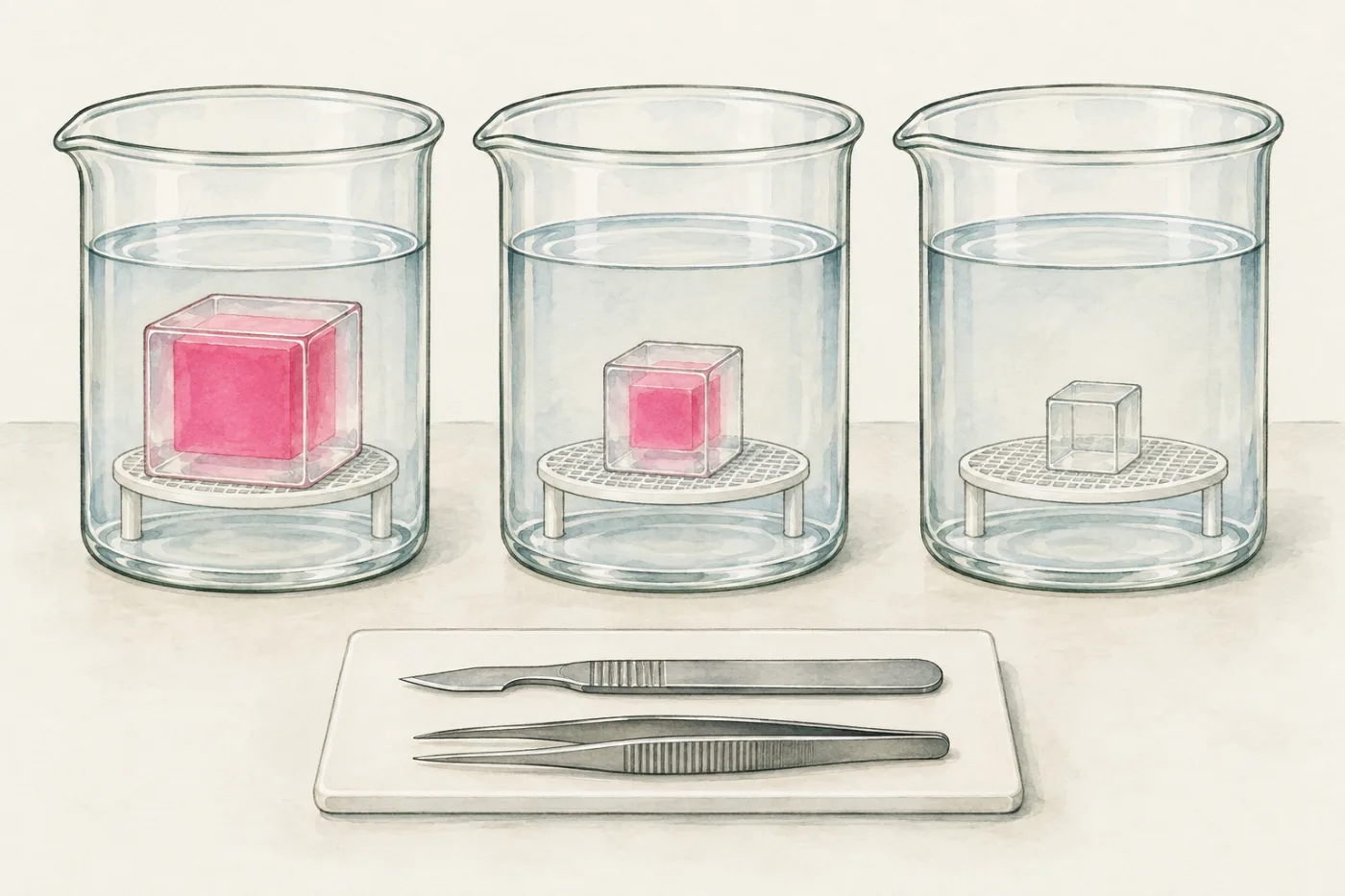
Agar is a firm jelly. This agar is made with a little alkali and an indicator, phenolphthalein, so it is pink. When acid soaks in, it neutralises the alkali and the indicator turns colourless. So the colour shows how far the acid has got. The agar is not a cell: it stands in for the distance that substances must travel.
Predict first: three pink cubes with sides of 2 cm, 1 cm and 0.5 cm go into the same acid at the same moment. Which one turns colourless all through first?
What the cubes showed
The colour faded from every face, from the outside in. The small cube cleared first, after about 3 minutes; the 1 cm cube after about 12; the big cube only after about 48. A cube that is twice as wide took about four times as long to clear.
In the full experiment, a fresh set then goes into the acid for exactly 4 minutes and is cut in half (open the experiment to try it). Every cut face had a colourless border of about the same width: the acid had soaked in the same distance on every cube. But the big cube still had a large pink core, the 1 cm cube a small one, and the small cube was colourless all through. In the same time, the acid travels the same distance. A small cube is cleared because its centre is close to the surface.
 (enlarge)
Surface area and volume
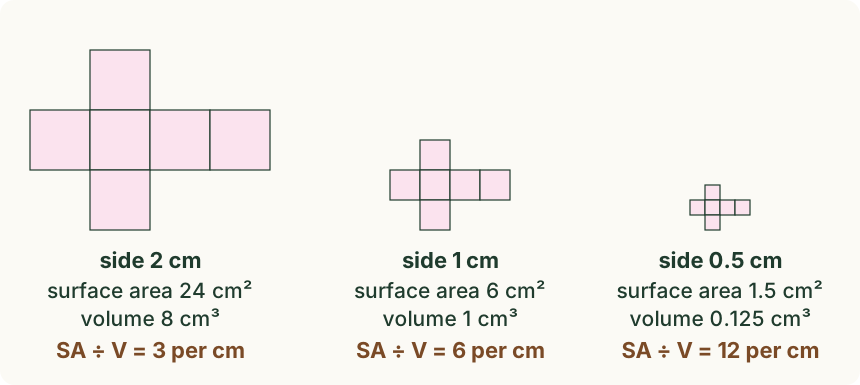
There is a second reason. Each cube takes in acid through its surface, but the acid has to reach all of its volume. Compare the surface with the volume:
 (enlarge)
The 1 cm cube has 6 faces of 1 cm², so 6 cm² of surface for 1 cm³ of volume: a surface area to volume ratio of 6 cm² per cm³, written 6 per cm (6 cm⁻¹). The big cube has more surface in total (24 cm²), but each cm³ of it has only 3 cm² of surface. The smaller the cube, the more surface it has for every cm³ inside it.
Trap: "The big cube has more surface, so the acid gets in faster." It has more surface in total, but much more volume to fill, and its centre is further away. What matters is the surface for each cm³ and the distance to the middle.
What changes the rate of diffusion
Making the cube smaller changed two things at once: the distance to the centre, and the surface for each cm³. It did not make the acid particles move any faster. In the full experiment you then keep the cubes at 1 cm and change one thing at a time. Warmer acid clears the cube sooner: the particles have more kinetic energy and move faster. Stronger acid clears it sooner too: the difference in concentration between the acid and the agar, the concentration gradient, is steeper.
Key idea: The rate of diffusion is faster with a larger surface area, a higher temperature, a steeper concentration gradient and a shorter distance.
A cell takes in what it needs, such as oxygen, through its surface, and the substances then spread through it by diffusion. If a cell were very large, its centre would be too far from the surface, and it would have too little surface for its volume. So cells stay small, and a large organism is made of very many of them.