Ana and Ben run the same green dye, with the same solvent, on the same kind of paper. Ana lifts the paper out early. Ben uses a taller strip and waits much longer. Ana's blue spot ends up 14 mm above the baseline, and Ben's ends up 28 mm above it. Did the dye change? No: in Ben's longer run the solvent went further, so the dye did too. To compare spots fairly, you need a number that doesn't depend on how long the run lasted.
In this part you'll calculate that number, called Rf, and then find substances that travel up the paper without showing any colour at all.
Two distances from the same baseline
Compare each spot with how far its solvent went. Ana's solvent front travelled 40 mm, and 14 ÷ 40 = 0.35. Ben's front travelled 80 mm, and 28 ÷ 80 = 0.35 too. Ben's spot went twice as far, but so did Ben's solvent, so the fraction stayed the same. That fraction is the Rf value of the spot.
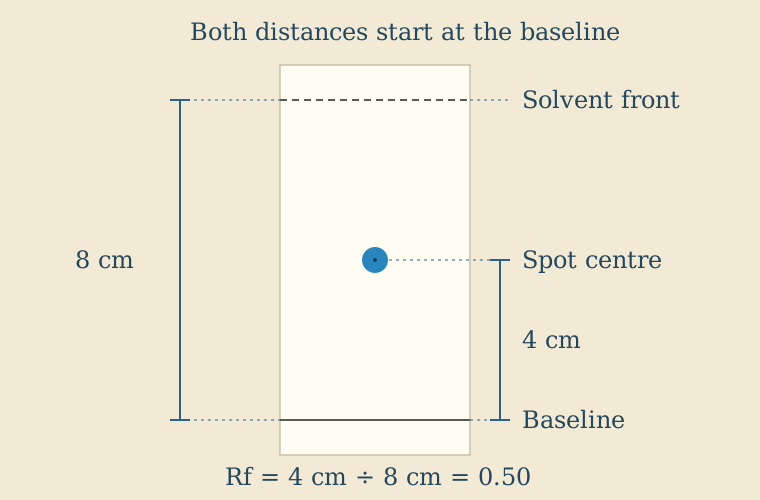
Rf = distance from baseline to spot centre ÷ distance from baseline to solvent front
Both distances have the same origin: the point they're measured from is the baseline. Measure to the centre of the spot, not its top edge, because a spot spreads out a little as it travels and its centre is the fairest point to read. The spot's distance goes on the top of the fraction, and the front's distance goes on the bottom.
Use the same unit for both distances: millimetres for both, or centimetres for both. Then the units cancel, so Rf has no unit. A spot can't travel further than the solvent that carries it, so a valid Rf is between 0 and 1.
 (enlarge)
Trap: “My Rf is greater than 1, so this dye travelled especially well.” A spot can't overtake its solvent front, so an Rf above 1 means a measuring mistake. Check that both distances start at the baseline, that the spot's distance is on the top, and that you measured to the solvent front, not to the top of the paper. And if the solvent hasn't moved at all, the bottom of the fraction is 0, so there's no Rf to calculate.
Rf lets you compare a short run with a long one, but only under the same conditions. Change the solvent, the paper or the temperature, and the same substance can give a different Rf, so an Rf isn't a fixed number that holds everywhere. A matching Rf, measured under the same conditions as a reference, supports a match.
Worked example
ignore the paper edge
Sometimes a ruler is laid from the bottom edge of the paper instead of from the baseline. Then every reading includes the gap between the edge and the baseline. This gap is the baseline offset, and you take it away from both readings. The baseline is 1.0 cm above the bottom edge. The spot centre is 4.0 cm above that edge, and the front is 7.0 cm above it. Predict which distances belong in the ratio.
Subtract the 1.0 cm offset from both readings. The spot travelled 3.0 cm, and the solvent travelled 6.0 cm. So Rf = 3.0 ÷ 6.0 = 0.50, not 4.0 ÷ 7.0.
Separate first, reveal afterwards
Fingerprints on paper are usually invisible, yet detectives can still find them: they spray the paper with a chemical that reacts with traces left by the skin and turns them purple. Chromatography has the same problem. Colourless substances can dissolve and travel up the paper just like dyes, but they leave no stain, so the paper looks blank.
To find them, first run the whole method on fresh paper, as before. Draw a pencil baseline, put a small spot of the sample on it and let it dry. Pour a shallow layer of a suitable solvent, below the baseline, then lower the paper in, cover the beaker and let the paper develop. Lift it out, mark the wet front straight away, and then let the paper dry. By then the substances have already separated and stopped moving.
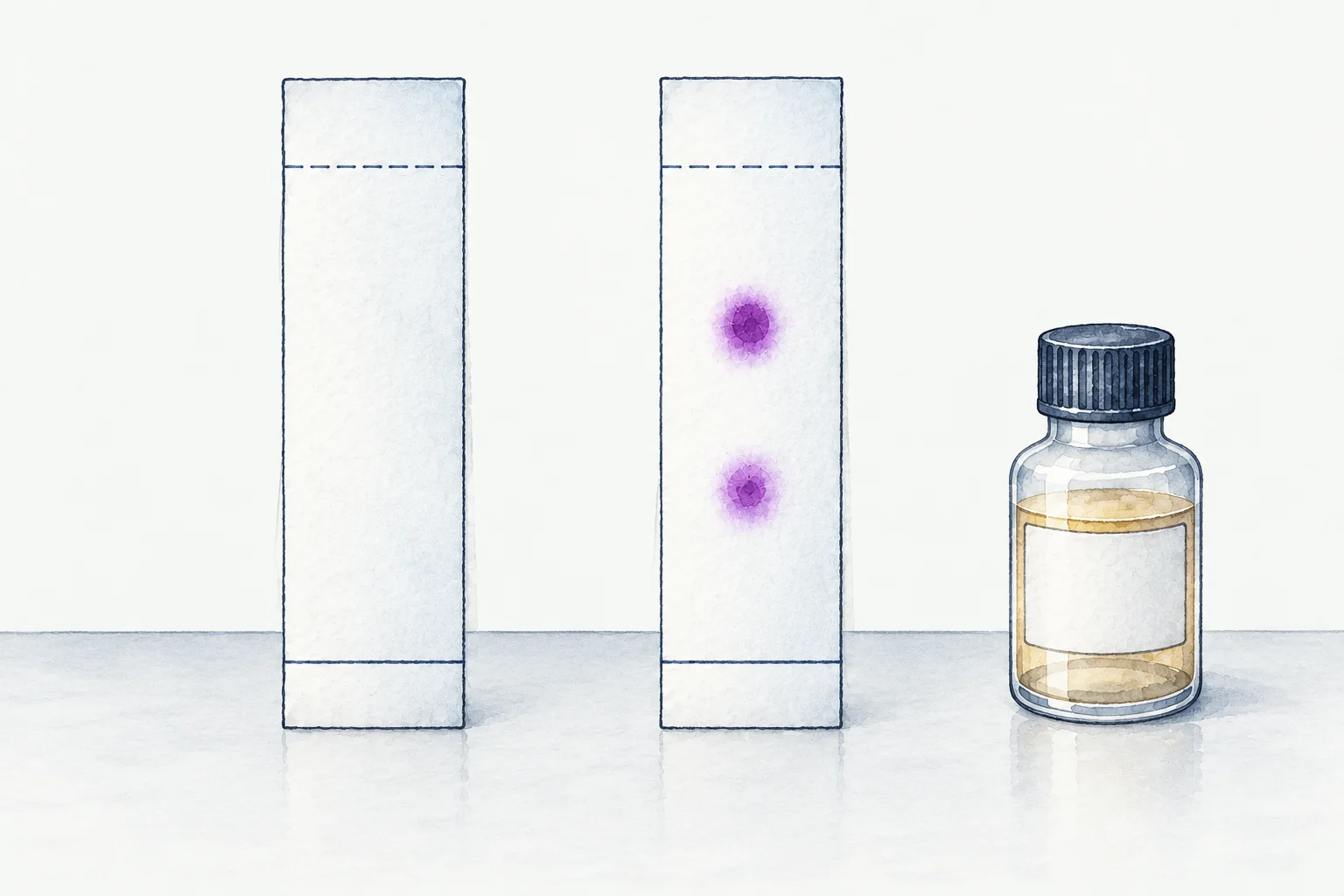
Only now does the locating agent come in. It's a chemical sprayed evenly over the removed, dry chromatogram: the paper you've already lifted out of the beaker and let dry. It reveals where the separated substances are by turning their spots coloured. In the experiment's run with colourless sample C, two purple spots appear.
 (enlarge)
Trap: “The locating agent did the separation.” The substances separated earlier, while the paper developed in the solvent. The locating agent only reveals where they ended up. It isn't the developing solvent, and it doesn't replace the front mark. You don't need to remember the name of any particular agent here.
Worked example
invisible is not absent
A dried colourless sample looks blank. After a suitable locating agent, two spots appear. That supports a mixture of at least two separated substances.
Work out Rf for each spot from its centre, using the same front mark for both. If the front was never marked, the spots you can now see won't give back the distance the solvent travelled, so you can't calculate Rf.
Try a fresh colourless sample
Press “Open experiment” at the top of this lesson. The full version goes further than the short one in part 1: after the comparison, the ruler lies beside your own paper with its 0 on the start line, so you read both distances straight from the baseline, and your Rf comes from your own readings. After that you repeat the method with the colourless sample C, and decide what a blank, dry paper tells you before you reach for the locating agent.
Case closed
- Measure both distances from the baseline: to the centre of the spot, and to the solvent front.
- Divide the spot's distance by the front's distance, in the same unit. Rf has no unit.
- For colourless substances, separate and dry first, then reveal the spots with a locating agent.
About this model
The times, spot sizes and data are made up to show the idea. Locating here stands for any way of detecting the spots, not a particular chemical reaction, and it isn't an instruction for spraying a real agent. Real solvents and locating agents need a risk assessment your teacher has approved, and suitable protection.