Tip a pan of cooked pasta into a colander. The pasta stays in the colander, and the water runs down the sink. The salt still dissolved in that water goes down the sink with it, although you never see it. Your basin of blue crystals in blue liquid is the same kind of problem. In this part you'll use a filter to send the crystals and the liquid to different places, find out what the liquid still carries, and dry the crystals without spoiling them.
One mixture, two destinations
A filter works like the colander, only much finer. Filter paper is full of tiny holes, small enough to hold back solid crystals. Dissolved particles are far smaller still, so they pass straight through with the water.
Pour the cooled mixture of crystals and solution into a funnel lined with filter paper, with a beaker below to collect what drips through. Before you read on, predict what drips into the beaker: pure water, with nothing else in it, or water with salt still dissolved in it?
The crystals stay on the paper. Solid left on the filter paper is called the residue. The liquid that passes through into the beaker (sometimes called the receiver) is the filtrate. Here the filtrate is still blue, because it's the leftover solution from part 2: water with some copper(II) sulfate still dissolved in it.
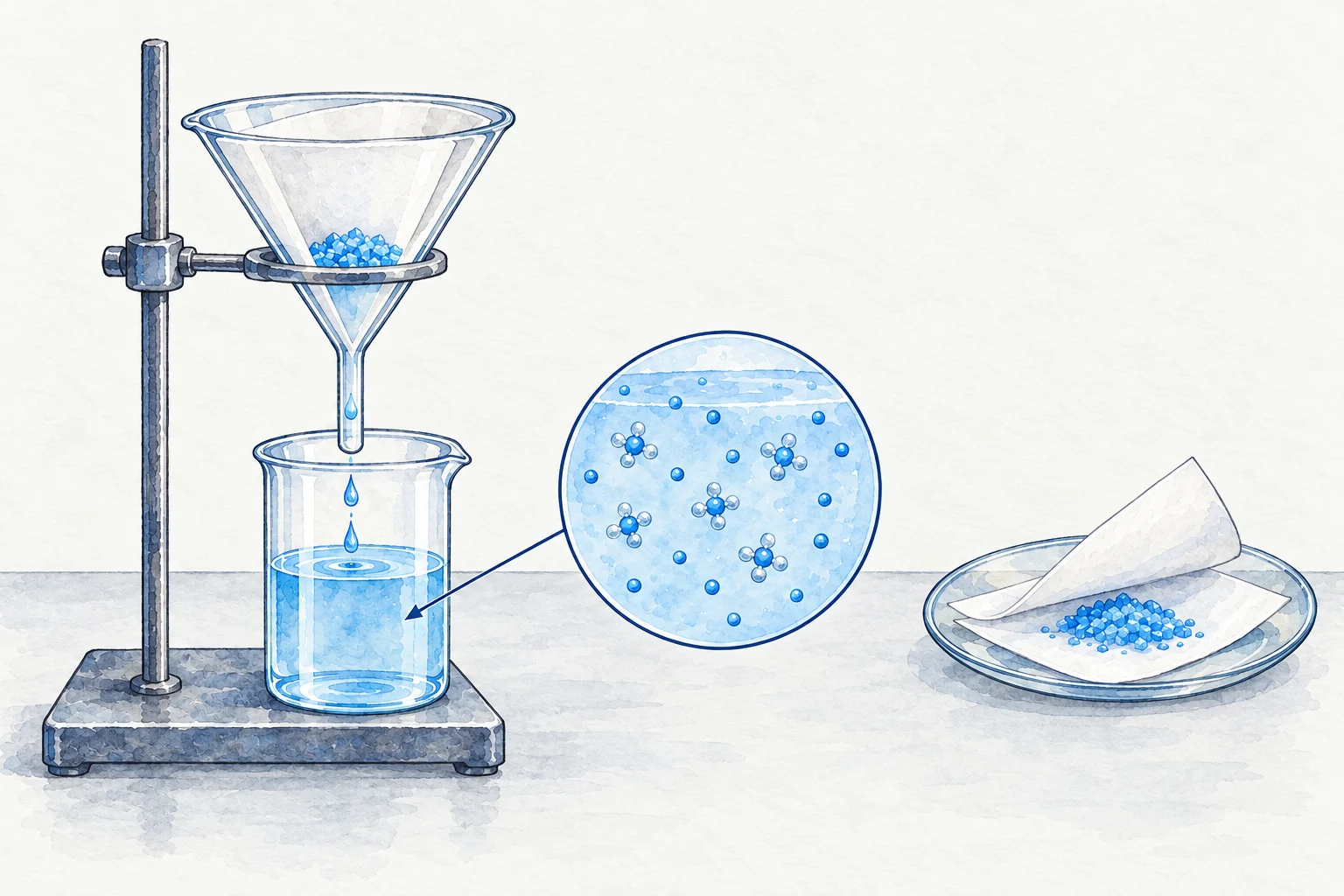 (enlarge)
Trap: “I could have filtered the original clear solution.” Its salt was all dissolved, so it would have gone through the paper with the water. A filter only holds back a solid that is already there, which is why you had to grow crystals first.
Because the blue filtrate still holds dissolved salt, it can give you more crystals. Heat it gently to remove some more water, test it with the rod and cool it again, and you get a second, smaller batch. You'll try this at the end of the experiment. Even then, some salt stays dissolved in the last filtrate.
Dry the outside, keep the crystals
The crystals come off the filter wet, because a thin layer of solution clings to their surfaces. Move them onto fresh filter paper, then gently blot them by pressing another sheet on top. The paper soaks up the liquid on the outside of the crystals.
Why not simply heat them dry? These blue crystals are hydrated: water is part of their structure, built in as they grew. This bound water is called water of crystallisation, and it's part of what makes the crystals blue. Blotting removes only the solution on their surfaces, so the water of crystallisation stays in place.
Trap: “Heat the crystals over a flame to make them extra dry.” Strong heating drives out the water of crystallisation, and the blue crystals turn into a white powder, a different substance. Blot away the surface liquid using the method your teacher approves instead.
Choose the method from the properties
Choose crystallisation when you want to get a soluble solid (one that dissolves) back out of its solution. It works well when cooling a concentrated solution of that solid makes crystals form. For a solid like sodium chloride, whose limit hardly changes with temperature, you'd evaporate much more of the water instead.
It can also help to make the solid purer. Impurities are unwanted substances mixed in with the one you want. If an impurity dissolves in water and there's less of it than the cool water can hold, it stays dissolved, so it ends up in the filtrate while the wanted salt forms crystals. That doesn't guarantee purity, though: a pure substance is made of only one substance, with nothing else mixed in. A little of the solution, with impurity in it, clings to the crystals, and some impurity can crystallise too.
Other mixtures need other methods. An insoluble solid, one that doesn't dissolve, is already there as grains, so you can filter it out straight away. If you want the water rather than the solid, crystallisation won't collect it, because the water you evaporate escapes into the air; distillation collects it.
Worked example
Is the blue filtrate pure water?
A student looks at the clear blue filtrate and labels it “pure water”. Is that right?
No. Some of the copper(II) sulfate formed crystals, which stayed on the paper, but some stayed dissolved, and that part passed through the paper with the water. The blue colour shows that it's there. Clear isn't the same as pure: a clear liquid can still hold dissolved solute. Follow where the salt went, not whether you can see grains.
Worked example
Put the reasons in order
Here's the whole method, starting from the prepared clear solution, with the reason for each step.
- Gently evaporate some water, so the solution becomes more concentrated.
- Test a cooled film on a glass rod. When crystals form on it, stop heating, while plenty of liquid is still left.
- Leave the main solution to cool and stand, so crystals grow while solution stays around them.
- Filter the cooled mixture, so the crystals stay on the paper and the remaining solution passes through.
- Blot the crystals between fresh sheets of filter paper, to remove the surface solution and keep the water of crystallisation.
Why not filter before cooling? The salt would still be dissolved, so it would pass through the paper. Why not heat to dryness? You'd remove the solution that the crystals grow from, and strong heat could turn the blue crystals into a white powder.
Case closed
- Grow the crystals first, then filter.
- The crystals stay on the paper as the residue; the dissolved salt goes with the water into the filtrate.
- Blot away the surface liquid, so the water of crystallisation stays.
Try the questions; some use a new sample. Save return and recall for later. The final check connects all three parts.
About this model
The scene starts from a prepared solution, so it doesn't teach making the salt by a reaction. It shows ideal collection: real crystals keep a little liquid, and some product is lost during handling. Full purity testing, measured yield and practical lab skill need more work than this. The questions and answer formats are original teaching exercises, not an official exam paper.