Someone at the back of the classroom peels an orange. A minute later you can smell it at the front. Nothing you could see crossed the room, and nobody wafted the smell towards you. So what travelled, and how did it find its way to you? In this part you'll track an invisible gas along a closed glass tank, using paper that changes colour when the gas arrives. Then you'll explain, with particles, how a gas spreads.
Particles on the move
Everything is made of tiny particles that are always moving. This idea is called kinetic particle theory (“kinetic” means to do with movement). In a gas the particles are far apart and move quickly. Each one travels in a straight line until it hits another particle or a wall. Every collision sends it off in a new direction.
That new direction is random: no direction is more likely than any other. Nothing steers a particle, and no particle aims anywhere.
The smell of the orange is made of particles too. Some of them escape from the peel as a gas and mix in among the particles of the air.
Tracking an invisible gas
Ammonia is a colourless gas with a sharp smell. You can't see it, but you can detect it. It dissolves in water to make an alkaline solution, and an alkali turns red litmus blue. So a damp strip of red litmus paper turns blue once enough ammonia reaches it.
The tank is a long glass box with a sliding glass lid. Six damp red litmus strips stand along its back wall, numbered 1 to 6 from the left. A few drops of concentrated ammonia solution go on a cotton-wool pad on a watch glass, and ammonia gas starts to come off the pad. The watch glass goes on a marked spot on the tank floor: near the left end, or in the centre. Then the lid closes, so no draught carries the ammonia.
Safety: Concentrated ammonia solution is corrosive, and the ammonia gas it gives off harms the eyes and lungs. A real version of this experiment is a teacher demonstration in a fume cupboard.
Predict, then run it
Run the experiment twice: once with the pad near the left end, once in the centre. Before you close the lid, predict. From the left end, will the nearest strip turn first, all six at once, or the farthest? From the centre, which strips will go first?
Compare the waits between strips in your results chart. Then select the tank glass and watch the particle whose path is drawn. Does it head straight for the far end?
What the strips showed
With the pad near the left end, strip 1 turned blue first, then strip 2, and so on to strip 6, with a longer wait each time. With the pad in the centre, strips 3 and 4 turned together, then 2 and 5, then 1 and 6.
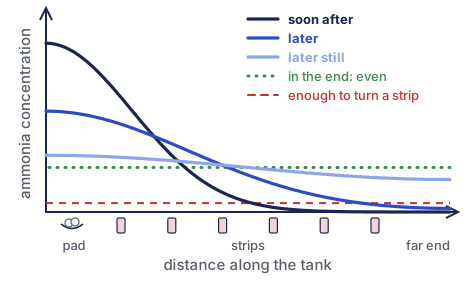
So the ammonia spread out from the pad, where there was a lot of it, into the rest of the tank, where there was little or none. How much of a substance there is in a given volume is its concentration. Just after the lid closed, it was high near the pad and almost zero further along.
Key idea: Diffusion is the net movement of particles (more of them moving one way than the other) from a region of higher concentration to a region of lower concentration, as a result of their random motion.
Diffusion doesn't change the amount of ammonia: the lid kept it all in. The same particles spread through more space, so the concentration near the pad falls while the concentration further along rises.
 (enlarge)
In the end the ammonia is spread evenly along the tank: the dotted line. That even level is the spread-out average, the same amount of ammonia shared out equally. It is lower than the early peak near the pad, higher than the early level far away, and never zero.
Why did each wait get longer? A strip turns blue once the concentration around it reaches the dashed line. Near the pad, that happens almost at once. Further along, the curve takes longer and longer to rise that high: spreading twice as far takes much more than twice as long. The next section shows why.
Inside: one particle's zigzag
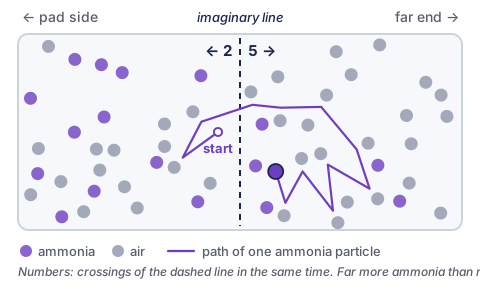
The magnified view shows what the strips can't. The ammonia particles (violet) move among the air particles (grey), and each change of direction stands for a collision. The particle whose path is drawn zigzags, and sometimes it heads back towards the pad. No particle aims anywhere.
 (enlarge)
So why does the gas as a whole spread away from the pad? Look at the dashed line in the figure: an imaginary line across the tank between two strips. Ammonia particles cross it both ways, at random.
But there are more of them on the pad side, so in the same time more cross away from the pad (5 in the figure) than come back (2). That difference is the net movement: overall, ammonia moves from higher to lower concentration, although single particles go both ways.
Each particle also wanders back and forth instead of marching ahead. That's why spreading over a long distance is so slow.
Trap: “The particles move towards the far end because there's more room there.” No particle aims anywhere. Each moves at random, in every direction. More of them cross from the crowded side simply because there are more of them there.
Trap: “Once the gas has spread out evenly, the particles stop.” They keep moving and colliding. Once the concentration is the same everywhere, as many particles cross each way, so only the net movement stops.
Worked example
Why pairs from the centre?
With the pad in the centre, strips 3 and 4 turned at the same moment, then 2 and 5, then 1 and 6. What does that tell you about the way the ammonia moved?
The concentration was highest at the centre. The particles move at random, so as many head left as right. The concentration therefore fell away equally on both sides. Strips 3 and 4 are the same distance from the pad, so the concentration around each reached the dashed line at the same moment. The same goes for 2 and 5, and for 1 and 6.
So the ammonia didn't head for either end. It spread out from where it was concentrated, equally in every direction. With the pad at the left end, it only seemed to travel to the right, because that was the only direction in which there was less of it.
Not only gases
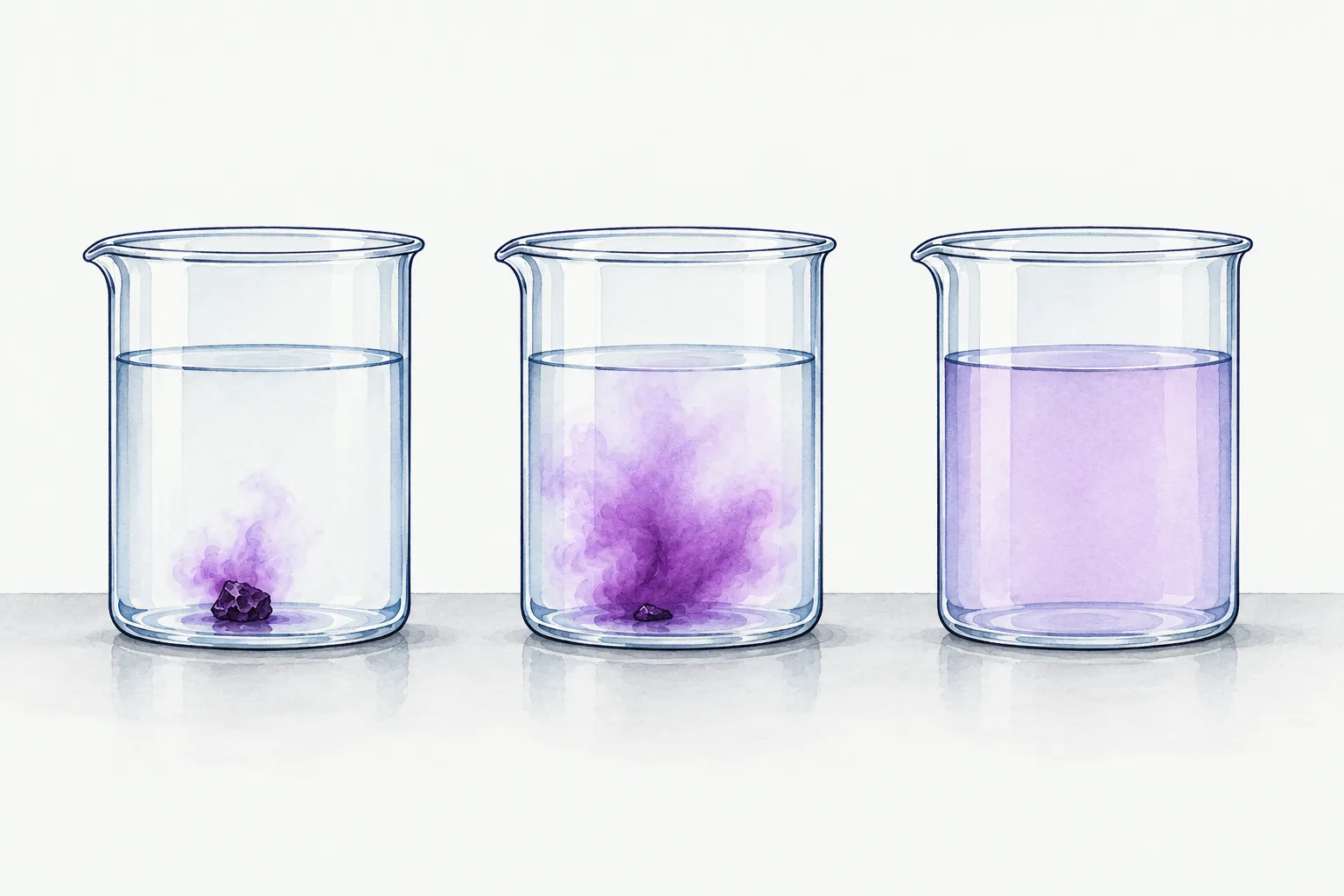
Diffusion happens in liquids too. Drop a crystal of purple potassium manganate(VII) into a beaker of still water. The purple spreads out from the crystal and, given enough time, colours all the water evenly.
 (enlarge)
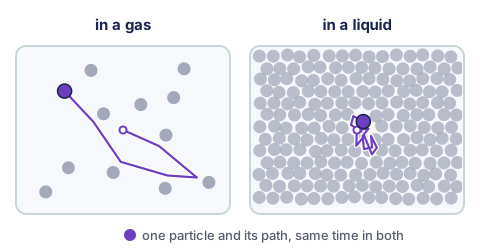
But diffusion in a liquid is much slower than in a gas. Left completely still, the purple takes days to spread evenly through the beaker, far longer than a lesson. Why? In a liquid the particles are close together, touching their neighbours. A purple particle can hardly move before it collides with a water particle, so it changes direction far more often than a gas particle. In the same time it gets much less far.
 (enlarge)
Draughts and stirring are something else
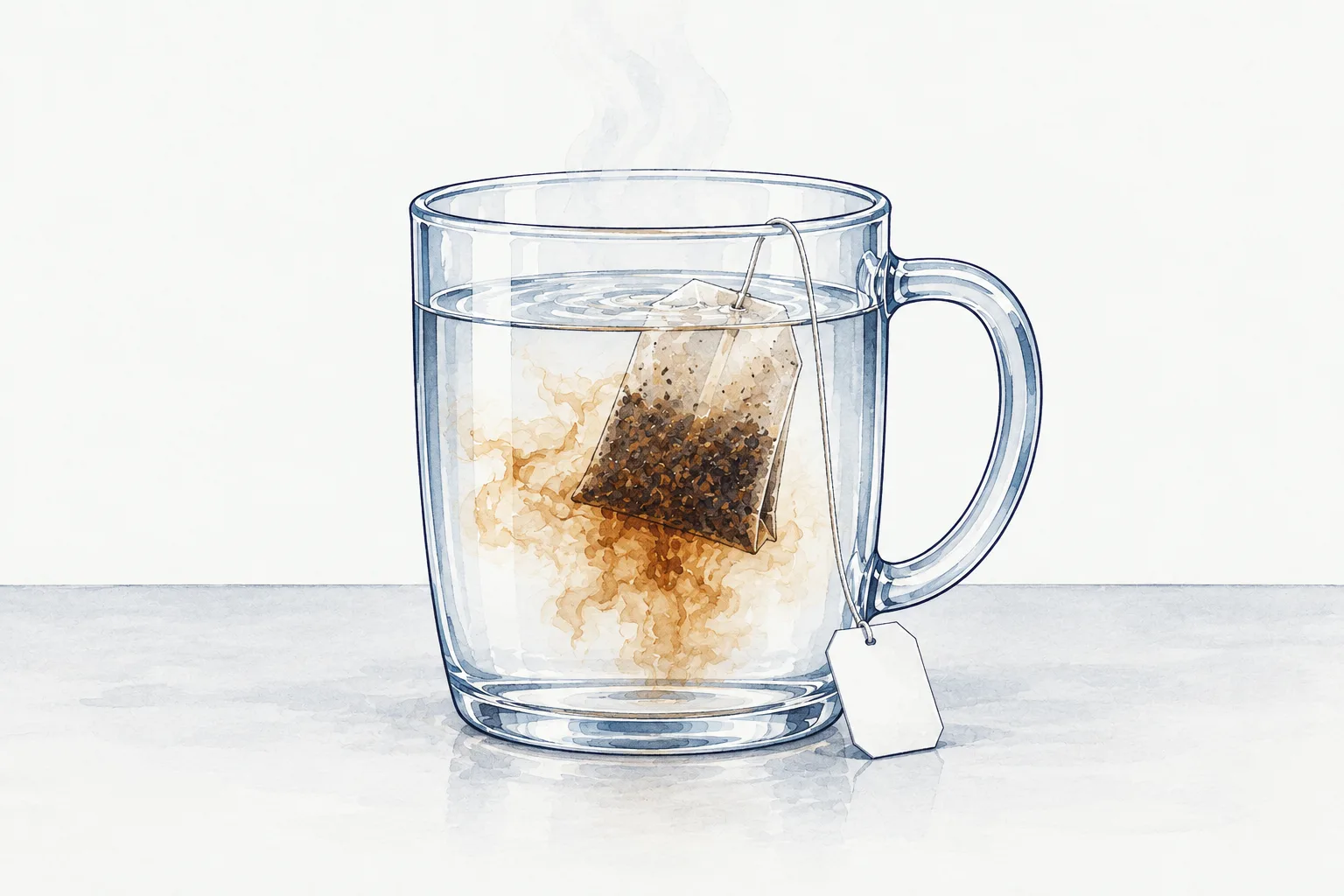
Drop a tea bag into hot water and brown streams sink from it straight away. Stir, and the whole mug turns brown in seconds. Open a window, and a smell sweeps across the room. All of these are much faster than diffusion, but they aren't diffusion. The sinking liquid, the spoon or the wind moves the whole liquid or the whole air, carrying its particles along together.
 (enlarge)
Diffusion needs no moving air and no stirring. It happens in perfectly still air and water, because the particles themselves are always moving. That's why the tank had a lid: so no draught carries the ammonia.
So how did the orange smell cross the classroom in a minute? Mostly in moving air: draughts, people walking about, warm air rising. In perfectly still air, diffusion alone would take days or even weeks.
Worked example
Diffusion or not?
Is each spreading diffusion? Ask one question: is something moving the whole air or liquid?
- A fan blows the smell of toast from the kitchen into the hall. Not diffusion: the fan moves the air, and the air carries the smell.
- A drop of food colouring sits at the bottom of a glass of still water, and over several days the colour creeps upwards. Diffusion: nothing moves the water, and the colour spreads from higher to lower concentration by the random motion of its particles.
- Sugar spreads through tea while you stir it. Not diffusion: the spoon moves the liquid. Unstirred, the sugar would still spread by diffusion, only far more slowly.
Case closed
To describe diffusion, say what spread, where it started (higher concentration), where it went (lower concentration) and that the amount stayed the same. To explain it, use particles: random motion and collisions, no particle aiming anywhere, but more particles crossing from the crowded side until the concentration is even. Expect it to be slower in a liquid, and don't confuse it with draughts or stirring.
About this model
The strip times are calculated for one puff of ammonia from the pad, spreading through the still air of a closed box. Time is schematic, so the chart has no numbers. A strip turns once enough ammonia dissolves in its water to make it alkaline. The magnified view shows a few particles, with far more ammonia than in real air.