Pour a cup of tea through a strainer. The tea leaves stay in the strainer, but the sugar you stirred in goes straight through with the tea, because it's dissolved. The strainer separates the leaves and does nothing to the sugar. Separation methods work like that: each one uses a particular difference between the substances, so it only works on a mixture that has that difference. In this part you'll meet three samples: water with fine grit in it, salt water, and a mixture of two liquids. You'll choose a method for each one from what you know about the substances and what you want to get back.
Start with properties and a product
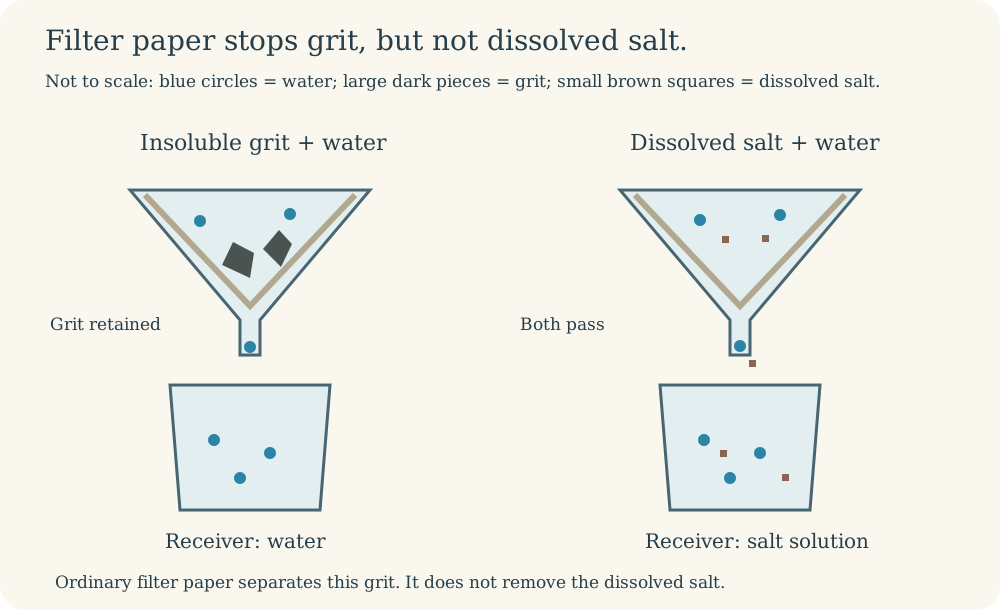
Look at the grit first. Grit is insoluble in water: it doesn't dissolve, so it stays as solid grains. Filtration uses that. Pour the mixture through filter paper, and the grains are too big to pass through its tiny holes, so they stay on the paper while the water runs through. The liquid that comes through is called the filtrate.
Salt water is different. The salt is dissolved, so it's spread through the water as particles far smaller than the holes in filter paper. It passes through with the water, and the filtrate is still salt solution, just as clear, or transparent, as before.
 (enlarge)
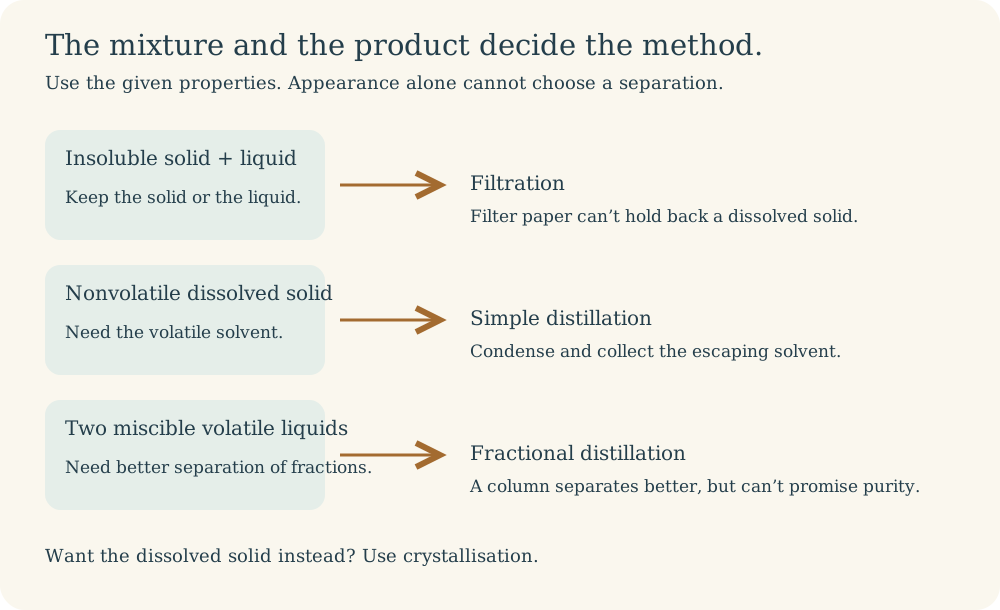
So the method depends on two things: a property of the components (the substances in the mixture) and the product you want. If you want the water back from a nonvolatile dissolved solid, use simple distillation. If you want the dissolved solid itself, evaporate some of the water and let the solid crystallise instead. For miscible liquids that can both vaporise, use fractional distillation, because the column enriches the vapour through repeated phase changes. When you compare two boiling points, check they were measured at the same pressure, because a liquid's boiling point changes with pressure.
Some mixtures need two methods, one after the other, in a sequence. Take sand stirred into salt water, when you want the salt. Filter first, so the insoluble sand stays on the paper. Then evaporate water from the filtrate, so the salt can crystallise. Each step uses one property, so plan which substance each step removes, and in what order.
 (enlarge)
Worked example
Use the information you are given
P and Q are miscible. Their pure boiling points are 78 °C and 83 °C at the same pressure. P is the more volatile over the relevant range, which here means at every temperature the run reaches. You want a fraction that's rich in P. Choose a method before you read on.
Both P and Q can vaporise, and their boiling points are only 5 °C apart, which is relatively close. In simple apparatus, the vapour would carry plenty of Q along with the P. A fractionating column gives the vapour many chances to condense and vaporise again, so fractional distillation separates them better. The early fraction should be richer in P, but that doesn't prove it's pure.
Now compare a salt dissolved in a volatile solvent. Only one substance can vaporise, so there's nothing for a column to separate, and simple distillation recovers the solvent. In both cases the properties you were given chose the method, not the way the liquid looks.
Read the thermometer carefully
In a fractional distillation, the head-vapour temperature often stays steady early in the run, and then it rises. You can see this in the experiment: the reading stays a few degrees above 65 °C while the A-rich vapour comes over, then climbs as more B arrives. A rise like that is useful evidence. It suggests the composition of the vapour is changing, so it's a good moment to change receivers. On its own it doesn't prove anything, though, because the reading also depends on the pressure, on where the bulb sits and on the mixture itself.
Trap: “The reading stayed steady, so the fraction is pure.” A thermometer reading on its own can't tell you which substance you have, its identity, or whether it's pure. You'd need other evidence, such as a suitable test on the collected liquid.
Other observations have limits too. Drops in the receiver show that vapour condensed. Less liquid in the flask shows that material moved. Neither tells you that every substance moved equally.
To keep track, account for each component on its own. All the A you started with is still somewhere: in the early fraction, in the later fraction, in the liquid left in the flask, or in the hold-up on the glass. Then do the same for B. In part 1 you did the same for the water and the salt.
Worked example
Diagnose a claim
A pupil pours salt water through ordinary filter paper. They say the paper removed the dissolved sodium chloride, and they label the clear filtrate “Pure water”. Which two parts of the claim fail?
First, ordinary filter paper can't remove dissolved salt, because the salt passes through with the water. Second, looking clear doesn't prove the water is pure, because salt solution looks clear too. Salt solution is a counterexample to “clear means pure”: one example that shows the general claim is wrong. Simple distillation could recover the water, because water vaporises while the nonvolatile salt stays behind. Even then, a claim that the water is pure still needs a proper test.
Notice what makes an answer complete. “Use distillation” only names a technique. A full answer connects it to a property: water vaporises while the salt stays in the flask, and cooling condenses the water into the receiver.
Return without the diagram
After a break, sketch the path of the sample and the path of the coolant from memory. Then explain three choices: why the column comes before the condenser, why the receivers stay separate, and why the heating stops before the flask is dry. Try the Return and recall questions before you look at the figures again.
Case closed
- Find out what's in the mixture and what you want to get back.
- Link a difference in properties to a method: insoluble or dissolved, volatile or not, more or less volatile.
- Explain where each substance ends up, and say what your evidence can't prove.
About this model
This module covers simple and fractional distillation, and compares them with filtration and crystallisation. It doesn't teach every separation method, every purity test or the fractions of crude oil. The practice uses matching and ordering tasks alongside written explanations, so it isn't a copy of an examination paper.