Put a pan of water on a hob, with a thermometer in the water, and watch the reading climb: 40 °C, 60 °C, 80 °C. Then the water starts to bubble hard, and the reading stops at 100 °C. Turn the hob up as far as it goes. The water bubbles more fiercely, but the thermometer still reads 100 °C. The hob is still giving the water energy every second, so where is that energy going, if it is not making the water any hotter? This part answers that question. The next two parts use the answer for the module question: why does sweating cool you down?
Solids, liquids and gases
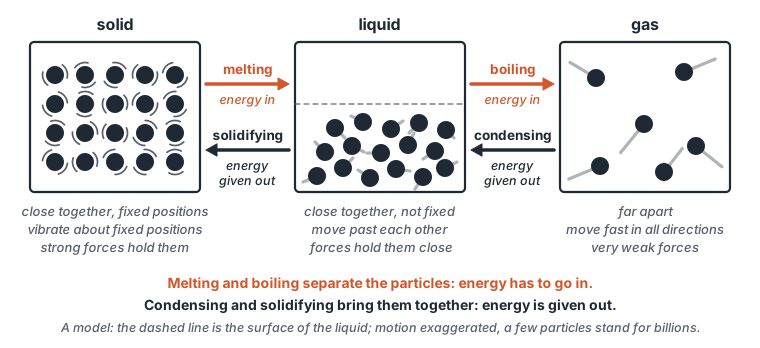
Everything is made of tiny particles. In a solid such as ice, the particles are packed close together in fixed positions, held there by strong forces between them. They cannot move from place to place, but each one vibrates about its fixed position. In a liquid such as water, the particles are still close together, and forces still hold them close, but they are not in fixed positions. They move past each other, which is why a liquid flows. In a gas such as steam, the particles are far apart and move fast in all directions, with only very weak forces between them.
You met the link with temperature in the specific heat capacity module. The particles of any substance move at a range of speeds, and the temperature tells you how fast they move on average. A higher temperature means a higher average kinetic energy of the particles.
 (enlarge)
Each change of state has a name. A solid turning into a liquid is melting. A liquid turning into a gas all through the liquid, with bubbles, at one fixed temperature, is boiling. (A liquid can also turn into a gas slowly, from its surface only: that is evaporation, the subject of the next two parts.) A gas turning into a liquid is condensation, or condensing. A liquid turning into a solid is solidification, or freezing: solidifying and freezing are two names for the same change.
Heating ice until it boils
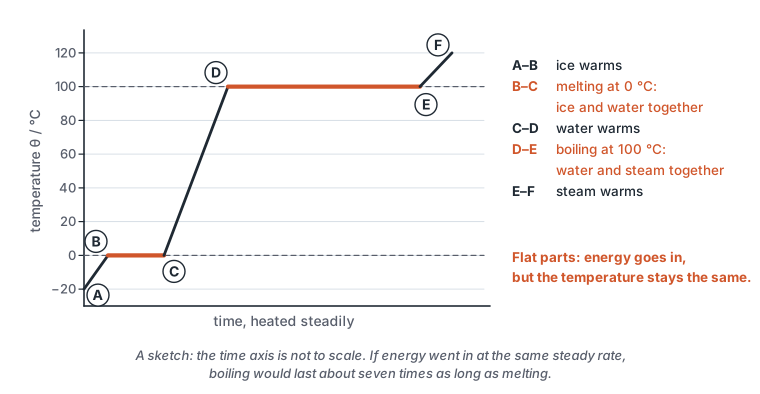
Take crushed ice straight from a freezer, at −20 °C, and put it in a beaker with a thermometer. Heat it at a steady rate and stir, so that the energy goes in evenly. Read the temperature every half minute until the water has been boiling for a while. Plot the temperature against time and you get a heating curve. On the graphs in this module the temperature has the symbol θ, the Greek letter theta, so “θ / °C” means the temperature in degrees Celsius. The heating curve is not one steady climb: it has two flat parts.
 (enlarge)
- A to B: the ice warms, from −20 °C up to 0 °C. Its particles vibrate faster.
- B to C: the ice melts. Ice and water are in the beaker together, and the temperature stays at 0 °C until the last of the ice has gone.
- C to D: the water warms from 0 °C to 100 °C. Its particles move faster.
- D to E: the water boils. Bubbles of steam form all through it, and the temperature stays at 100 °C until all the water has turned to steam.
- E to F: if all the steam could be collected and heated, its temperature would rise again.
The sketch squashes the time axis. If energy went into the beaker at the same steady rate all the way through, the water would take about seven times as long to boil away as the ice took to melt, because separating the particles completely, into a gas, takes about seven times as much energy as loosening them into a liquid. A real beaker never quite manages a steady rate, because the hotter it gets, the more energy it loses to the room, but boiling away still takes far longer than melting.
You can heat a block of ice on a hotplate yourself, and watch its heating curve go flat, in the Chemistry course, in the module States and changes of state.
Energy in, but no rise in temperature
Along the flat parts, the heater is still on and energy is still going in. The temperature does not change, so the particles are not moving any faster on average. The energy is doing a different job: it is separating the particles.
During melting, the energy breaks the particles out of their fixed positions. They are still close together, but now they can move past each other. During boiling, the energy pulls the particles right away from each other, against the forces that hold them close, so they become a gas. Only when every particle has made the change does the energy go back into making the particles move faster, and the temperature rise again.
So melting and boiling both need an energy input, and both happen without a change in temperature. A pan of boiling water stays at 100 °C however high the hob is turned up. A hotter hob makes the water boil away faster; it does not make it hotter.
Trap: “No energy goes in while the graph is flat.” The heater is on the whole time. Along the flat part, its energy separates the particles instead of making them move faster, so the temperature stays the same until the change of state is complete.
Trap: “Turning the hob up makes boiling water hotter.” Boiling water stays at its boiling point. More energy each second makes it boil away faster; its temperature stays at 100 °C.
0 °C and 100 °C
The temperature at which a solid melts is its melting point; the temperature at which a liquid boils is its boiling point. Each pure substance has its own. For pure water at standard atmospheric pressure, the usual pressure of the air at sea level, the melting point is 0 °C and the boiling point is 100 °C. The Celsius scale was built on these two temperatures.
The boiling point depends on the pressure of the air above the water. High on a mountain the air pressure is lower, so water boils at a lower temperature: at 3000 m, at about 90 °C. Food cooks more slowly there, because boiling water cannot get hotter than its boiling point. Dissolving something in water, such as salt, also changes both temperatures, so 0 °C and 100 °C are the values for pure water at standard atmospheric pressure.
Worked example
Reading the heating curve
Use the heating curve of water to answer: (a) at which temperatures are there flat parts, and what is happening at each? (b) Between B and C the heater supplies energy, but the temperature does not rise. What is the energy doing? (c) If energy goes in at the same steady rate, which takes longer, melting or boiling?
(a) There are flat parts at 0 °C and at 100 °C. At 0 °C, from B to C, the ice is melting: ice and water are there together. At 100 °C, from D to E, the water is boiling: water and steam are there together. These are the melting point and the boiling point of water at standard atmospheric pressure. (b) The energy separates the particles: it breaks them out of their fixed positions, so the solid becomes a liquid. The particles do not move faster on average, so the temperature stays at 0 °C until all the ice has melted. (c) Boiling takes longer: about seven times as long, if energy goes in at the same steady rate. To turn water into steam, the particles must be pulled right apart, which takes much more energy than letting them move past each other.
Cooling: condensing and freezing
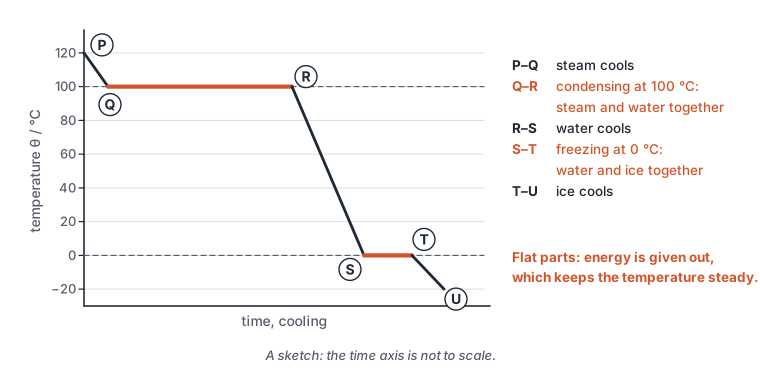
Now run the heating curve backwards. Start with steam at 120 °C and let it cool, with nothing heating it. The cooling curve has flat parts at the same two temperatures.
 (enlarge)
Follow the particles along the curve. From P to Q the steam cools, so its particles slow down: the temperature falls because their average kinetic energy falls. At 100 °C, from Q to R, the steam condenses. Condensation in terms of particles: the gas particles come close together, and the forces between them hold them close, so they form a liquid. From R to S the water cools, and its particles slow down again. At 0 °C, from S to T, the water freezes. Solidification in terms of particles: the liquid particles settle into fixed positions in a regular pattern, where strong forces hold them, so they form a solid in which each particle can only vibrate.
Along the two flat parts the temperature does not change, so the particles do not slow down on average. They keep the same average kinetic energy while they come together into a liquid, or settle into fixed positions in a solid. As they do, energy is given out: the same energy that had to go in to separate them. It is transferred to the cooler surroundings. So along a flat part the substance keeps losing energy, but its temperature stays the same, because that energy comes from the particles coming together, not from them slowing down. When the change of state is complete, the temperature falls again. Condensing steam gives out a lot of energy, which is why steam from a kettle can scald your hand worse than the same mass of boiling water.
Trap: “While water freezes at 0 °C, its particles slow down.” They slow down while the water cools to 0 °C. While it freezes, the temperature stays at 0 °C, so their average speed stays the same: they settle into fixed positions, and the energy given out as they do is transferred to the surroundings.
Trap: “When a liquid freezes, its particles stop moving.” In a solid the particles still vibrate about their fixed positions. Freezing fixes their positions; it does not stop them moving.
Trap: “The temperature stays steady while water freezes because nothing is happening.” Energy is being given out the whole time, as the particles settle into fixed positions. That energy is what keeps the temperature at 0 °C until all the water is ice.
Worked example
A steamy mirror, then frost
After a hot shower, a cold bathroom mirror is covered in tiny drops of water. On a cold winter morning, a puddle outside has a skin of ice. Describe what happens to the particles in each case, and say what happens to energy.
At the mirror, water vapour in the warm air touches the cold glass. Its particles come close together on the glass, and the forces between them hold them close: the vapour condenses into liquid water. Energy is given out as they come together, and it passes into the cold glass, which is why a steamy mirror warms up a little. In the puddle, the water particles slow down as the water cools to 0 °C. At 0 °C they settle into fixed positions in a regular pattern, where strong forces hold them: the water solidifies, or freezes. While it freezes, the temperature stays at 0 °C, so the particles do not slow down on average. Energy is given out as they settle, and it passes to the cold air and ground, so the puddle stays at 0 °C until all of it has frozen.
Worked example
A cooling curve in the lab
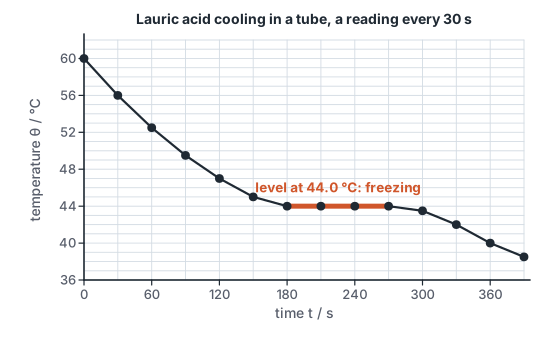
A pupil melts some lauric acid, a waxy solid, in a boiling tube in a beaker of hot water. She takes the tube out of the water, puts a thermometer in it, and reads the temperature, θ, every 30 s while it cools.
| t / s | 0 | 30 | 60 | 90 | 120 | 150 | 180 | 210 | 240 | 270 | 300 | 330 | 360 | 390 |
|---|---|---|---|---|---|---|---|---|---|---|---|---|---|---|
| θ / °C | 60.0 | 56.0 | 52.5 | 49.5 | 47.0 | 45.0 | 44.0 | 44.0 | 44.0 | 44.0 | 43.5 | 42.0 | 40.0 | 38.5 |
(a) Plot the graph and find the freezing point of lauric acid. (b) Explain the flat part. (c) Suggest one way to make the result more reliable.
(a) Plot time on the x-axis and temperature on the y-axis, and draw a smooth line through the points. The line is flat at 44.0 °C from 180 s to 270 s, so the freezing point of lauric acid is 44 °C. Its melting point is the same temperature.
 (enlarge)
(b) Along the flat part, the lauric acid is solidifying. Its particles are settling into fixed positions, with the same average speed, and energy is given out as they do. That energy makes up for the energy lost to the air, so the temperature stays at 44 °C until all of it is solid. Then it falls again. (c) Stir the liquid gently with the thermometer until it becomes too stiff, so that the whole tube is at one temperature. Or take readings more often, every 15 s, near the flat part, so that its start and end show clearly. Repeating the run and getting the same flat temperature also makes the result more reliable.
Case closed
Where does the energy go when a pan of water boils at 100 °C? It separates the particles. During melting and boiling, energy goes in without a change in temperature: it breaks the particles out of their fixed positions (melting, at 0 °C for water) or pulls them right apart into a gas (boiling, at 100 °C for water at standard atmospheric pressure). When a gas condenses or a liquid solidifies, the reverse happens: the particles come together, energy is given out to the surroundings, and the temperature stays steady until the change is complete. The particles slow down only while the temperature falls, before and after the flat parts. The next part turns to a change that happens below the boiling point, from the surface of a liquid, and finds out how it cools a hot tube of water.
About this model
This part has no experiment. The heating and cooling curves of water are sketches: the time axis is not to scale, and real curves have rounded corners, because a real beaker is never at one temperature all through. The particle pictures are models: a few particles stand for billions, and their motion is exaggerated so that it shows. The lauric acid readings are typical school values, written for teaching. 90 °C at 3000 m is a rounded value.