Mash a strawberry in a bag with a little washing-up liquid and salty water, filter it, and gently pour ice-cold ethanol on top. Within a minute, white threads rise into the ethanol, and you can wind them onto a stick. Those threads are the strawberry's genetic material, millions of molecules clumped together. Almost every living cell contains this molecule (one exception: your red blood cells lose theirs as they mature), and it holds the instructions for making the cell's proteins. In this part you find out how the molecule is built, and why its two halves always match.
This part is Supplement content (syllabus 4.1.4).
Two strands in a double helix
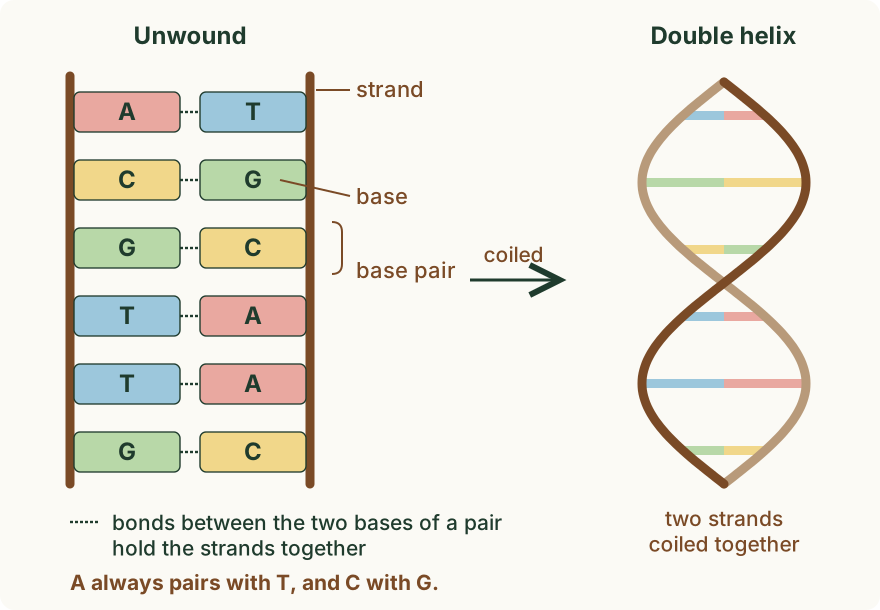
The molecule is DNA. A DNA molecule is very long and thin, and it is made of two long chains called strands. The two strands run side by side and are coiled around each other, like a ladder twisted into a spiral. This shape is called a double helix: "double" because there are two strands, and "helix" because each one winds round like the thread of a screw.
Bases and base pairs
Each strand carries a row of chemicals called bases. There are four kinds, known by their letters: A, T, C and G (you do not need their full names). The bases on one strand point inwards, towards the bases on the other strand, so that each base faces a partner. Two bases facing each other make a base pair, like one rung of the ladder.
Bonds between the two bases of each pair hold the strands together. (In the diagram, one dashed line stands for these bonds.) A DNA molecule has a great many base pairs along its length (in your cells, often millions), so although each bond is weak, together they hold the two strands firmly.
The bases always pair up in the same way: A with T, and C with G. An A never pairs with C or G, and a C never pairs with A or T. So if you know the order of bases on one strand, you know the other strand too. Where one strand reads A C G T T G, the strand opposite must read T G C A A C.
 (enlarge)
Trap: "Any base can pair with any other base." The bases always pair the same way: A with T, and C with G. A pair such as A with G, or C with T, does not form.
Counting bases
Because every A is paired with a T, a DNA molecule always has exactly as many A bases as T bases. In the same way, it has as many C bases as G bases.
Take a short piece of DNA with 10 base pairs: 3 of them are A–T pairs and 7 are C–G pairs. That piece has 20 bases in all: 3 A, 3 T, 7 C and 7 G. The numbers of A and T match, and so do the numbers of C and G, but A and C do not have to match.
Trap: "All four bases come in equal numbers." Only the partners are equal: A equals T, and C equals G. A DNA molecule can have many more C–G pairs than A–T pairs, or the other way round.
Why the order matters
The order of the bases along a strand varies from one stretch of DNA to the next, and it is different in every kind of living thing. That order is a code: it carries the instructions for which amino acids to join, and in which order, to build each of the cell's proteins. Because the two strands always match, a cell can separate them and use each one to build a new partner strand, so that when the cell divides, each new cell gets an exact copy of the instructions.
Key idea: A DNA molecule is two strands coiled together to form a double helix. Each strand carries a row of bases. Bonds between pairs of bases hold the strands together, and the bases always pair the same way: A with T, and C with G.