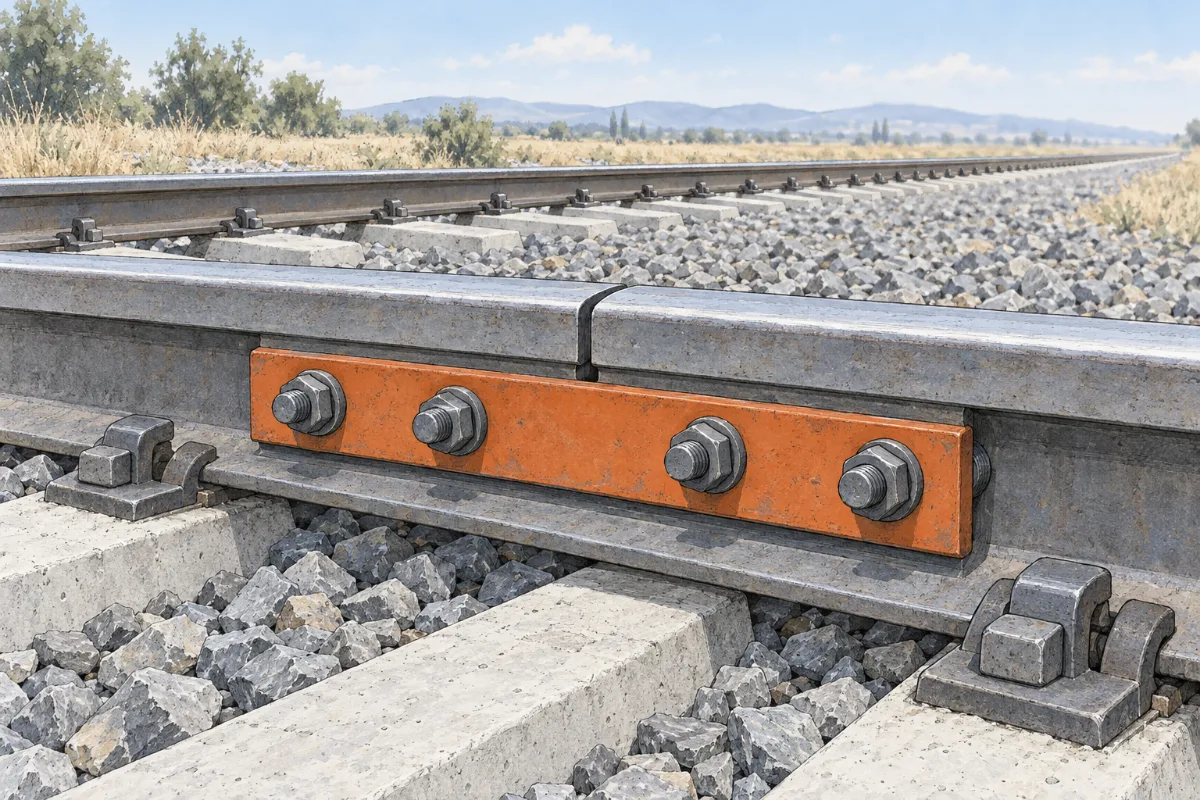
Look closely at an older railway line and every so often you will see a small gap where two rails meet, with a steel plate bolted across the joint to keep the ends in line. The gap is there on purpose. A steel rail 20 m long gets about 1 cm longer when it warms by 40 °C, from a cold winter morning to a hot summer afternoon. Without gaps, the rails would push against each other on a hot day and could bend sideways out of line, a dangerous fault called a sun kink. In the last part, the sealed can could not get bigger, so its pressure rose. Most things are free to get bigger when they warm, and they do. Why, and why do some get much bigger than others?
 (enlarge)
Things expand when they warm
When a solid, a liquid or a gas is warmed, it gets bigger: it expands. When it cools, it gets smaller again: it contracts. Almost everything does both: warm it and it will expand, cool it and it will contract. This is thermal expansion. (One odd exception is water just above freezing: from 0 °C to 4 °C it contracts as it warms. Above 4 °C it expands like everything else.) The particles themselves do not grow. Warmer particles move faster: in a solid they vibrate harder about their fixed positions, and in a liquid or a gas they move about faster. So on average they push each other a little further apart, and the whole object takes up more space. The mass stays the same.
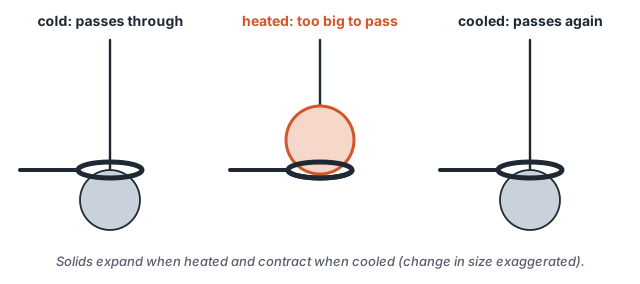
A metal ball on a handle just fits through a metal ring. Heat the ball in a flame and it no longer goes through: it has expanded. Let it cool and it contracts and passes through again.
 (enlarge)
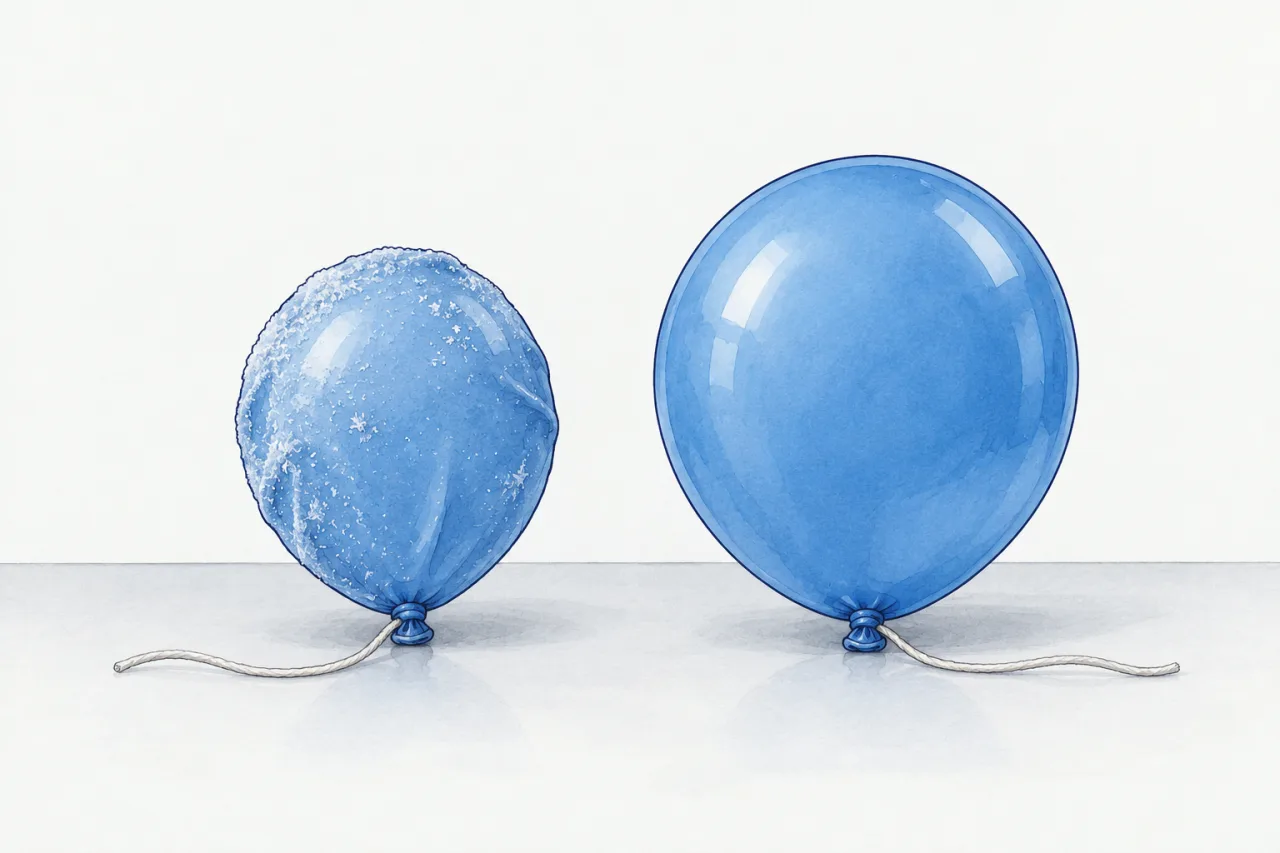
Liquids expand too. Fill a flask to the brim with water at room temperature, warm it, and water spills over the top. A gas expands too, if it is free to get bigger, like the air in a balloon or in a syringe whose plunger can slide. Its pressure then stays the same as the air outside. Warm it and its particles hit the rubber or the plunger more often and harder, pushing it out until the air is spread out enough for its pressure to match the air outside again. Cool it and it contracts. Warmed by the same amount, a gas expands far more than a solid or a liquid.
 (enlarge)
Trap: “When something expands, its particles get bigger.” The particles stay the same size and the same in number. They move faster, or vibrate more, so they spread a little further apart. The volume grows; the particles do not.
How much each one expands
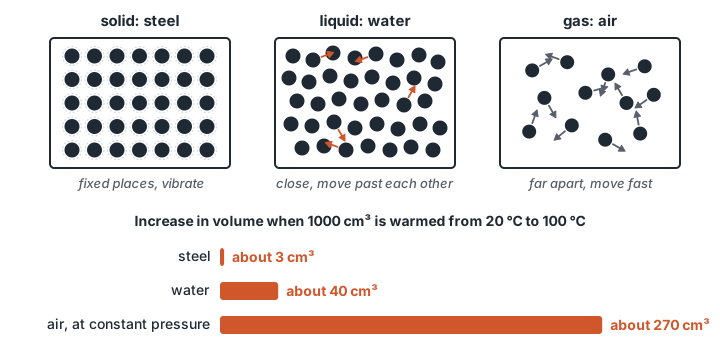
Warm 1000 cm³ of steel, of water and of air from 20 °C to 100 °C (the air free to expand, so its pressure stays the same). The steel gains about 3 cm³. The water gains about 40 cm³. The air gains about 270 cm³. Gases expand most, by far; liquids expand less; solids expand least. The reason lies in how the particles are arranged, how they move, and the forces between them.
- In a solid, the particles are packed close together in fixed positions, held there by strong forces. Warming makes them vibrate more about their fixed positions, but the strong forces keep them close, so they move only a tiny bit further apart.
- In a liquid, the particles are still close together, with forces between them, but they are not in fixed positions: they move past each other. The forces hold them less tightly than in a solid, so warming moves them further apart.
- In a gas, the particles are far apart and move fast in all directions, and the forces between them are very weak. Nothing holds them together, so when they move faster they spread out much further, as far as the pressure around them lets them.
 (enlarge)
Trap: “Solids do not expand; only liquids and gases do.” Solids expand too, only much less. A 20 m steel rail grows by about 1 cm for a 40 °C rise, and a steel bridge 1 km long grows by about 50 cm. Small changes in a big object still matter.
Worked example
Copper, alcohol and air
Equal volumes of copper, alcohol and air are warmed by the same amount (the air free to expand, so its pressure stays the same). Put them in order, from the one that expands most to the one that expands least, and explain the order in terms of their particles.
Air expands most, then alcohol, then copper. Air is a gas: its particles are far apart and the forces between them are very weak, so when they move faster nothing holds them back and they spread out a long way. Alcohol is a liquid: its particles are close together and attract one another, but they are not in fixed positions, so warming moves them further apart, though far less than in a gas. Copper is a solid: strong forces hold its particles close together in fixed positions, and warming only makes them vibrate more on the spot, so it expands least.
Expansion in everyday life
Thermal expansion is useful. In a liquid-in-glass thermometer, the liquid in the bulb expands more than the glass around it, and the only way it can go is up a very narrow tube, so a small increase in volume moves the thread a long way. A metal lid stuck on a glass jar comes off more easily after you run hot water over it: the metal lid expands more than the glass.
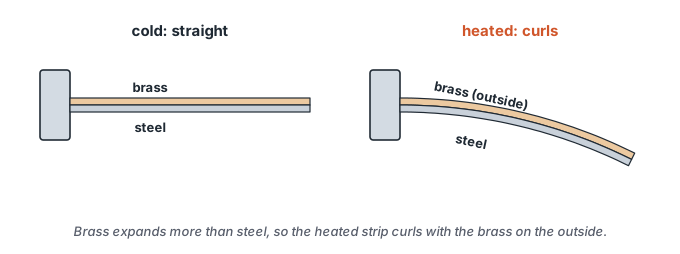
A bimetallic strip is two strips of different metals, such as brass and steel, joined along their length. Brass expands more than steel. When the strip is heated, the brass gets longer than the steel, so the strip curls, with the longer brass on the outside of the curve. When it cools, it straightens again. A bimetallic strip can open or close an electrical contact as the temperature changes: in a thermostat, which switches a heater off when the room is warm enough and on again when it cools, and in a fire alarm, which rings a bell when it gets hot.
 (enlarge)
Thermal expansion also causes problems, and engineers have to allow for it:
- Railway lines have gaps between the rails, or the rails are welded into one long piece and clamped down while stretched, so that they cannot buckle.
- Bridges have expansion joints: gaps bridged by metal teeth that slide between each other as the bridge grows and shrinks. Concrete roads and pavements are laid in slabs with soft filling between them.
- Overhead power cables are hung with some slack. In winter they contract and pull tighter; if they were put up tight in summer, they could snap in the cold.
- A thick glass can crack if boiling water is poured into it: the inside warms and expands before the outside does.
- A car's fuel tank filled to the brim on a cold morning can overflow in the afternoon sun, because the fuel expands more than the steel tank.
Worked example
A heater's thermostat
A heater's thermostat has a bimetallic strip of brass and steel, clamped at one end. When the room is cold, the free end of the strip presses up against a contact just above it, and the heater is on. As the room warms, the strip must bend down, away from the contact, to switch the heater off. Which metal must be on top? Explain how the thermostat keeps the room at a steady temperature.
When the strip is heated, the brass expands more than the steel, so the strip curls with the brass on the outside of the curve. For the free end to move down, the outside of the curve must be the top, so the brass must be on top. As the room warms, the strip bends down, leaves the contact and switches the heater off. As the room cools, the strip contracts back to straight, touches the contact again, and the heater comes back on. The room's temperature stays close to the one the thermostat is set for.
Case closed
Solids, liquids and gases all expand when they are warmed and contract when they cool. The particles do not grow: they move faster, or vibrate more, and spread further apart. Gases, free to expand, expand most, because their particles are far apart with very weak forces between them; liquids expand less; solids expand least, because strong forces hold their particles in fixed positions. Expansion is put to use in thermometers and in the bimetallic strips of thermostats and fire alarms, and it must be allowed for in railways, bridges, power cables and full containers. And the sealed can of the module question? Its gas would expand if it could, but the rigid walls stop it. So instead the pressure rises, and that is why a sealed can can burst when it gets hot.
About this model
This part has no experiment. The particle pictures are models: only a few particles are shown, drawn far bigger than real. The changes in size in the ball-and-ring and bimetallic-strip pictures are exaggerated so that they show: a real steel ball 2.5 cm across, heated by a few hundred degrees, grows by less than a tenth of a millimetre. The increases in volume for steel, water and air are measured values, rounded.