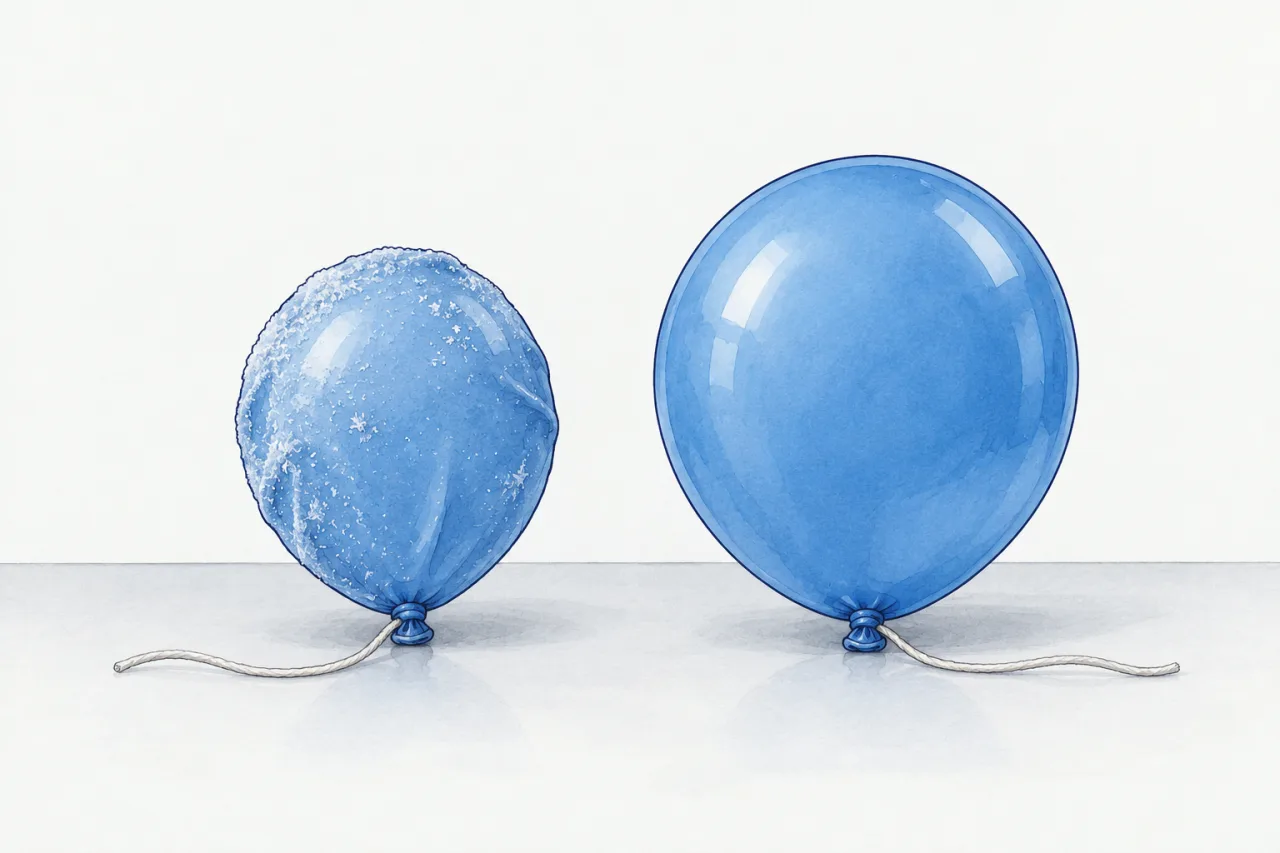
Blow up two balloons to the same size and tie them tightly. Put one in a freezer for an hour. When you take it out, it's smaller and wrinkled. Leave it on the table, and within a few minutes it has grown back to the size of the other one. The knot never came undone, so no air got in or out. What did the cold do to the air? In this part you'll warm and cool the trapped air in the syringe, and explain with particles why a gas takes up more space when it's warmer.
 (enlarge)
One change at a time
In part 1 you squeezed the air in a sealed gas syringe by putting weights on its plunger. Now you'll change its temperature instead, using the water bath. The water reaches above the plunger seal, so all the trapped air takes the temperature of the water. A hotplate warms the bath. To cool it, you pour away the hot water and fill the bath with ice and cold water.
Pressure is how hard something pushes on each bit of a surface; here, the push of the atmosphere (plus any weights) on the plunger. To see what temperature alone does, you need a fair test again. Before you warm the air, the experiment asks you what must stay the same.
Safety: Hot water and hotplates can burn and scald. Do a real version of this experiment only with a teacher-approved safety procedure.
Predict before you try it. When the bath warms to 80 °C, will the plunger move out, move in or stay where it is? What will happen in the ice bath?
As the bath warms, how much does the volume rise, and what do the particles in the magnified view do? Watch again in the ice bath.
Warmer air takes up more space
| Water bath | Volume / cm³ |
|---|---|
| 20 °C (start) | 50 |
| 80 °C (warm bath) | 60 |
| 2 °C (ice bath) | 47 |
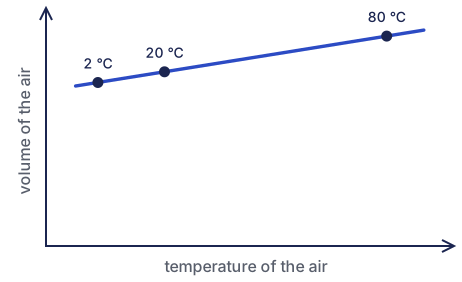
Warmed to 80 °C, the air took up 60 cm³; in the ice bath at 2 °C, only 47 cm³. For a fixed amount of gas at constant pressure (the pressure kept the same), increasing the temperature increases the volume: the gas expands. Decreasing the temperature decreases the volume: the gas contracts.
Why did cooling change the volume by only 3 cm³, when warming changed it by 10 cm³? Compared with the start (20 °C), the bath warmed by 60 °C but cooled by only 18 °C. A bigger change in temperature gives a bigger change in volume. On a graph, the three readings lie on a straight line.
 (enlarge)
Key idea: For a fixed amount of gas at constant pressure, a higher temperature means a larger volume, and a lower temperature means a smaller volume.
Inside: faster particles push harder
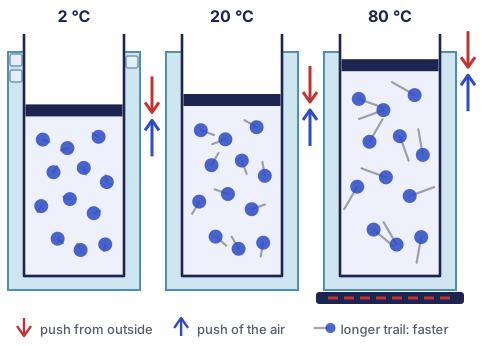
Kinetic particle theory says that the particles of a substance are always moving, and the higher the temperature, the faster they move on average. Faster particles have more kinetic energy, the energy of movement. Watch the magnified view as the bath warms: the particles speed up (the speed-up is drawn much bigger than real, so you can see it) and spread out. The figure below compares all three temperatures.
Faster particles hit the walls and the plunger harder, and more often, because they cross the space quicker. So for a moment the air pushes up harder than the atmosphere pushes down, and the plunger moves out.
As the plunger moves out, the particles have more space, so they reach each bit of the wall less often, and their push falls back. The plunger stops when the pushes balance again. Each collision is now harder than at the start, but there are fewer of them on each bit of the wall, so the pressure is back where it was. Only the volume is bigger.
Cooling works the other way. The particles slow down and hit the plunger less hard and less often, so the atmosphere pushes the plunger in. In the smaller space the slower particles reach the plunger more often, until the pushes balance again at a smaller volume.
 (enlarge)
Trap: “Heating makes the particles bigger, or makes more of them.” Neither. The sealed syringe holds the same particles, each the same size. They move faster and push the plunger out, so the spaces between them get bigger.
Trap: “Gas particles stop moving when they're cold.” Cooling slows them down, but they keep moving. The air in the ice bath is still a gas, still pushing on the plunger.
Worked example
Reading the warm and cold results
Use the table. Describe the effect of temperature on the volume of the air, and say what was kept the same.
Compared with the start, the volume increased at 80 °C and decreased at 2 °C: the higher the temperature, the larger the volume. The pressure was kept the same, because there were no weights on the plunger in any of the three readings. The amount of air stayed the same too, sealed in by the cap. Only the temperature changed, so the temperature caused the change in volume.
Worked example
The balloon from the freezer
Explain why the balloon in the picture at the top shrank in the freezer and grew back on the table.
The tied balloon holds a fixed amount of air, and the air around it pushes on it just as hard in the freezer as on the table. In the freezer, the air inside cools. Its particles slow down and hit the rubber less hard and less often. The air outside, helped by the stretched rubber, now pushes harder, so the balloon shrinks until the pushes balance at a smaller volume.
Back on the table, the air inside warms up again. Its particles speed up, hit the rubber harder and more often, and push the balloon back out to its old size. None of them left the balloon, and none of them changed size.
When the amount of gas changes
A hot-air balloon is open at the bottom. When the burner heats the air inside, the air expands and some of it is pushed out through the opening, so the amount of air in the balloon changes. A sealed syringe, a tied balloon or a sealed packet can't lose any gas. Before you explain a change in volume, check that the amount of gas is fixed.
 (enlarge)
Case closed
 (enlarge)
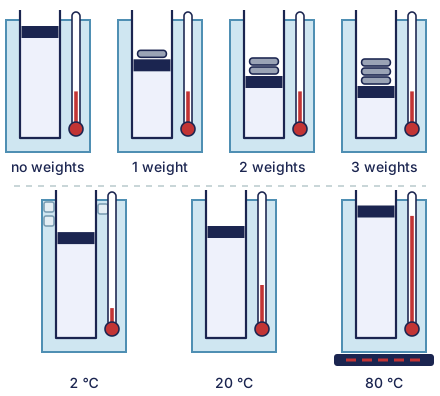
- More pressure, same temperature: the volume decreases. Less space, so more hits on the walls.
- Less pressure, same temperature: the volume increases. More space, so fewer hits.
- Higher temperature, same pressure: the gas expands. Faster particles hit harder and more often.
- Lower temperature, same pressure: the gas contracts. Slower particles hit softer and less often.
In every case the particles keep their size and their number. Always say which quantity was kept the same.
About this model
The experiment treats air as an ideal gas in a perfectly sealed, frictionless syringe. Each simulated reading is taken once the air matches the water's temperature. The magnified view shows 12 particles, much slower than real ones, and exaggerates the speed-up and the extra space when warm. From 2 °C to 80 °C, real particles speed up by less than a fifth.