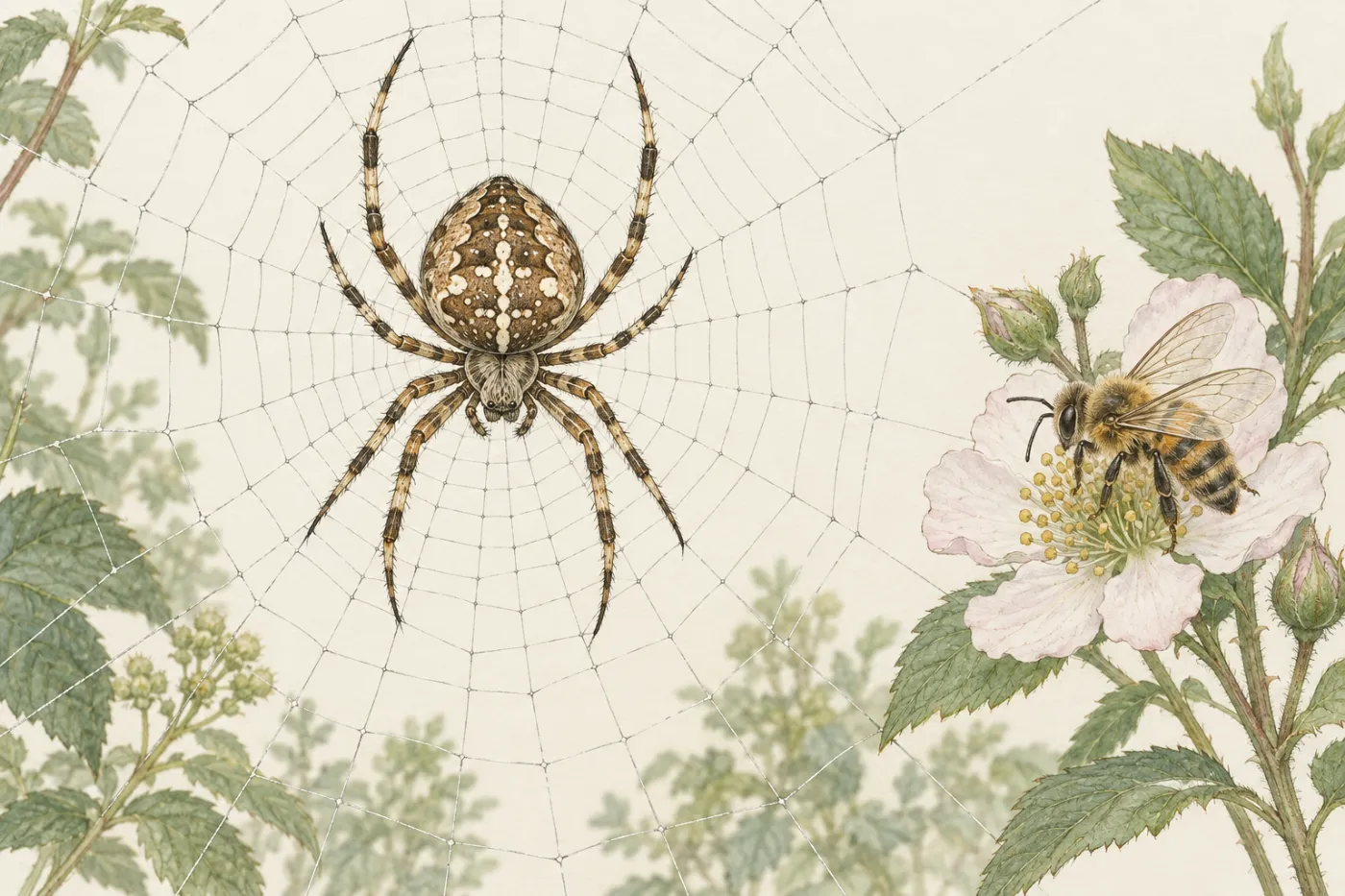
Lift a log in a garden and a crowd of small animals scatters. A beetle runs for cover, a woodlouse rolls into a ball and a centipede slides away into the dark. On a bush nearby, a garden spider waits in its web while a bee visits the flowers. Many people call all five of them "insects" or "creepy-crawlies". A biologist would say that only two of the five are insects. Which two? And if the other three are not insects, what are they?
 (enlarge)
Jointed legs and a hard outer skeleton
All five animals belong to the largest group in the animal kingdom: the arthropods. More than three-quarters of all known animal species are arthropods. Like the sea anemone, they have no backbone, so they are not vertebrates. Instead, every arthropod has three features:
- jointed legs: each leg is made of stiff pieces joined by bendy joints (the name "arthropod" means "jointed foot");
- an exoskeleton: a hard skeleton on the outside of the body, which covers and protects it like a suit of armour;
- a segmented body: the body is built from a row of sections called segments.
An exoskeleton cannot stretch, so a growing arthropod sheds its old exoskeleton from time to time and grows a new, larger one.
Trap: "Any animal with bendy legs is an arthropod." A lizard's legs have joints too, but its skeleton is made of bone inside its body, and it has a backbone. An arthropod has all three features: jointed legs, an exoskeleton and a segmented body.
Four groups of arthropods
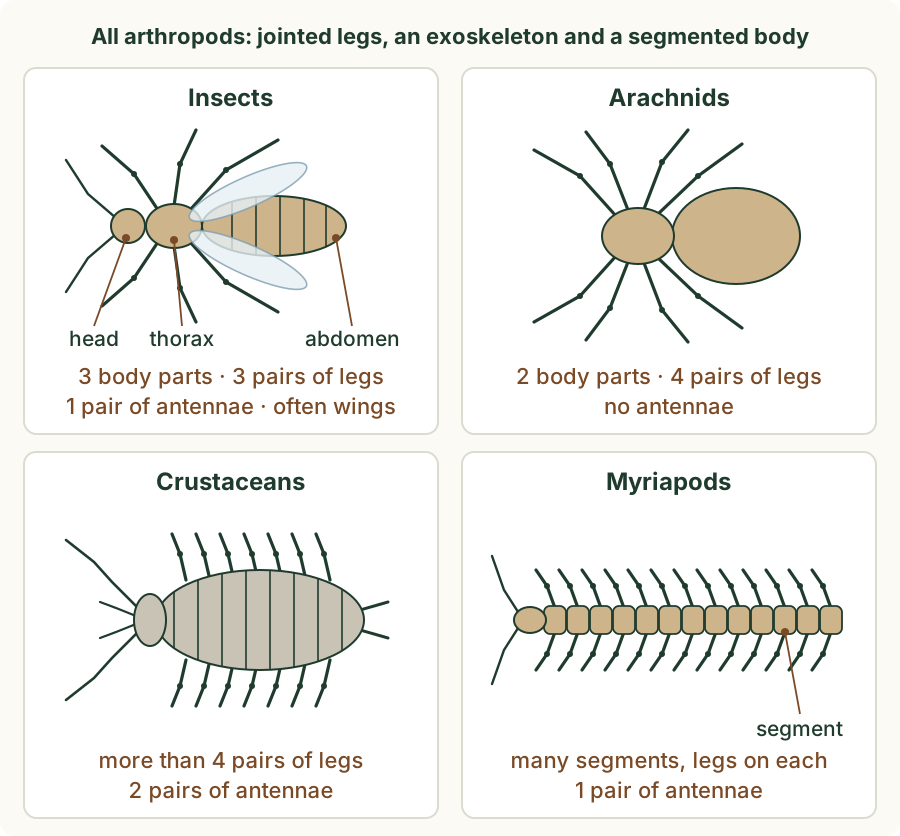
To place an arthropod in its group, count three things: its body parts, its legs and its antennae, the pair or pairs of long feelers on the head. Four groups are enough for most of the arthropods you will meet: insects, arachnids, crustaceans and myriapods. In the table, the three body parts of an insect are the head, the thorax (the middle part, which carries all six legs) and the abdomen (the back part).
| Group | Body | Legs | Antennae | Examples |
|---|---|---|---|---|
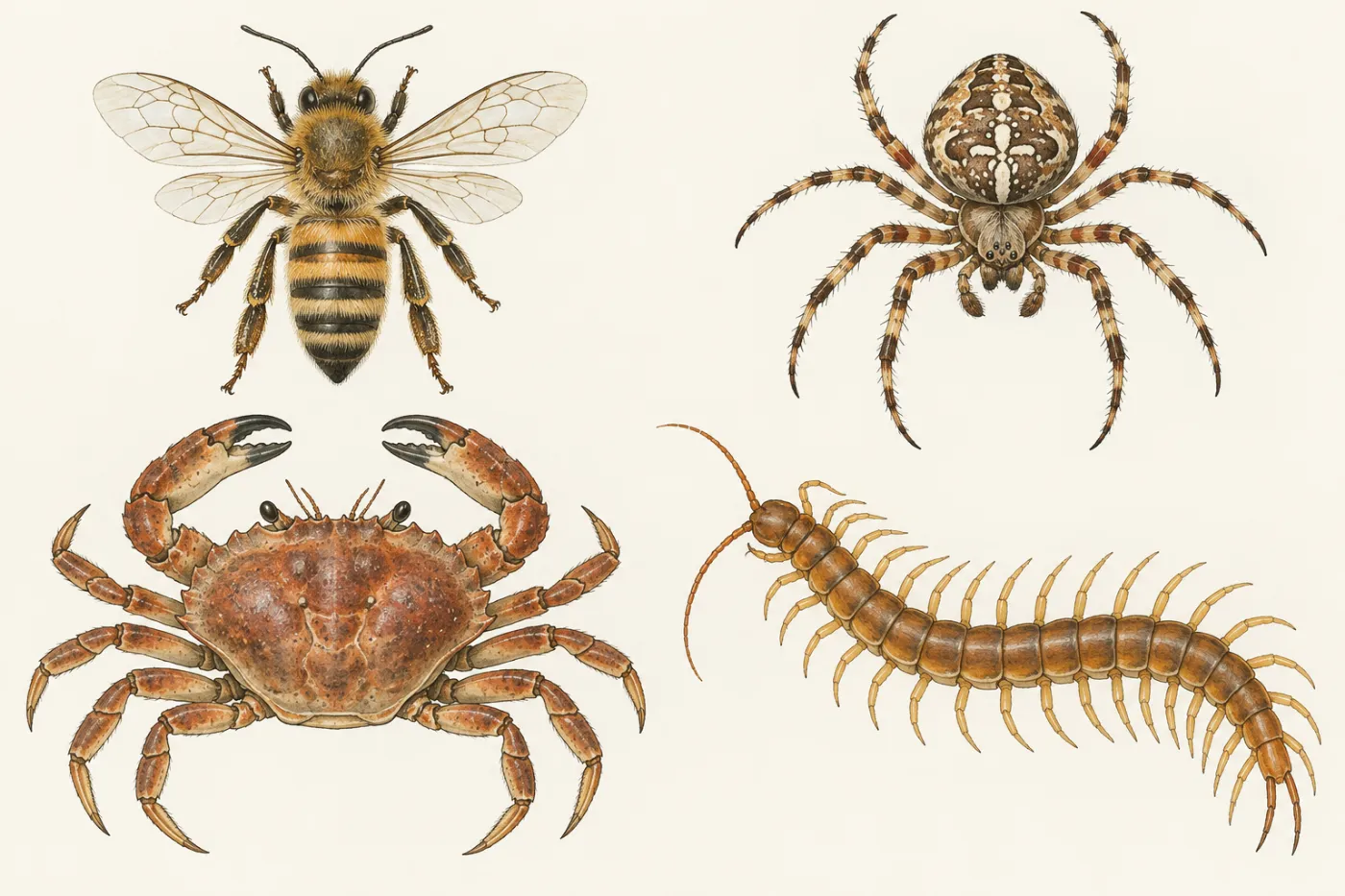
| Insects | 3 parts: head, thorax, abdomen | 3 pairs (6), all on the thorax | 1 pair | beetle, bee, butterfly, ant |
| Arachnids | 2 parts | 4 pairs (8) | none | spider, scorpion |
| Crustaceans | many segments, often under a hard shell | more than 4 pairs | 2 pairs | crab, shrimp, woodlouse |
| Myriapods | a long body of many segments | legs on each segment | 1 pair | centipede, millipede |
Most adult insects also have wings on the thorax, often two pairs. In a beetle, the front pair of wings are hard wing cases that close over the abdomen and hide it.
 (enlarge)
 (enlarge)
Trap: "A spider is an insect." An insect has three body parts, three pairs of legs and one pair of antennae. A spider has two body parts, four pairs of legs and no antennae, so it is an arachnid.
Counting legs and antennae
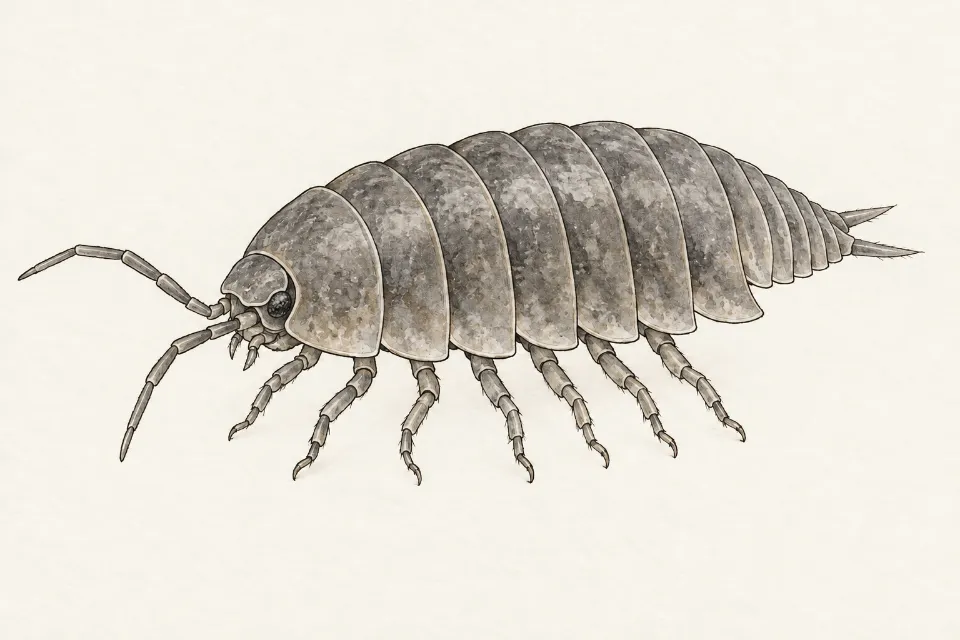
The woodlouse is the animal people most often place in the wrong group. It is small and grey and lives under logs, so it looks like a "bug". Take it step by step.
 (enlarge)
- Is it an arthropod? It has jointed legs, a hard exoskeleton of plates and a segmented body: yes.
- Count the legs on one side: seven, one under each large plate. That is seven pairs, fourteen legs in all. An insect has three pairs and an arachnid four pairs, so it is neither.
- Count the antennae: two pairs, but one pair is tiny and hard to see without a lens.
- Two pairs of antennae and more than four pairs of legs: the woodlouse is a crustacean, a relative of crabs and shrimps that lives on land.
The garden spider is a trap for counting. Count everything that sticks out at the front and you may get ten "legs". Look closer: next to its mouth are two short feelers called pedipalps. They are not legs and not antennae; the spider uses them to hold its food. It walks on four pairs of legs and has no antennae at all.
The centipede is easier once you know what to look for. Its long body is made of many segments, with one pair of legs on each segment, and it has one pair of antennae: it is a myriapod. The beetle has three body parts (its abdomen is under the wing cases), three pairs of legs and one pair of antennae: it is an insect, like the bee.
Trap: "A woodlouse is an insect." An insect has three pairs of legs and one pair of antennae. A woodlouse has seven pairs of legs and two pairs of antennae, so it is a crustacean.
Now try the bench. In the experiment, the ground beetle, the garden spider, the woodlouse and the centipede come out of the box one at a time. Make a first guess for each one if you like; then look through the hand lens and count body parts, legs and antennae before you choose its group.
Key idea: Arthropods have jointed legs, an exoskeleton and a segmented body. Insects have three body parts, three pairs of legs and one pair of antennae, and often wings. Arachnids have two body parts, four pairs of legs and no antennae. Crustaceans have more than four pairs of legs and two pairs of antennae. Myriapods have a long body of many segments with legs on each, and one pair of antennae.