How thick is one page of a book? Your ruler's smallest marks are a millimetre apart, and a page is much thinner than that. Yet with nothing but that ruler you can find the thickness of one page to a hundredth of a millimetre. By the end of this part you'll know how, and you'll be able to read a ruler and a measuring cylinder without the three mistakes that catch most people out.
 (enlarge)
The smallest division
Look closely at a ruler. The long marks are centimetres (cm) and the small marks between them are millimetres (mm). The gap between two neighbouring marks is the scale's smallest division: on most rulers it is 1 mm. You can read a length to the nearest smallest division, and on a clear scale you can often judge half a division, 0.5 mm.
The names tell you the size. Milli means a thousandth and centi means a hundredth, so 1 mm is 0.001 m and 1 cm is 0.01 m. A length of 40.0 cm is 0.400 m. Write every reading with its unit, and keep the digits you actually read: “40.0 cm” says you read it to the nearest millimetre; “40 cm” does not.
Start at zero, or subtract
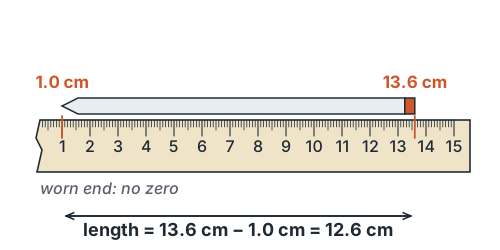
The end of an old ruler is often worn or chipped, so its zero mark may not sit at the very end. Put the end of the object on the zero mark and read the other end. If you can't use zero, start at any clear mark and subtract.
 (enlarge)
A reading that is wrong by the same amount every time, like one taken from a worn end, is a zero error. It doesn't go away when you repeat the measurement, so you have to spot it and correct it.
Put your eye level with the mark
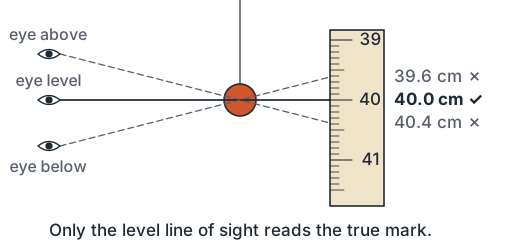
Where should your eye be when you read a scale? Predict first, then try it on a ruler held a little way behind a pencil tip. Look from one side, and the tip seems to sit against one mark; move your head to the other side, and it seems to sit against a different one. Only with your line of sight straight across, level with the mark and square to the scale, do you read the true value.
This error, caused by looking at a scale from the side, is called parallax. It is worst when the scale is some distance behind the thing you are measuring, so keep the scale close to the object too.
In the experiment, a pendulum hangs beside a half-metre rule whose zero is level with the pivot. Its length is measured from the pivot to the centre of the bob. Choose where to put your eye, and see what the rule says.
Did the reading change when your eye moved? Above the mark you read a few millimetres too much; below it, too little.
 (enlarge)
Measuring cylinders
A measuring cylinder measures the volume of a liquid. Its scale is in cubic centimetres (cm³); 1 cm³ is the same as 1 millilitre (ml). Before you read it, find the smallest division: on a 100 cm³ cylinder it is usually 1 cm³, on a 250 cm³ cylinder often 2 cm³.
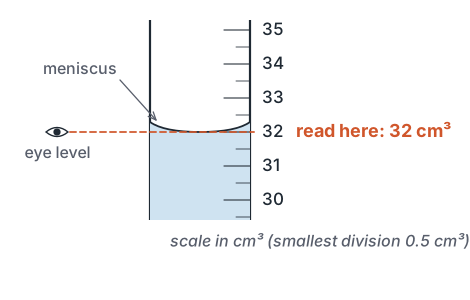
Water curves up at the glass, so its surface sags in the middle. This curved surface is the meniscus. Stand the cylinder on a flat bench, bring your eye level with the surface, and read the bottom of the meniscus.
 (enlarge)
Trap: “Read the top of the curve, where the water touches the glass.” For water, read the bottom of the meniscus, with your eye level with it. The edges climb the glass and give a reading that is too big.
A measuring cylinder can find the volume of a solid too. For an odd-shaped stone, read the water level, lower the stone in gently, and read the level again: the rise in the level is the stone's volume. A rectangular block is easier: its volume is length × width × height, each measured with a ruler. You'll use both when you find densities.
Too small to measure? Measure lots
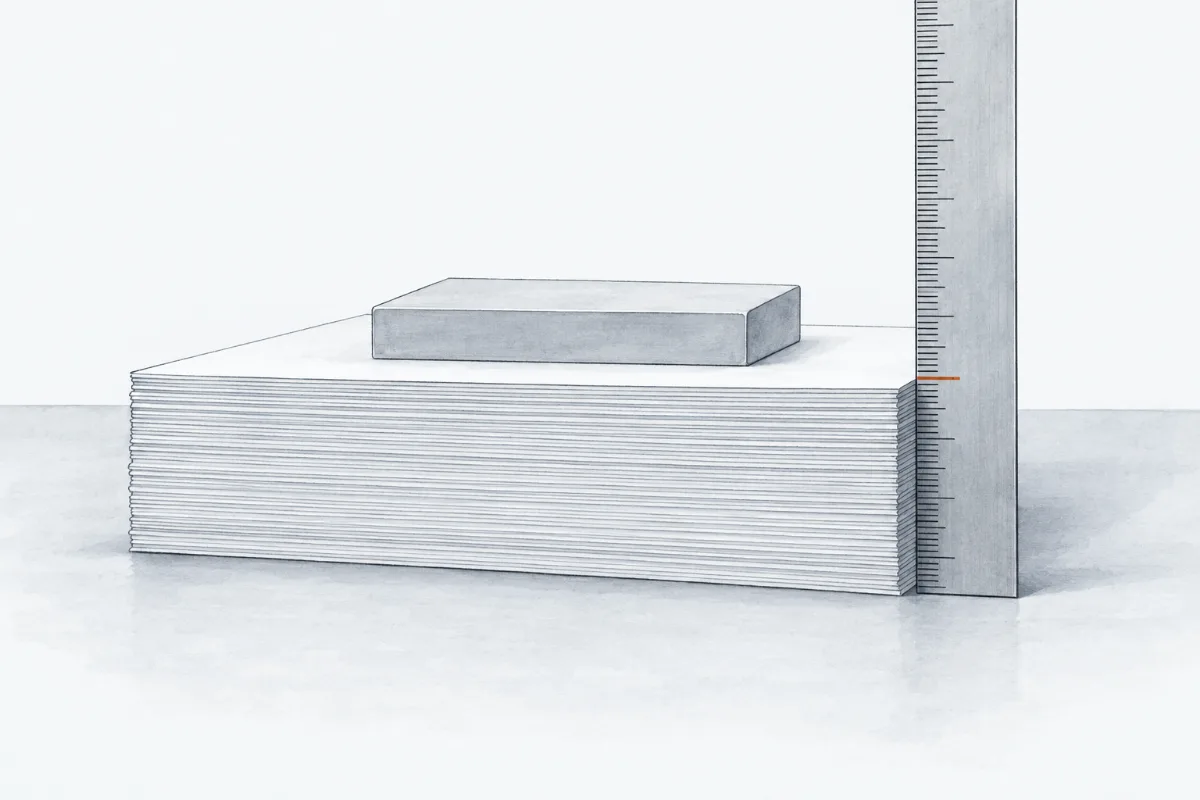
Back to the page. One sheet of paper is about 0.1 mm thick, less than one smallest division of your ruler. Measure it directly and the answer is somewhere between “nothing” and “1 mm”: useless.
So measure many sheets at once. Press a stack of 200 sheets flat and measure its thickness: say 18 mm. Every sheet is about the same, so one sheet is 18 mm ÷ 200 = 0.09 mm. Your reading of the stack could still be out by half a millimetre, but sharing that over 200 sheets makes it only 0.0025 mm per sheet. Measuring a multiple and dividing gives the average size of one, far more precisely than measuring one on its own.
The same trick works for anything small that comes in identical copies: the diameter of a thin wire wound 30 times round a pencil, the thickness of a coin in a stack of 20, the length of one grain of rice in a row of 20 laid end to end.
Worked example
A ruler with a worn end
A pupil measures a key with a ruler whose end is worn. One end of the key is on the 2.0 cm mark and the other end is between the 7.8 cm and 7.9 cm marks, nearer 7.8 cm. Find the length of the key.
Read the far end to the nearest millimetre: 7.8 cm. The key starts at 2.0 cm, not at zero, so subtract: 7.8 cm − 2.0 cm = 5.8 cm. The answer is 5.8 cm, or 58 mm. Starting at a clear mark and subtracting avoids the zero error of the worn end.
Worked example
The thickness of one sheet
A ream of printer paper has 500 sheets. Squeezed flat, the ream is 4.8 cm thick. How thick is one sheet, in millimetres?
Change to millimetres first: 4.8 cm = 48 mm. Then divide by the number of sheets: 48 mm ÷ 500 = 0.096 mm. One sheet is about 0.096 mm thick. Measuring 500 sheets made the reading 48 mm long, so an error of 0.5 mm in reading it is only about 1 % of the answer.
Case closed
To read a length or a volume well, first find the smallest division of the scale. Then avoid the three mistakes: a zero error (start at a clear mark and subtract if it isn't zero), parallax (keep your eye level with the mark) and misreading the meniscus (for water, read the bottom of the curve). When something is too small for the scale, measure a multiple of it and divide by how many there are.
About this model
The rule in the experiment hangs about 3 cm behind the string. With your eye about 30 cm away and 5 cm above or below the mark, the reading is out by about 5 × 3 ÷ 30 = 0.5 cm; real errors depend on how far the rule is from the string and from your eye. The rule and readings are simulated.