Fill a kettle and switch it on: it takes minutes to boil. An empty aluminium saucepan on a hob gets too hot to touch in well under a minute. And at the beach the sea stays cool all day while the sand burns your feet. Why does water take so long to heat up? In the last part you measured the specific heat capacity of aluminium: about 950 J/(kg °C) with the block in a jacket, against a book value of 900 J/(kg °C). Now you measure it for water, with the same heater and the same energy, and compare the two.
A kilogram of water
To calculate a specific heat capacity you need the mass of the sample in kilograms. A liquid has to be weighed in a container, so it is often easier to measure its volume. Water makes this simple: 1 cm³ of water has a mass of 1 g. So 1000 cm³ of water, which is 1 litre, has a mass of 1000 g, which is 1.00 kg. To get 1.00 kg of water, measure out 1000 cm³. In the same way, 250 cm³ of water has a mass of 250 g, or 0.250 kg. (This is the density of water, the mass of each cubic centimetre: 1.0 g/cm³.)
Trap: “1000 cm³ of water has a mass of 1000 kg.” Each cubic centimetre has a mass of 1 g, so 1000 cm³ has a mass of 1000 g, which is 1 kg. Check the unit of the mass every time, before you put it into c = ΔE / (mΔθ): it must be in kilograms.
Heating a liquid safely and fairly
The method for a liquid uses the same idea as for the block: measure the mass, the energy supplied and the rise in temperature, then calculate c = ΔE / (mΔθ). Three things are different.
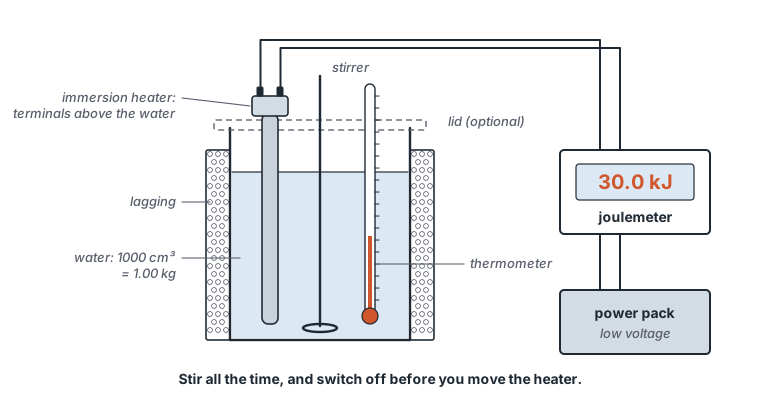
Lagging. The beaker is wrapped in lagging, a layer of insulating material such as felt or polystyrene, so that less energy escapes to the air through its sides. A lid on top stops energy escaping from the surface of the water as well.
Stirring. The water next to the heater warms first. Unless the water is stirred, some parts of it are hotter than others, and the thermometer shows only the temperature where its bulb happens to be. Stir gently all through the heating, and once more just before each reading, so that all the water is at the same temperature as the thermometer.
Safety. Water and electricity together need care.
Safety: Use a low-voltage power pack, never the mains. Switch the power off before you put the heater into the water, take it out or move it. Keep the heater’s terminals above the water. Never switch on a heater that is not in water or in a block: in air it gets very hot very quickly.
 (enlarge)
Heat the water and measure
What is on the bench. The same heater, thermometer, joulemeter and power pack as in the last part. A 1 litre beaker stands in a sleeve of lagging, and 1000 cm³ of water, measured out at room temperature, 20.0 °C, waits beside it. A stirrer stands ready.
What you do. Find the mass of 1000 cm³ of water and pour it into the beaker. With the power off, move the heater and the thermometer from the block into the water, with the terminals above the surface. Predict first: with the same heater and the same 30.0 kJ, will the water warm more than the block in its jacket, about the same, or much less? Then switch on, stir, and record the temperature every 3.0 kJ. Work out the specific heat capacity of water and compare it with that of aluminium.
What the experiment showed
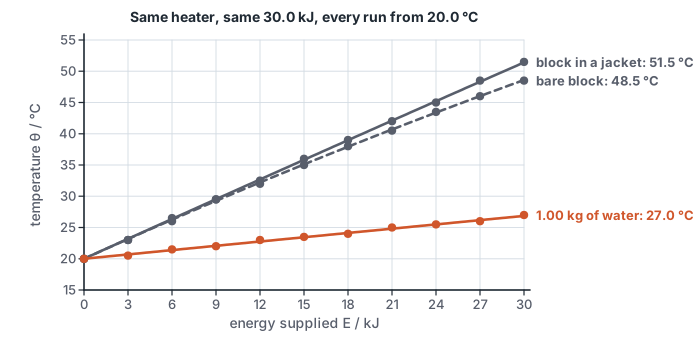
Do the experiment before you read on. 1000 cm³ of water has a mass of 1.00 kg, the same mass as the block. With the same heater and the same 30.0 kJ, the water warmed from 20.0 °C to only 27.0 °C: a rise in temperature of 7.0 °C. The block in its jacket had risen by 31.5 °C, so the water’s rise was less than a quarter of the block’s, and its line on the graph is far shallower.
| E / kJ | water θ / °C |
|---|---|
| 0 | 20.0 |
| 3 | 20.5 |
| 6 | 21.5 |
| 9 | 22.0 |
| 12 | 23.0 |
| 15 | 23.5 |
| 18 | 24.0 |
| 21 | 25.0 |
| 24 | 25.5 |
| 27 | 26.0 |
| 30 | 27.0 |
 (enlarge)
The readings go up in uneven steps, sometimes 0.5 °C and sometimes 1.0 °C for each 3 kJ. The water really warmed steadily, by about 0.7 °C every 3 kJ, but the thermometer can only be read to the nearest 0.5 °C. As the water warmed, its particles moved faster, just as the aluminium particles did: a higher temperature, a higher average kinetic energy, more internal energy. Each kilogram of water simply needs far more energy to get there.
Worked example
The specific heat capacity of water
Use the readings to calculate the specific heat capacity of water. Then explain why the answer is a little higher than the book value, 4200 J/(kg °C).
ΔE = 30.0 kJ = 30 000 J. m = 1000 cm³ of water = 1.00 kg. Δθ = 27.0 °C − 20.0 °C = 7.0 °C. So c = ΔE / (mΔθ) = 30 000 J ÷ (1.00 kg × 7.0 °C) ≈ 4290 J/(kg °C). That is a little more than 4200 J/(kg °C), for the same reasons as with the block. Some of the 30 000 J warmed the beaker, the heater and the thermometer, and some escaped to the air in spite of the lagging, so the water’s rise was smaller than it would have been, and a smaller Δθ gives a bigger c. A rise of only 7.0 °C is also hard to measure precisely: reading it half a degree out either way would change the answer by about 7 %. A bigger rise would be easier to measure.
Comparing materials
| Material | Typical specific heat capacity / J/(kg °C) |
|---|---|
| water | 4200 |
| aluminium | 900 |
| dry sand | about 830 |
| concrete, brick | about 800 to 880 |
| iron | about 450 |
| copper | about 390 |
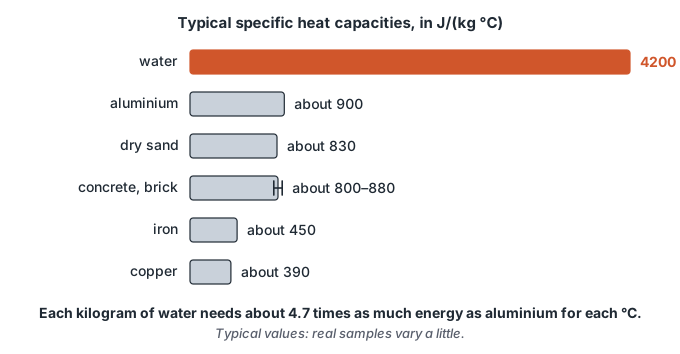
These are typical values: a real sample of sand or brick depends on what it is made of and how dry it is. Water’s specific heat capacity is unusually high, higher than that of almost any other common material. Each kilogram of water needs about 4200 J for each degree; each kilogram of aluminium needs about 900 J. 4200 ÷ 900 ≈ 4.7, so water needs about 4.7 times as much energy as the same mass of aluminium for the same rise in temperature, and the same energy warms it about 4.7 times less. Your own measurements, 4290 and 952 J/(kg °C), give a ratio of about 4.5, a little less. Both came out too high, but the aluminium by more: 952 is about 6 % above 900, while 4290 is only about 2 % above 4200. The block warmed far more than the water, so more energy escaped from it, even through its jacket. The book values give the true ratio.
 (enlarge)
Trap: “Water warms slowly because it loses more energy to the air.” In the experiment the water was lagged and never more than 7 °C above the room, so it lost less energy to the air than either block did. It warms slowly because each kilogram needs far more energy for each degree: its specific heat capacity is high.
Why water warms and cools slowly
Back to the beach. The Sun delivers about the same energy to each square metre of sand and of sea. Dry sand has a specific heat capacity of about 830 J/(kg °C), water about 4200 J/(kg °C), about five times as much. So each kilogram of water needs about five times as much energy as sand for each degree, and the same sunshine warms the top of the sea far less than the sand. The sea also mixes: waves and currents share the energy with the deeper water, so even more kilograms share it.
It works the other way round too. A material with a high specific heat capacity gives out a lot of energy for each degree it cools. At night the sand cools quickly, but the sea cools slowly: it can give out a great deal of energy while its temperature hardly drops. That is one reason why places by the sea have cooler summers and milder winters than places far inland.
A hot object in cold water. Drop a hot piece of metal into cold water, and energy passes from the hotter one to the colder one until both reach the same temperature. If the container is insulated, so that no energy escapes, the energy the metal gives out is equal to the energy the water takes in. Equal energies do not mean equal changes in temperature, though. Put a hot 1 kg block of copper (about 390 J/(kg °C)) into 1 kg of cold water (4200 J/(kg °C)). Each degree the copper cools gives out only about 390 J, but each degree the water warms needs about 4200 J. So the copper’s temperature falls about ten times as far as the water’s rises, and the two meet much nearer the water’s starting temperature than the copper’s.
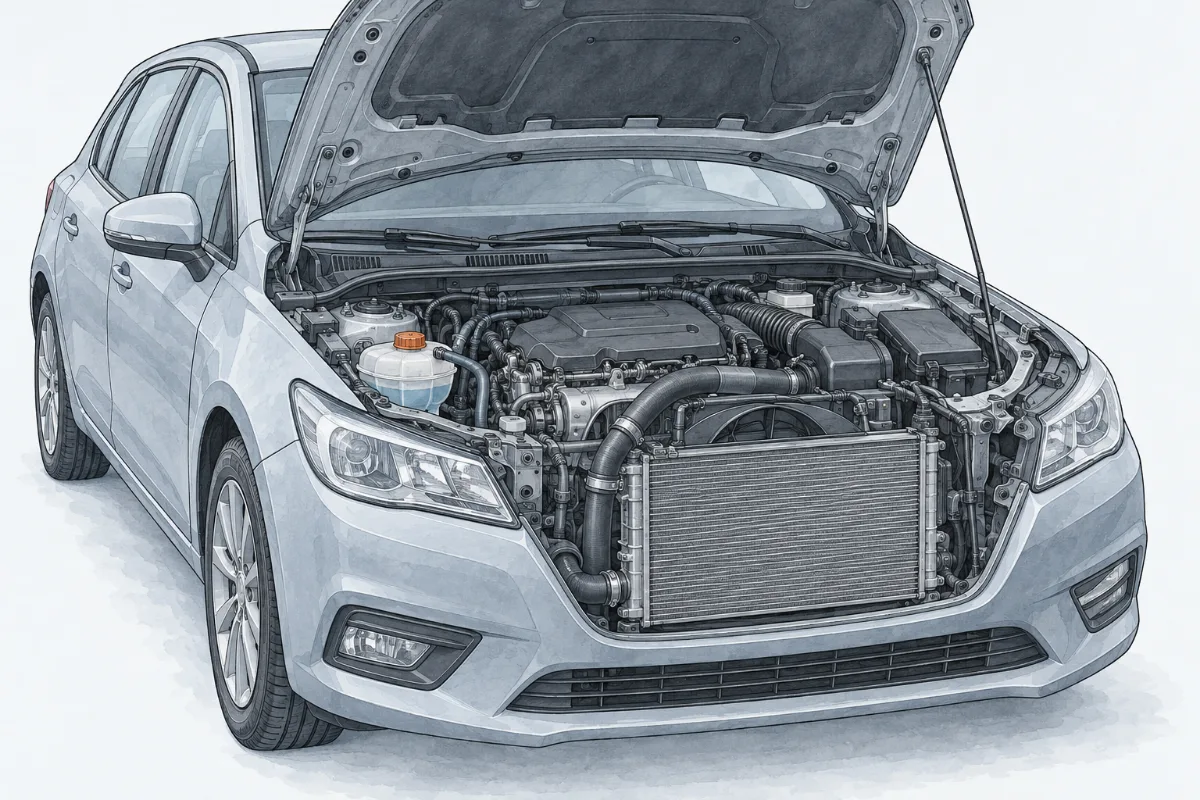
Car engines. A running engine gets hot, and it must be kept from overheating. Water, with antifreeze added (a liquid that stops it freezing in winter), is pumped through channels in the engine. Each kilogram carries away about 4200 J for every degree it warms, so a modest flow of water takes a lot of energy away while warming by only a few degrees. The hot water then flows through the radiator at the front of the car, a panel of thin tubes and fins, where air rushing through cools it before it goes back to the engine. A liquid used like this to carry energy away is called a coolant, and water, with its high specific heat capacity, is a very good one.
 (enlarge)
Hot-water bottles. A rubber bottle filled with hot water keeps a bed warm for hours. As 1 kg of water cools from 60 °C to 30 °C it gives out 1 kg × 4200 J/(kg °C) × 30 °C = 126 000 J, about 4.7 times as much as 1 kg of aluminium would give out as it cooled by the same amount.
Worked example
Sand and sea
1.0 kg of dry sand and 1.0 kg of water each take in 42 kJ of energy from the Sun, and none of it escapes. The specific heat capacity of the sand is 830 J/(kg °C) and that of the water is 4200 J/(kg °C). Calculate the rise in temperature of each.
ΔE = 42 kJ = 42 000 J. For the water, Δθ = ΔE / (mc) = 42 000 J ÷ (1.0 kg × 4200 J/(kg °C)) = 10 °C. For the sand, Δθ = 42 000 J ÷ (1.0 kg × 830 J/(kg °C)) ≈ 51 °C. The same energy warms the sand about five times as much as the water. On a real beach the sand loses some energy to the air and the sea shares its energy with deeper water, but the difference in specific heat capacity is a big part of why the sand gets so much hotter.
Storage heaters
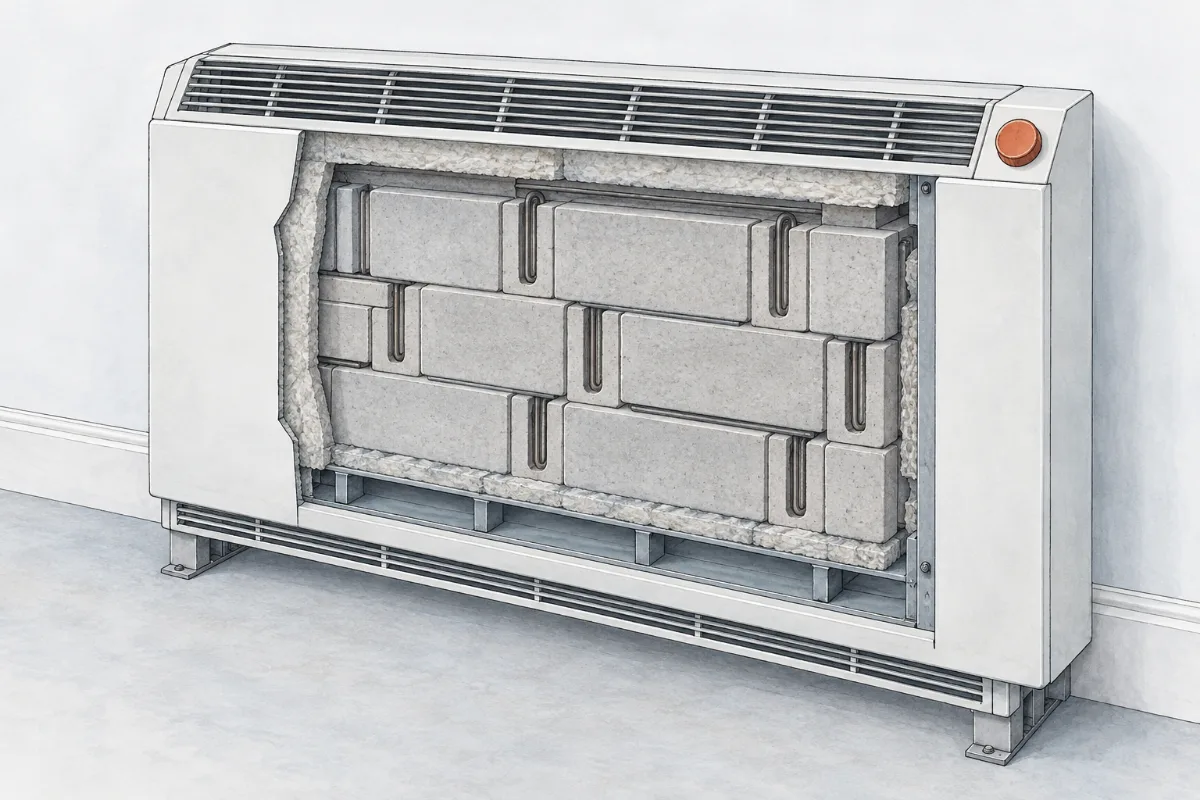
A storage heater stores energy at night and gives it out during the day. Inside its metal case is a stack of dense bricks, with electric heating elements between them and a thick layer of insulation all round. Overnight, when electricity is often cheaper, the elements heat the bricks to a high temperature, several hundred degrees Celsius. During the day the bricks cool slowly, and the stored energy warms the room.
Bricks have a lower specific heat capacity than water, about 800 J/(kg °C), so why use them? Because a storage heater holds a large mass of bricks, and bricks can be heated far hotter than water, which boils at 100 °C. A large mass and a large rise in temperature together store a lot of internal energy: ΔE = mcΔθ. The insulation slows the escape of that energy, so the bricks stay hot all day.
 (enlarge)
Worked example
A storage heater overnight
A storage heater holds 100 kg of bricks with a specific heat capacity of 800 J/(kg °C). Overnight they are heated from 100 °C to 600 °C. Calculate the energy stored. Then explain why the same energy could not be stored in 100 kg of water starting at 20 °C.
Δθ = 600 °C − 100 °C = 500 °C. ΔE = mcΔθ = 100 kg × 800 J/(kg °C) × 500 °C = 40 000 000 J. A million joules is a megajoule (MJ), so this is 40 MJ. To store 40 MJ, 100 kg of water would need a rise of Δθ = ΔE / (mc) = 40 000 000 J ÷ (100 kg × 4200 J/(kg °C)) ≈ 95 °C, taking it from 20 °C to about 115 °C. But water boils at 100 °C. The bricks store so much because they can be heated to a very high temperature.
Measuring c: a solid and a liquid
The two experiments in this module follow one method. Measure three things, then calculate c = ΔE / (mΔθ).
| A solid (a metal block) | A liquid (water) | |
|---|---|---|
| Mass m | weigh the block on a balance | measure the volume (1 cm³ of water has a mass of 1 g), or weigh the beaker empty and full |
| Energy ΔE | immersion heater in one hole; joulemeter set to zero, read at the end | immersion heater in the liquid, terminals above it; joulemeter set to zero, read at the end |
| Rise Δθ | thermometer in the other hole; final temperature minus starting temperature | thermometer in the liquid, stirred all the time; final temperature minus starting temperature |
| Main errors | energy escapes to the air; the heater and the thermometer warm too | energy escapes to the air; the beaker, the heater and the thermometer warm too |
| Improvements | an insulating jacket; a drop of oil in the thermometer’s hole | lagging and a lid; stir all the time; a large enough rise to read accurately |
In both experiments the errors work the same way. The joulemeter counts energy that does not all reach the sample, so the rise in temperature is smaller than it should be and the calculated specific heat capacity usually comes out too high. Insulation makes the rise closer to the true one. A drop of oil in the thermometer’s hole fills the air gap round the bulb, so that the thermometer shows the temperature of the block. And always use the rise in temperature, never the final temperature: the sample was already at room temperature before any energy went in.
Another way: a polystyrene cup
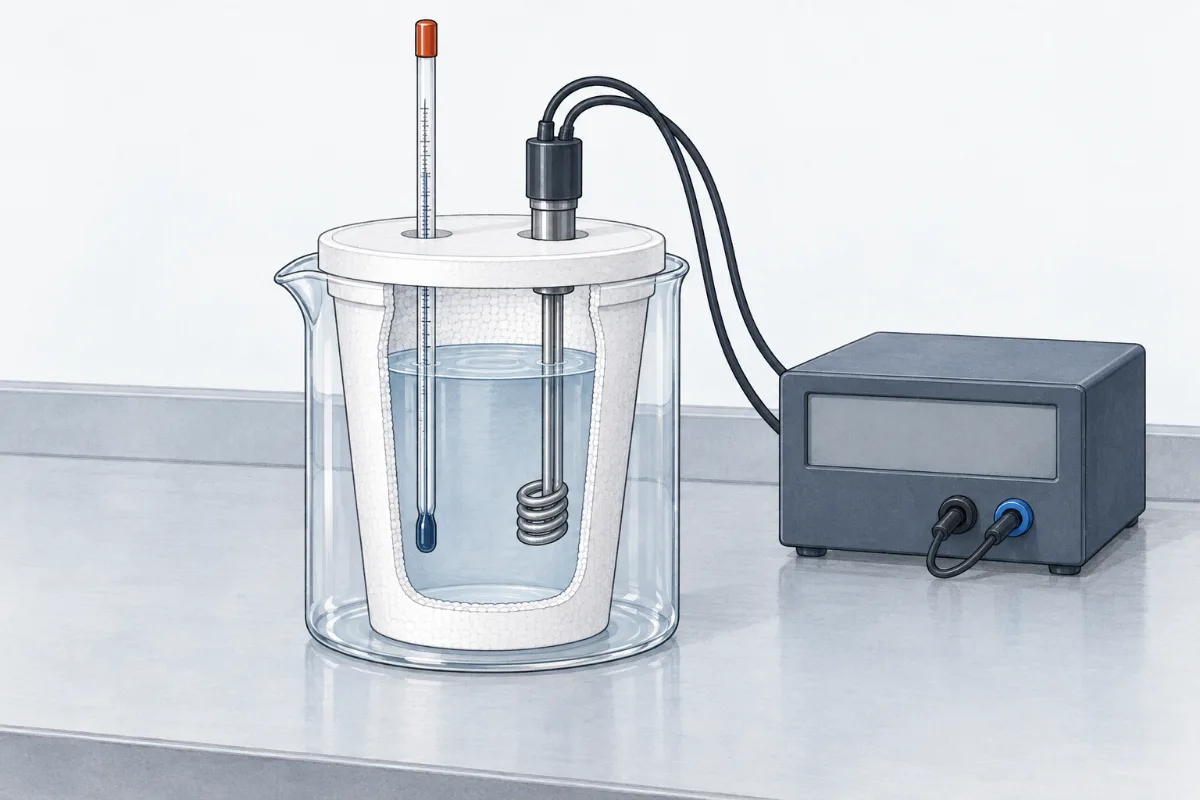
Schools often measure the specific heat capacity of water in a polystyrene cup instead of a beaker. Polystyrene is a good insulator, and the cup is so light that very little energy goes into warming it. A lid with holes for the heater and the thermometer stops energy escaping from the surface, and the cup stands in a glass beaker so that it cannot tip over. A cup holds less water, such as 200 cm³ (0.200 kg), so the same energy gives a bigger rise in temperature, which is easier to read accurately.
 (enlarge)
Case closed
Why does water take so long to heat up? Because its specific heat capacity is very high: each kilogram of water needs about 4200 J for every degree, about 4.7 times as much as aluminium (900 J/(kg °C)) and about five times as much as sand. With the same heater and the same 30.0 kJ, 1.00 kg of water warmed by only 7.0 °C, while the block of the same mass in its jacket warmed by 31.5 °C. The same property makes water slow to cool: it gives out a lot of energy for each degree, which is why it is used as a coolant and in hot-water bottles, and why the sea stays cooler than the sand by day. Your measured values, about 4290 J/(kg °C) for water and 952 J/(kg °C) for aluminium, came out a little high, because the apparatus warmed too and some energy escaped.
About this model
The beaker, the water, the heater, the joulemeter and the thermometer are simulated. Each joule from the heater warms the water (4200 J for each °C for 1 kg), the heater and the thermometer (40 J for each °C) and the part of the beaker that warms with the water (100 J for each °C), or escapes to the air, faster the warmer the water is compared with the room. The water is taken to be perfectly stirred, so that it all has one temperature, and none of it evaporates. The readings are rounded to the nearest 0.5 °C. A real heater takes a little while to warm up and goes on warming the water for a while after it is switched off; this one does not.