Skip to content

Topic 12 of 12 · 4 of 10 modules ready

Experimental techniques and chemical analysis

Measuring, separating and identifying substances: the practical skills behind every other topic.

Modules

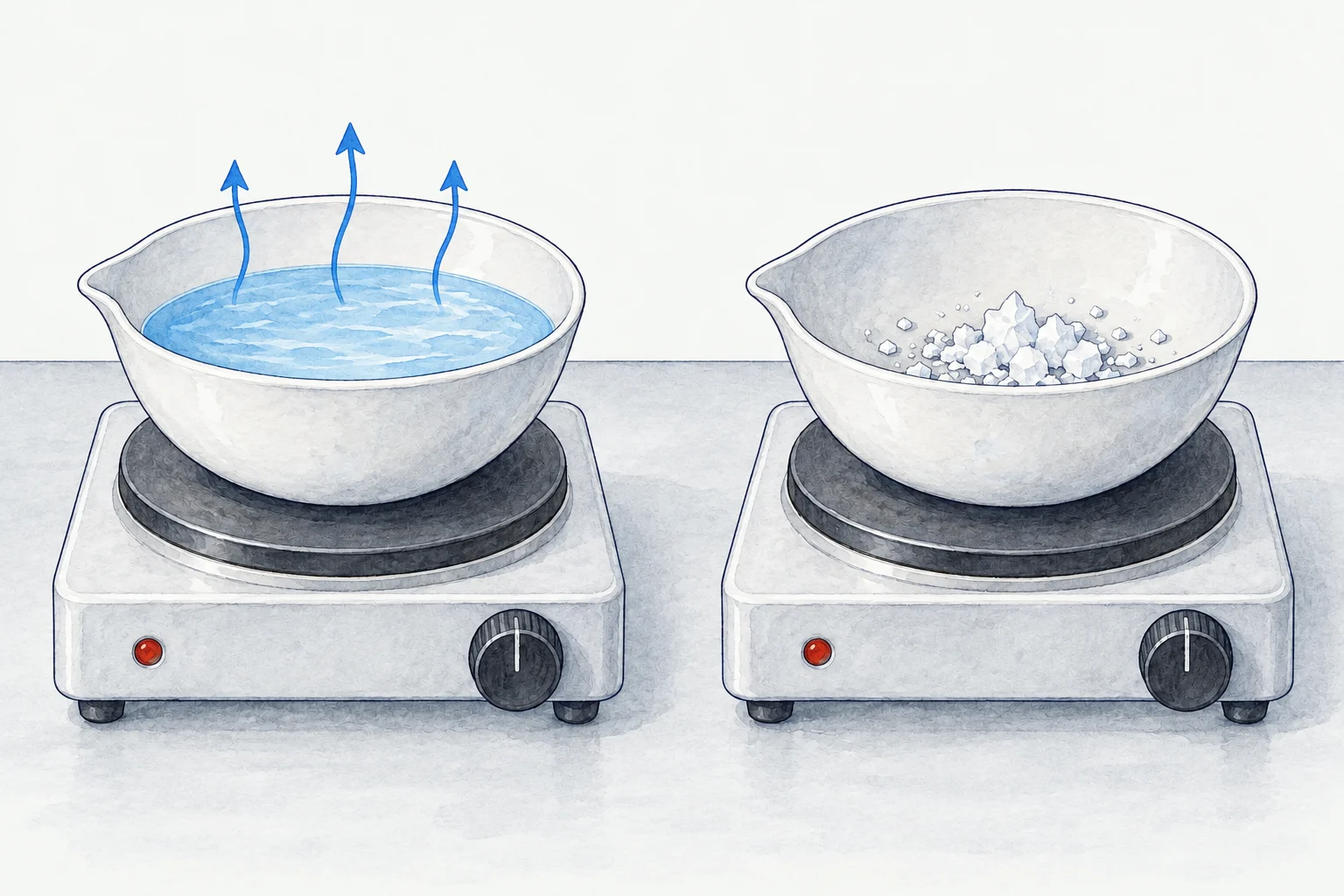
  1. Salt remains after water is removed from the salt solution.

    Module 1 · syllabus 12.1, 12.4 · 4 parts

    Mixtures and separation

    The salt disappears. Has it gone?

    Follow a mixture from the first stir to the final separation. Discover what dissolves, what stays behind and how to get a substance back.

    1. Where did the salt go? Solvent, solute and solution
    2. What gets through the filter? Residue, filtrate and dissolved salt
    3. How can the salt return? Recovery and choosing a solvent
    4. Which separation should come first? Build and explain a method

    Experiment One sample · follow every component

Syllabus statements for this topic · for teachers · 16 statements

Core for every pupil · Supplement also for Extended entry. Paraphrased from the Cambridge IGCSE Chemistry 0620 syllabus (2026–2028); check the official syllabus for exact wording.

12.1 Experimental design

Covered in Mixtures and separation, Crystallisation

  • 12.1.1Time, temperature, mass and volume apparatusC
  • 12.1.2Experimental method/apparatus trade-offsC
  • 12.1.3Solvent, solute, solution, saturation, residue and filtrateC

12.2 Acid–base titrations

  • 12.2.1Titration procedure and apparatusC
  • 12.2.2Indicator endpointC

12.3 Chromatography

Covered in Paper chromatography

  • 12.3.1Coloured-solute paper chromatographyC
  • 12.3.2Chromatograms: identity and purityC
  • 12.3.3Colourless chromatography and locating agentS
  • 12.3.4Rf calculation and interpretationS

12.4 Separation and purification

Covered in Mixtures and separation, Crystallisation, Distillation
  • 12.4.1Selective solvent, filtration, crystallisation, simple/fractional distillationC
  • 12.4.2Selecting and sequencing separation methodsC
  • 12.4.3Identity/purity from melting and boiling dataC

12.5 Identification of ions and gases

  • 12.5.1Anion tests: carbonate, halides, nitrate, sulfate, sulfiteC
  • 12.5.2Cation tests: Al, NH4+, Ca, Cr(III), Cu, Fe(II), Fe(III), ZnC
  • 12.5.3Gas tests: ammonia, CO2, chlorine, hydrogen, oxygen, SO2C
  • 12.5.4Flame tests: Li, Na, K, Ca, Ba, CuC