The particle model of matter and how heating changes temperature, state and size.
Modules
Module 2 · syllabus 2.1.2, 2.1.3, 2.2.1 · 3 parts
Gas pressure and temperature
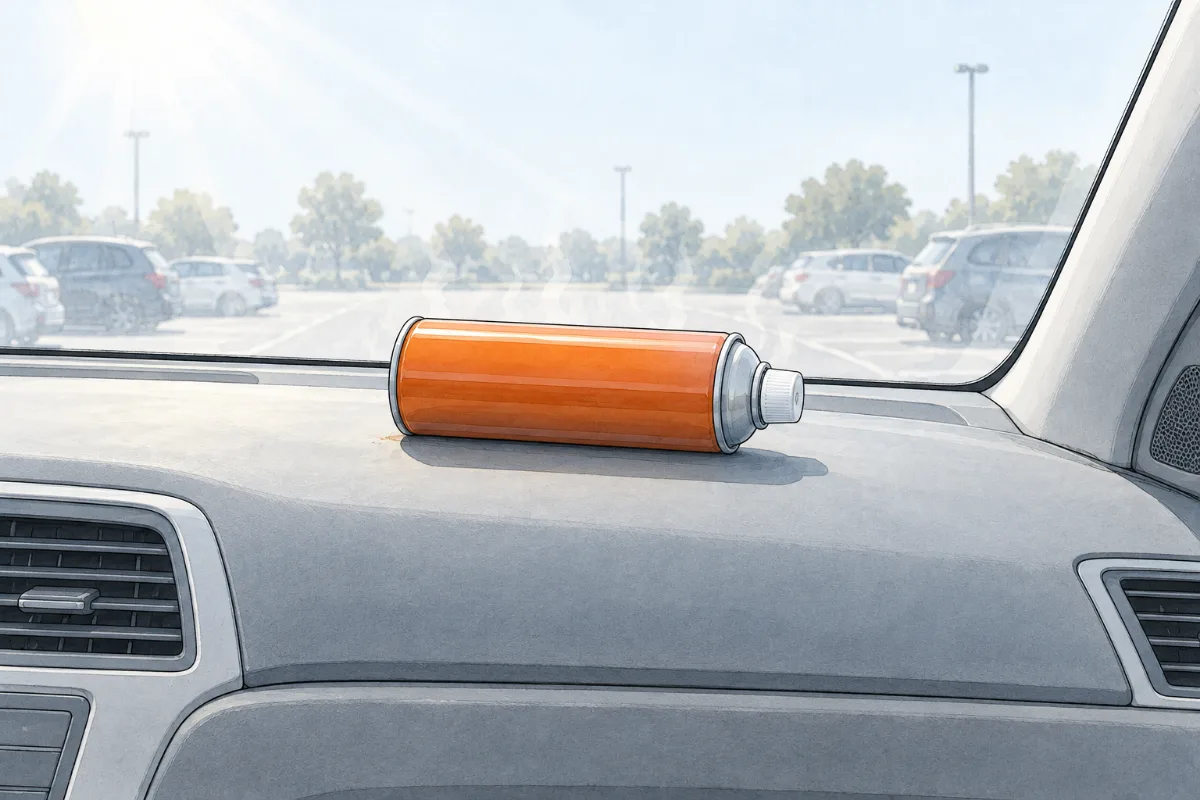
Why can a sealed can burst when it gets hot?
Trap some air in a syringe joined to a pressure gauge and squeeze it to smaller and smaller volumes, with a magnifier showing a model of its particles. Then lock the plunger, cool the air with ice and warm it on a hotplate, and extend the graph to find where the pressure would reach zero.
Squeezing a gasGas pressure from particles hitting the walls, as a force per unit area; squeezing a gas at a steady temperature, and pV = constant with its graphs
Heating a gas at a fixed volumeHeating a gas at a fixed volume, in particle terms; the kelvin scale and T = θ + 273
Thermal expansionThermal expansion of solids, liquids and gases, why gases expand most, and where expansion is useful or a problem
Experiment Squeeze trapped air · then lock it, cool it and warm it
Syllabus statements for this topic · for teachers · 45 statements
Core for every pupil · Supplement also for Extended entry. Paraphrased from the Cambridge IGCSE Physics 0625 syllabus (2026–2028); check the official syllabus for exact wording.
2.1.1 States of matter
2.1.1.1Properties of solids, liquids and gasesC
2.1.1.2Names of the changes of stateC
2.1.2 Particle model
Covered in Gas pressure and temperature
2.1.2.1Particle arrangement, separation and motion; particle diagramsC
2.1.2.2Particle motion, temperature and absolute zeroC
2.1.2.3Gas pressure from particle collisions with wallsC
2.1.2.4Random motion of suspended specks supports the particle modelC
2.1.2.5Brownian motion explained by random molecular collisionsC
2.1.2.6Particle forces, distances and motion set propertiesS
2.1.2.7Gas pressure as collision force per unit areaS
2.1.2.8Fast light molecules move visible specks; atoms versus specksS
2.1.3 Gases and the absolute scale of temperature
Covered in Gas pressure and temperature
2.1.3.1Gas pressure with temperature or volume, in particle termsC
2.1.3.2Kelvin and Celsius; T = θ + 273C
2.1.3.3pV = constant at fixed temperature, with its graphS
2.2.1 Thermal expansion of solids, liquids and gases
Covered in Gas pressure and temperature
2.2.1.1Thermal expansion of solids, liquids and gasesC
2.2.1.2Everyday uses and problems of thermal expansionC