Characteristics and classification of living organisms
What makes something alive, and how biologists sort and name millions of species.
Modules
Module 1 · syllabus 1.1, 1.2 · 3 parts
Living things and keys
How can you name a living thing you have never seen before?
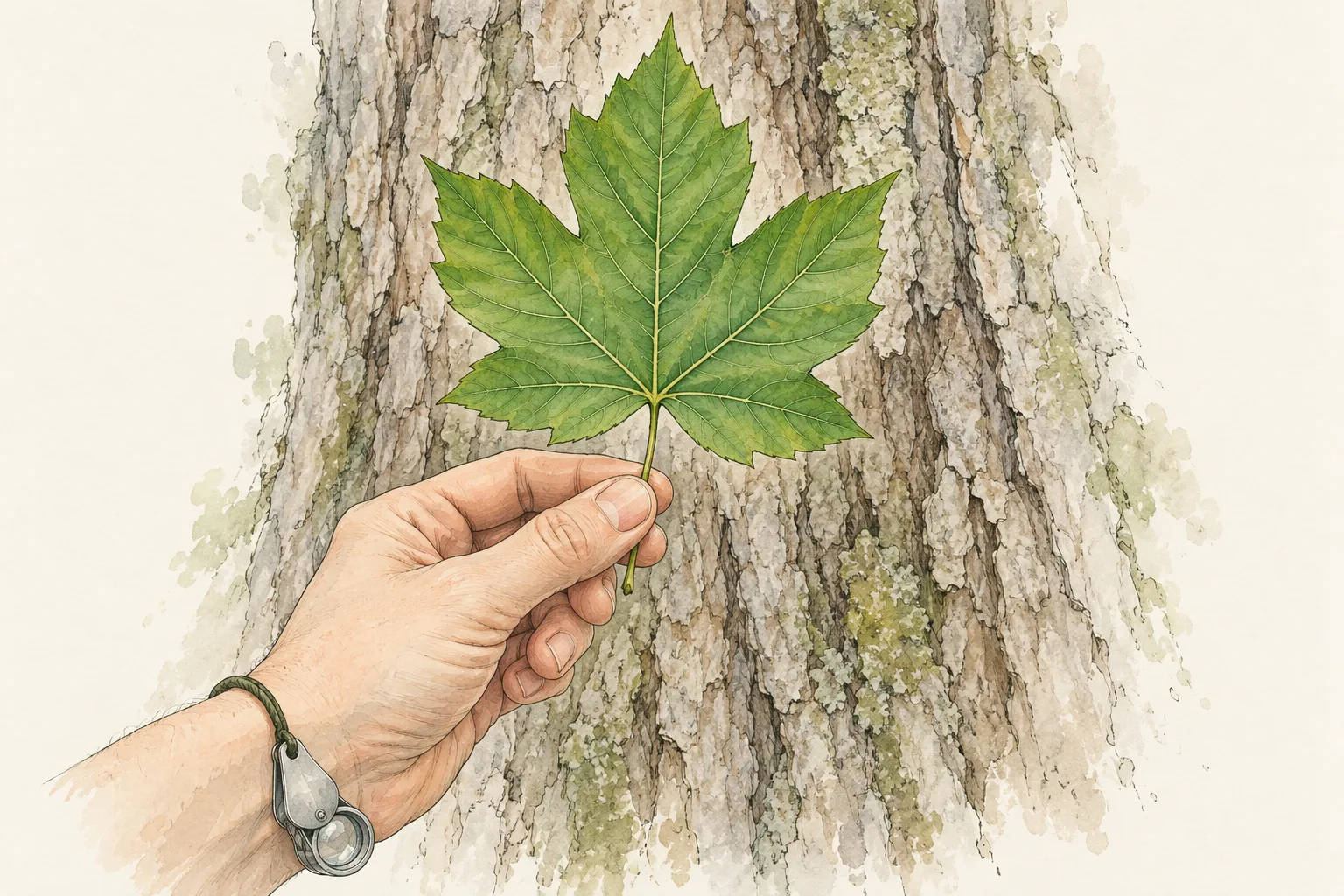
Put six mystery leaves behind a hand lens and name each one with a dichotomous key, one pair of statements at a time. Find out what a shared first part of a scientific name means, build a key of your own for four leaves you know, and (Supplement) compare short DNA strips to see which trees are most closely related.
Is it alive?The seven characteristics of living organisms, and how to test whether something is alive
Naming with a keyDichotomous keys: naming organisms by features you can see, and building a key of your own
Species and scientific namesSpecies, two-part scientific names and, in the Supplement, what DNA shows about relationships
Experiment Six mystery leaves and a hand lens · name each one with a key, then build a key of your own
Syllabus statements for this topic · for teachers · 15 statements
Core for every pupil · Supplement also for Extended entry. Paraphrased from the Cambridge IGCSE Biology 0610 syllabus (2026–2028); check the official syllabus for exact wording.
1.1 Characteristics of living organisms
Covered in Living things and keys
1.1.1Seven characteristics of living organismsC
1.2 Concept and uses of classification systems
Covered in Living things and keys
1.2.1Classifying organisms by shared featuresC
1.2.2Species: interbreed to give fertile offspringC