Stir a spoonful of sugar into a glass of water, and it disappears. Keep adding spoonfuls and stirring. Water can hold a surprising amount of sugar, but not an unlimited amount: after many spoonfuls, the extra sugar just sits on the bottom, however long you stir. Yet a glass that could take more sugar looks just as clear as one that can't. So how can you tell whether a solution has room for more? In this part you'll learn a simple test that tells you, and why just looking at a solution, even a coloured one, can't.
What is dissolved?
Where did the first spoonful go? It's still in the glass, spread through the water as particles far too small to see, which is why sugar water tastes sweet. The substance that dissolves, like the sugar, is the solute. The liquid it dissolves in, here the water, is the solvent. Together they make a solution.
Our experiment uses a blue solution that a technician has made up. Its solute is a blue salt called copper(II) sulfate, and its solvent is water. The blue colour comes from the dissolved salt, so you know the salt is there even though you can't see a single grain.
A limit at this temperature
Picture a glass of sugar water that looks perfectly clear. Before you read on, predict: can you tell just by looking whether it can take more sugar?
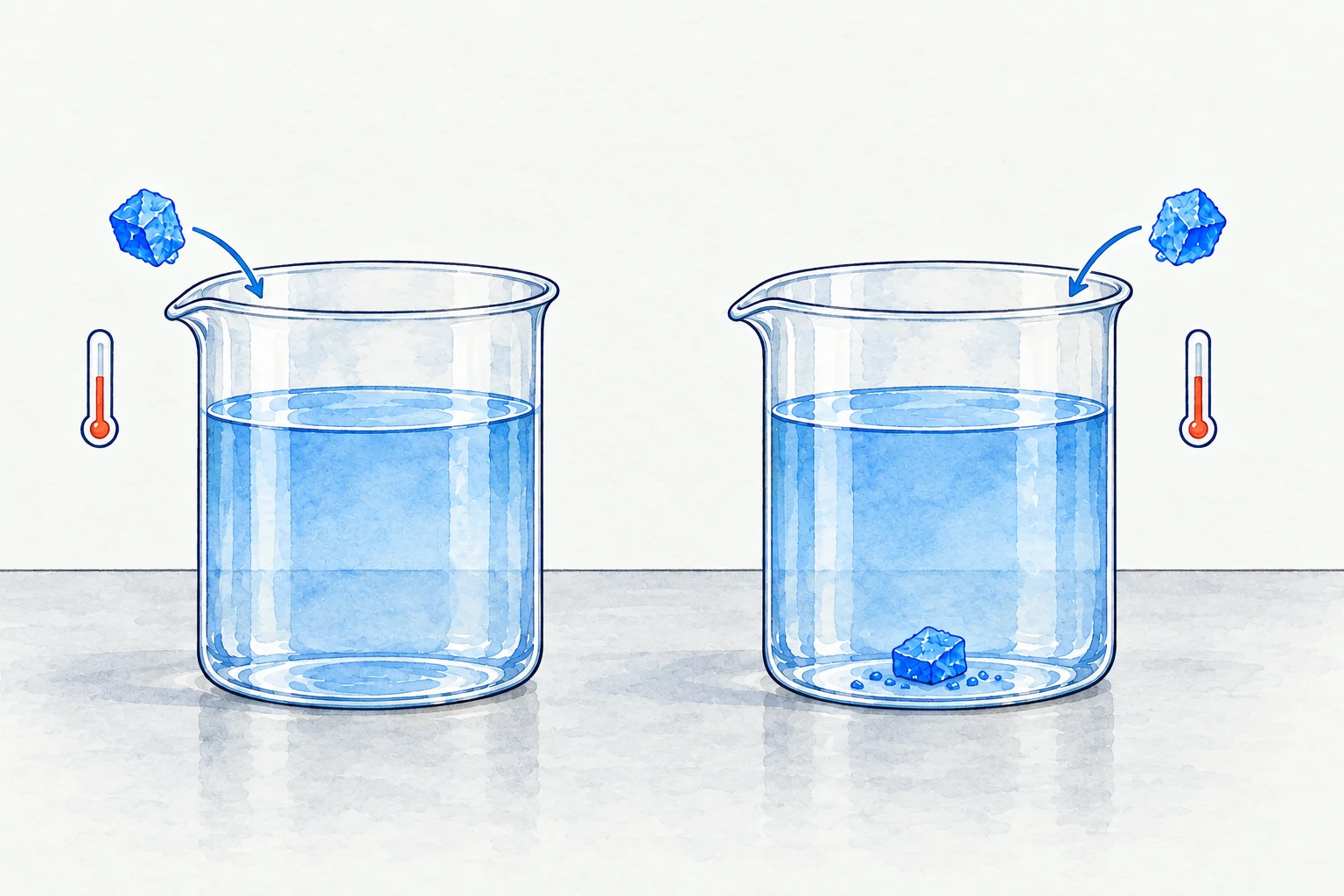
You can't. Clear only means there are no grains in it. To find the limit, add a little more sugar and stir. If it stays as grains, even after plenty of stirring and waiting, the water can't dissolve any more. A solution that contains as much dissolved solute as it can, at that temperature, is saturated. A solution that can still dissolve more is unsaturated.
The words “at that temperature” matter, because the limit changes when the solution gets warmer or cooler. That's why the test only works if the temperature stays steady while you stir and wait.
 (enlarge)
The right-hand beaker holds saturated solution and some extra solid on the bottom. The solid isn't part of the solution: it's the evidence that the test has found the limit.
Trap: “A saturated solution must have grains in it.” Take the extra solid away, and the saturated solution is clear: you can see through it, and there's no solid in it at all. It still holds as much dissolved salt as it can at that temperature, so it's still saturated.
Concentrated is not the same as saturated
Think about two glasses with the same amount of tea, one with a spoonful of sugar and one with four. The second tastes sweeter because each sip holds more dissolved sugar. Concentration describes how much solute is dissolved in a given amount of solution. A solution with a lot of solute in that amount is concentrated; one with only a little is dilute. To compare two solutions fairly, compare the same amount of each: the one with more dissolved solute is more concentrated.
Concentrated doesn't mean saturated, though. Sugar dissolves so well in water that even the very sweet tea could take many more spoonfuls, so it's concentrated and unsaturated. Some other solids hardly dissolve in water at all. Limewater, which is used to test for carbon dioxide, is one example: it's usually a saturated solution of calcium hydroxide, but so little calcium hydroxide dissolves that it's saturated and dilute. That's why neither concentrated nor dilute tells you, on its own, whether more can dissolve. To know that, you need to know which solute and solvent you have and the temperature, or you need to do the test.
Warmer water, a higher limit
For copper(II) sulfate, the limit rises with temperature: more of it can dissolve in warm water than in cool water. You'll use that fact in part 2, because it's what makes crystals grow as a warm solution cools.
Trap: “Heating lets every solute dissolve more.” Temperature affects different substances differently. Sodium chloride (common salt), which you met in Mixtures, dissolves only a little more in hot water than in cold. So for each solute, use what you know about that solute, not one rule for all of them.
Worked example
Dark blue is not a saturation test
Two copper(II) sulfate solutions both look dark blue, and both are at the same steady temperature. You add a small crystal of copper(II) sulfate to each and stir well. In the first, the crystal dissolves. In the second, some of it is still there after plenty of stirring and time. What does that tell you?
The first solution could dissolve more, so it was unsaturated. The second has reached its limit at that temperature, so it's saturated. Both looked dark blue, so the colour couldn't have told you this: a solution can look dark blue and still be below its limit. The added crystal told you.
Worked example
No grains, but still saturated
Saturated solution stands above some extra crystals. You filter it at the same temperature: the crystals stay on the paper, and clear blue solution passes through. Is that solution unsaturated now?
No. Filtering took away the solid that hadn't dissolved, but it didn't take away any of the dissolved salt. The solution still holds as much as it can at that temperature, so it's still saturated, even with no grains in sight.
Case closed
To find out whether a solution can dissolve more, keep its temperature steady, add a little of the same solute, stir and give it time.
- If it all dissolves, the solution was unsaturated.
- If some stays, the solution is saturated at that temperature now. It may have been just below its limit before: part of the solid dissolved until the limit was reached.
Concentrated and dilute compare how much solute is dissolved. Saturated means the solution has reached its limit. Looking shows you whether undissolved solid is there, and colour can hint at concentration, but looking alone can't tell you whether a solution is saturated.
Try the questions. In each answer, say what the test shows that colour can't.
About this model
Our examples assume enough stirring and time at the stated temperature, because slow dissolving alone doesn't prove that a solution is saturated. Never taste laboratory samples.