Leave a jar of honey in a cool cupboard for a few weeks, and it can turn grainy: tiny sugar crystals appear in a liquid that was clear. You can watch the same kind of change in the lab, only much faster. A basin of clear blue copper(II) sulfate solution cools on the bench, and blue crystals with flat, shiny faces grow on the bottom, while blue liquid stays around them. Nobody added any solid, so where did the crystals come from? In this part you'll get a solution ready to grow crystals, use a glass rod to find out when it's ready, and then explain what cooling does.
First, keep the salt and lose some water
Our basin starts with the prepared solution, and that solution is too dilute to give crystals: even when it cools, the water can keep all its salt dissolved. So the first job is to remove some of the water. Before you read on, predict which part of the solution leaves when you heat the basin gently: the water or the salt?
Gentle heat makes some of the water evaporate: it turns from liquid into water vapour, a gas, and leaves the basin. The salt doesn't evaporate, so all of it stays behind. The same amount of salt is now dissolved in less water, so the solution becomes more concentrated, and a deeper blue. Removing only some of the water like this is called partial evaporation. Chemists also say that it concentrates the solution.
Stop while plenty of liquid is left, because the crystals will grow from the solution as it cools. If you heated the basin until it was dry, there would be no solution left for crystals to grow in. Strong heating would also drive out the water that is built into the blue crystals themselves, and leave a white powder instead. Part 3 explains that water.
A small test tells us when to stop
So how much water should you remove? The basin can't show you, because the hot solution stays clear. A glass rod gives you a quick test. Dip a clean rod into the solution and lift it out: a thin film of solution stays on its tip. This film is your test drop. It's so thin that it cools in the air within seconds, so it gives you an early sign of what cooling might do to the whole basin.
Look closely at the tip. If the film stays a clear, wet film, the answer is “not yet”: heat a little longer, then test again. If tiny crystals form on the rod, the solution is concentrated enough. Stop heating and leave the basin to cool and stand. Stand means it stays still and untouched while it cools.
The rod test is a quick, practical sign, not a measurement. It doesn't tell you exactly how close the hot solution is to its limit. The thin film also loses a little water to the air, so it's slightly more concentrated than the basin and can show crystals a little early.
Try it now. Choose a method, then predict what the rod will show the first time you dip it. Keep heating and testing until you think the solution is ready, then watch the basin as it cools. Two close-ups help you. The round magnifier on the bench shows the rod's tip, then looks down into the basin. The small drawing beside the buttons shows the liquid close up: circles are water, separate squares are dissolved salt, and squares packed together at the bottom are a crystal.
Cooling lowers the limit
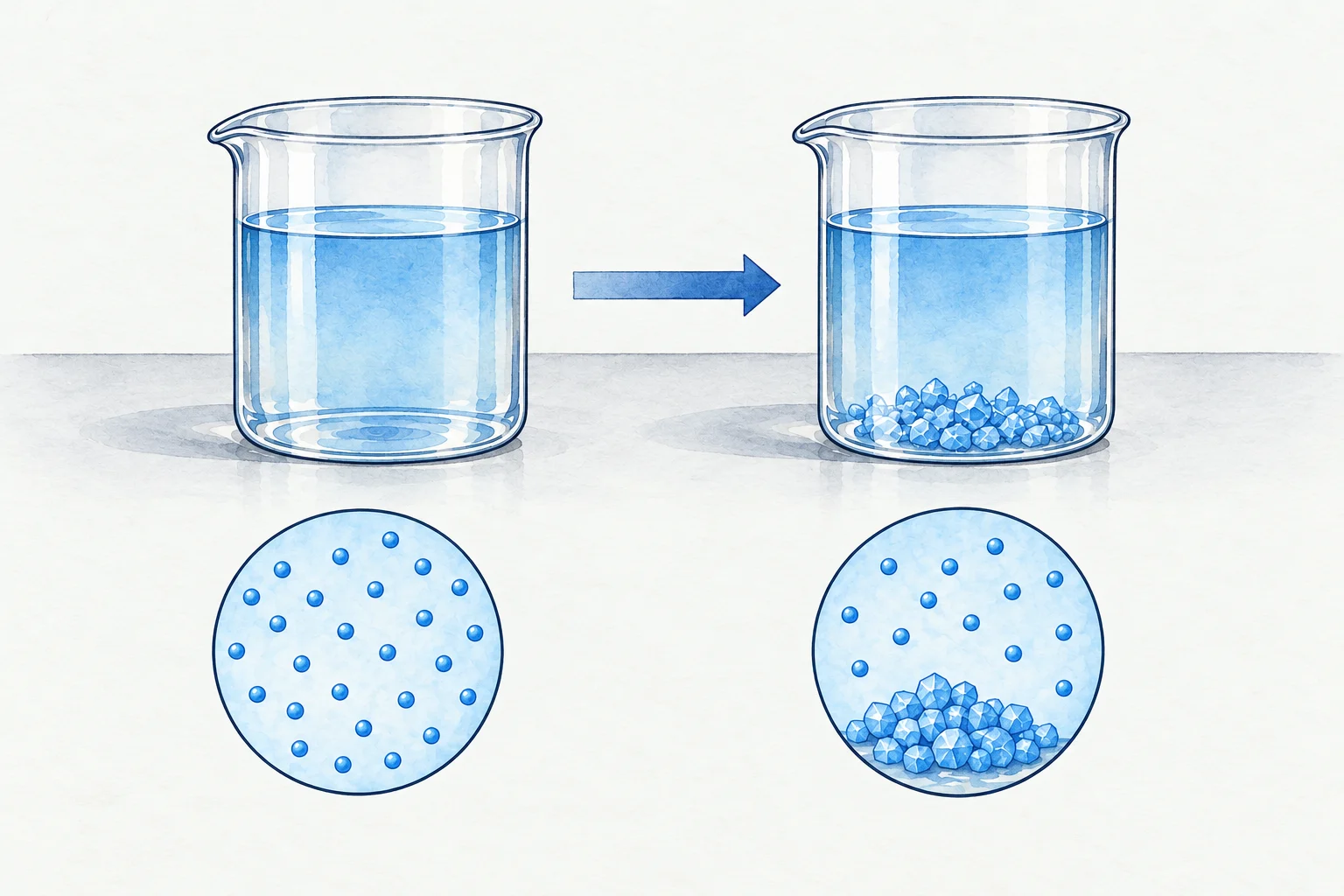
What did you see as the basin cooled? Crystals appeared in a liquid that had been clear, and blue liquid stayed around them.
Here's why. Remember from part 1 that more copper(II) sulfate can dissolve in warm water than in cool water. While the concentrated solution was warm, its water could keep all the salt dissolved. As it cools, the limit drops, so the water can no longer hold all of that salt. The salt that can't stay dissolved leaves the solution and builds up into solid crystals. Forming crystals from a solution like this is called crystallisation.
 (enlarge)
Trap: “The blue liquid froze.” The basin only cools to room temperature, far above the temperature at which water freezes. The crystals are copper(II) sulfate, not ice, and water with some salt still dissolved in it stays liquid around them.
Cooling works so well here because much more copper(II) sulfate can dissolve in hot water than in cold. A salt whose limit hardly changes with temperature, such as sodium chloride, gives very few crystals on cooling, so you'd get its crystals by evaporating much more of the water instead.
Some salt stays in the liquid
Not all the salt becomes solid. Cool water can still hold some salt, just less than warm water, so some of it stays dissolved in the water that's left. That's why blue liquid remains around the crystals. This leftover solution is sometimes called the mother liquor.
Leaving the basin to stand gives the crystals time to grow. In the experiment the wait is shortened, so it doesn't predict how long real crystals take to grow, or their size or shape.
Worked example
Less water, no extra salt
You evaporate some water from a solution without losing any salt. Has the amount of salt in the basin increased?
No. The same salt is now shared by less water, so the concentration has increased, not the amount of salt. That matters when the solution cools. If enough water has evaporated, it now holds more salt than the cool water can keep dissolved, so some of it can form crystals.
Worked example
Cooling too early
A student cools a dilute solution straight away, and no crystals form. Has the salt vanished?
No. The solution was still too dilute, so even the cool water could keep its salt dissolved, and nothing had to leave the solution. To try again, warm the basin and gently evaporate more water, then test a cooled film on a glass rod. When crystals form on the rod, cool the basin again. Keep liquid in the basin the whole time, because heating it to dryness skips the stage where crystals grow from the solution.
Case closed
- Remove some water and keep the salt, so the solution becomes more concentrated.
- Test a small cooled drop, the film on a glass rod. When it forms crystals, stop heating.
- Let the main solution cool and stand. Cool water can hold less of this salt, so some forms crystals, and solution stays around them.
Look back at the experiment: why was the basin clear before cooling, and why did it hold crystals afterwards? Then try the questions with this page closed.
About this model
This is one selected salt, and more of it dissolves at higher temperatures. No calibrated solubility curve, exact yield or real-time crystal-growth rate is modelled. If you rewarm a cooled sample, its crystals dissolve again first; a later concentration stage then removes more water. Real heating and copper(II) sulfate handling need a teacher-approved safety procedure.