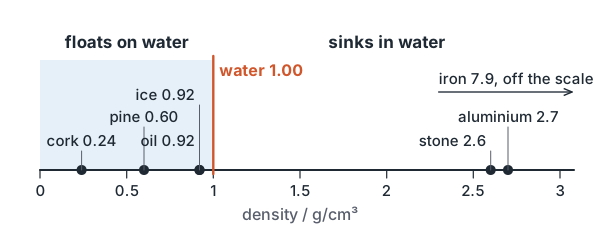
You now have three densities: pine 0.60 g/cm³, stone 2.6 g/cm³ and cooking oil 0.92 g/cm³. Water is 1.00 g/cm³. Before you read on, predict: which of the three will float in water? By the end of this part you'll be able to decide from density data alone whether an object floats or sinks, and which of two liquids ends up on top.
Less dense than water floats
Here is the rule. An object floats in a liquid if its density is less than the liquid's density. It sinks if its density is greater. (An object with exactly the liquid's density stays wherever you put it, neither rising nor sinking.)
So the pine block, at 0.60 g/cm³, floats in water, and the stone, at 2.6 g/cm³, sinks. Mass and size do not matter here: the block is about 19 times heavier than the stone and floats anyway.
Why does density decide? A floating object sinks into the water until the water it has pushed aside has the same mass as the object itself. A block less dense than water reaches that point while part of it is still above the surface: the pine block, with 0.60 of water's density, settles with about 60 % of it under water. A stone never reaches that point: even completely under water, the water it pushes aside has less mass than the stone, so it keeps going down.
 (enlarge)
Trap: “Heavy things sink and light things float.” The big pine block is heavier than the small stone, and it is the block that floats. Compare densities, not masses: is each cubic centimetre of the object heavier or lighter than a cubic centimetre of the liquid?
Now test your prediction. Put the block and the stone in the tank of water, and watch the water level as the block goes in. Then pour the oil onto water in a beaker.
Did it happen as the densities said? When the block went in, the water rose by the volume the block pushes aside, about 600 cm³, which has the same mass as the whole block.
Worked example
Which will float?
A candle has a mass of 45 g and a volume of 50 cm³. Will it float in water? Will it float in cooking oil (0.92 g/cm³)?
Density of the candle = 45 g ÷ 50 cm³ = 0.90 g/cm³. Water is 1.00 g/cm³: 0.90 is less, so the candle floats in water. Oil is 0.92 g/cm³: 0.90 is less again, so it floats in oil too, but only just.
One object, two materials
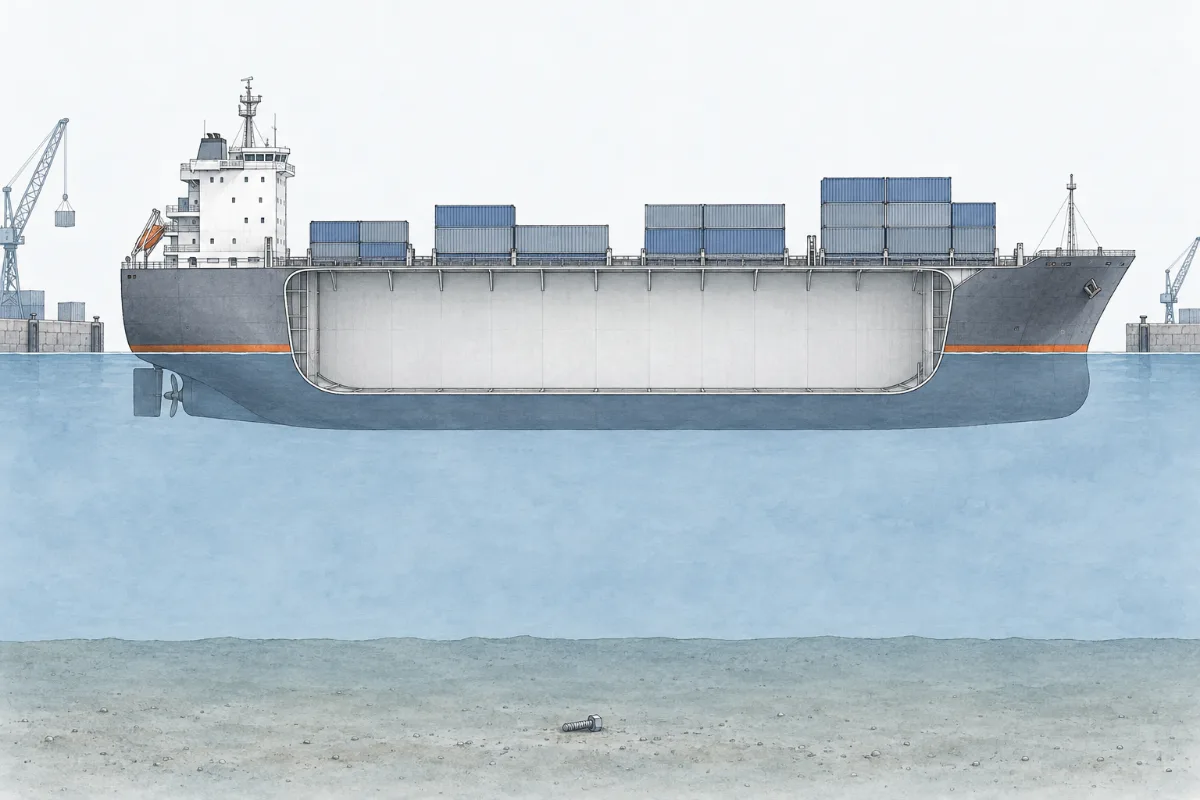
Steel has a density of 7.9 g/cm³, so a steel bolt sinks. Yet a steel ship floats. The ship is not solid steel: it is a thin steel shell around a huge space full of air. Divide the ship's total mass by the total volume of its hull and you get its average density, and that is less than the density of water. Load the ship and its average density rises, so it settles lower in the water. Fill the hull with water and it sinks.
 (enlarge)
One liquid on another
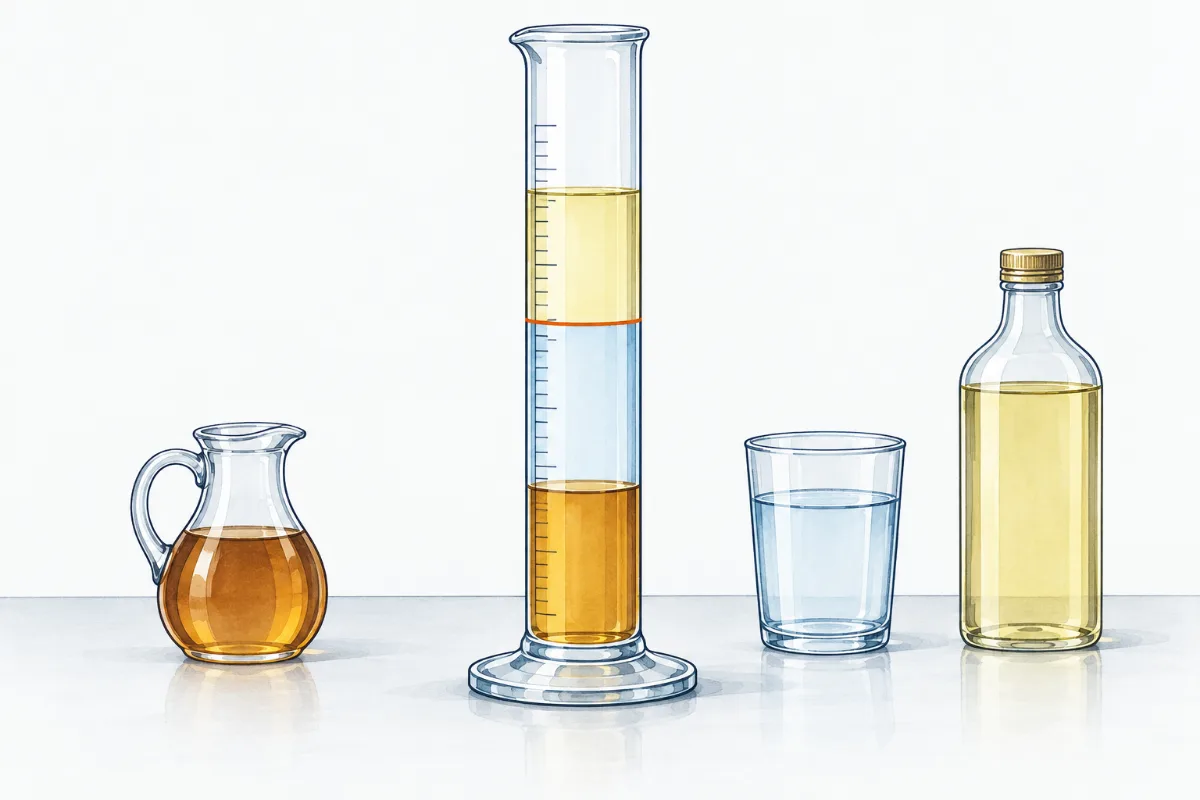
Pour cooking oil onto water and it stays on top in a separate layer. Shake them and the oil breaks into drops, but as soon as you stop, the drops rise and join again. Oil and water don't mix: they are immiscible. For liquids that don't mix, the same rule holds: the less dense liquid floats on the denser one, so the densest liquid ends up at the bottom.
 (enlarge)
Syrup (about 1.4 g/cm³) sinks below water, and oil (0.92 g/cm³) floats on it. Poured gently, the syrup stays a separate layer for a while; stir it, though, and it dissolves in the water, because sugar dissolves. The rule only works for liquids that do not mix. Alcohol (0.79 g/cm³) poured onto water doesn't float as a layer: it mixes in.
Trap: “Oil floats because there is less of it.” A whole pan of oil still floats on a cup of water poured underneath it. What matters is the mass of each cubic centimetre: oil's is 0.92 g and water's is 1.00 g.
Worked example
Three liquids in a jar
Three liquids that do not mix are poured into a jar: liquid A (1.26 g/cm³), liquid B (0.80 g/cm³) and water (1.00 g/cm³). In what order do they settle, from the bottom up?
The densest goes to the bottom: A at 1.26 g/cm³. Next water at 1.00 g/cm³. B, the least dense at 0.80 g/cm³, floats on top. From the bottom: A, water, B.
Case closed
Why does a big log float when a small stone sinks? Not because of its mass or its size, but because of its density. Wood packs about 0.6 g of matter into each cubic centimetre, less than water's 1.00 g, so a log floats however big it is. A stone packs about 2.6 g, so even a tiny pebble sinks. Compare the object's density with the liquid's: less dense floats, denser sinks. Two liquids that don't mix settle the same way, the less dense on top.
About this model
In the experiment the tank and the beaker hold fresh water at 1.00 g/cm³. The block settles with 0.60 of its height under water because its density is 0.60 of water's; that link is a useful check, not something you need to calculate. The apparatus is simulated.