Rub an alcohol-based hand sanitiser into your hands, and they feel cold and then dry within a minute. The gel is mostly alcohol and water, mixed into one clear liquid, and the alcohol evaporates faster than the water. The water evaporates too, just more slowly. Evaporation is vaporisation from the surface of a liquid, so it can happen without boiling.
In part 1 only the water could leave the flask, because salt doesn't turn into vapour. Now picture a mixture like that gel, where both liquids can leave as vapour. Can distillation still pull them apart? In this part you'll find out why simple distillation isn't enough, how a column does better, and why you collect the liquid in more than one beaker.
Mixed together, but not the same
In the experiment, the flask holds two imaginary liquids, A and B. Pour them together and they mix completely into one clear liquid, with no layers. Liquids that do this are miscible. Oil and water are not: they form two layers. Both A and B are colourless, so you can't tell them apart by looking.
They behave differently when you heat them, though. A is more volatile than B: it turns into vapour more readily. That fits their boiling points. The pure boiling point of a substance is the temperature at which it boils on its own, at a stated pressure. In this model, at normal pressure, pure A boils at 65 °C and pure B at 100 °C, so A, with the lower boiling point, is the more volatile one. Comparing how readily two liquids turn into vapour means comparing their relative volatility.
Here's the surprise. When the mixture boils, the vapour isn't pure A. It contains both A and B, because both of them can vaporise. But the vapour is richer in A than the liquid it came from: A makes up a bigger share of the vapour than of the liquid in the flask. Collect that vapour in the simple apparatus from part 1, and the distillate is only a little richer in A, because plenty of B comes over with it.
Trap: “A boils off first, and B can't vaporise until the thermometer reaches B's boiling point.” A mixture isn't two pots taking turns. Both liquids enter the vapour from the start, A more readily than B. The boiling points help you predict which liquid the vapour is richer in; they don't switch B on or off.
Give the vapour more chances to separate
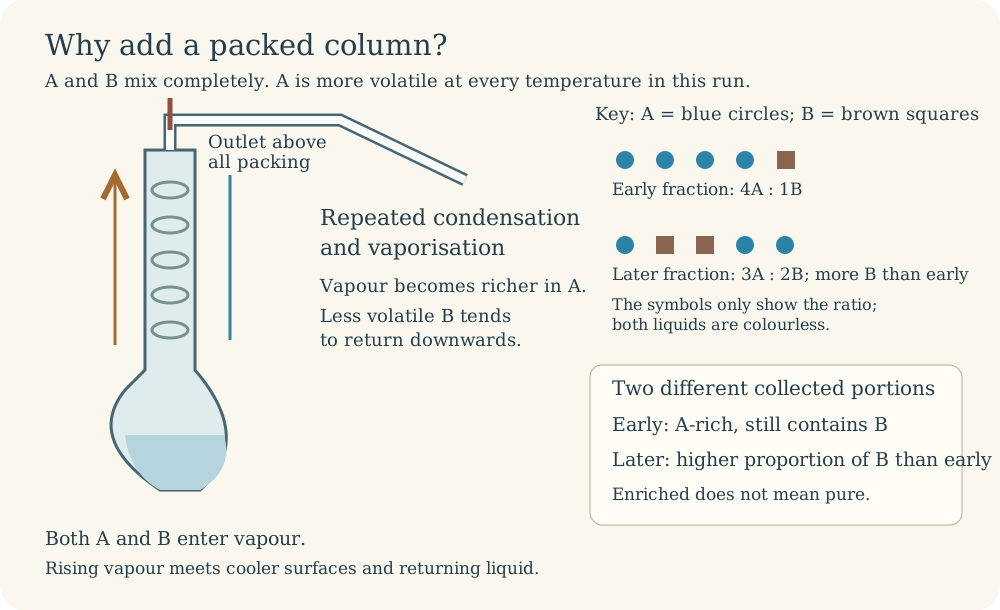
So how do you get vapour that's much richer in A? You give it more chances to separate. A fractionating column is a tall glass tube filled with glass beads, and it fits between the flask and the condenser. The beads are called the packing. As the hot vapour rises, it meets the cooler beads, and some of it condenses into liquid on them. More hot vapour rising from below heats that liquid, so part of it vaporises again.
Each time the vapour condenses or the liquid vaporises, the substance changes state. Chemists also call a change of state a phase change. B is less volatile, so it condenses more readily and tends to run back down towards the flask. A vaporises more readily, so it moves on up. After many of these phase changes, the vapour reaching the top is much richer in A than the vapour leaving the flask. We say the column enriches the rising vapour in A.
Trap: “The beads catch B, like a filter.” The beads don't trap any particles. Both A and B travel up the column as vapour and down it as liquid. The beads only give the vapour plenty of cool surfaces, so it can condense and vaporise again and again.
Before you look at the figure, predict where the condenser should connect: below the packing, or above it?
 (enlarge)
The sidearm, the outlet that leads from the head to the condenser, belongs above all of the packing. Then the vapour passes through the whole column, with all its chances to separate, before it leaves. A sidearm lower down would let vapour escape halfway up, so it would skip the rest of the column.
The thermometer bulb sits level with the sidearm, right in the path of the vapour that's leaving. There it measures the head-vapour temperature, as in part 1. If the bulb were in a corner where the vapour hardly moves (a stagnant space), or down in the flask, it would measure something else. As the vapour gets richer in B, the reading rises. That rise tells you about the vapour leaving the head. It doesn't tell you directly how much A is left in the flask.
So there are two kinds of distillation. Simple distillation has no column. It works well when only one substance can vaporise, like the water from salt solution in part 1. Fractional distillation adds a fractionating column. It separates miscible liquids that can both vaporise, and it matters most when their boiling points are close together. It separates them better, but it doesn't promise pure products.
Worked example
Richer is a comparison
A fraction is the portion of liquid you collect during one part of a run. Suppose an early fraction contains 8 units of A and 2 units of B, and a later fraction contains 6 units of A and 4 units of B. The units are made up, just for comparing, and the figure above shows the same ratios, 4 : 1 and 3 : 2. Which fraction is richer in B?
Compare each substance's share of the total, its proportion, not just the raw numbers. Both fractions hold 10 units in total. In the early fraction B is 2 out of 10, and in the later one B is 4 out of 10. So the later fraction is richer in B, and the early one is richer in A. “Richer” is always a comparison between samples. It describes their composition, which means the substances a sample contains and their proportions.
Neither fraction is pure. A pure substance contains only one substance, and both of these fractions contain A and B.
Trap: “A-rich means it contains the most A.” Composition and total amount are different things. A small A-rich fraction can contain less A altogether than a much larger fraction that is less rich in A.
Worked example
Keep the portions separate
In the experiment, the reading stays a few degrees above 65 °C while the A-rich vapour comes over. Then it starts to climb, which tells you the vapour now carries more B. If you kept collecting in the same beaker, that liquid would mix into your A-rich fraction. So you change the beaker, in this order:
- Collect the early fraction in the first receiver.
- Switch off the heat and let the last drops drain into that same receiver. Some vapour and liquid are still left in the column and the condenser, and this residual material keeps dripping for a while after the heat goes off. Those drops belong to the early fraction.
- Wait until the dripping stops and the glass is safe to handle. Then exchange the receiver: move the first one aside and put an empty one in its place.
- Switch the heat back on and collect the later fraction in the new receiver.
- Finally, switch off, let the apparatus drain and cool, and keep some liquid in the flask. Never heat it dry.
Pour both portions into one bottle, and you lose the difference you worked to get: the mixture ends up somewhere in between. And changing receivers doesn't change what's in the flask. It only changes where the next drops go.
Case closed
- Both liquids volatile and miscible? A fractionating column separates them better than simple apparatus.
- Repeated condensing and vaporising on the packing enriches the rising vapour in the more volatile liquid.
- Collect the early and later fractions in separate receivers. Compare their composition, without calling either one pure.
About this model
A and B are imaginary. A stays the more volatile liquid for the whole run, and the mixture has no azeotrope. An azeotrope is a mixture whose vapour has the same composition as the liquid, so distillation can't separate it any further. Some real mixtures have one, ethanol and water among them; we don't calculate that limit here. The amounts, the symbols, the thermometer readings and the stages are drawn to show the idea, not calculated from the two boiling points. Each heat-off step drains its last drops into the same receiver.