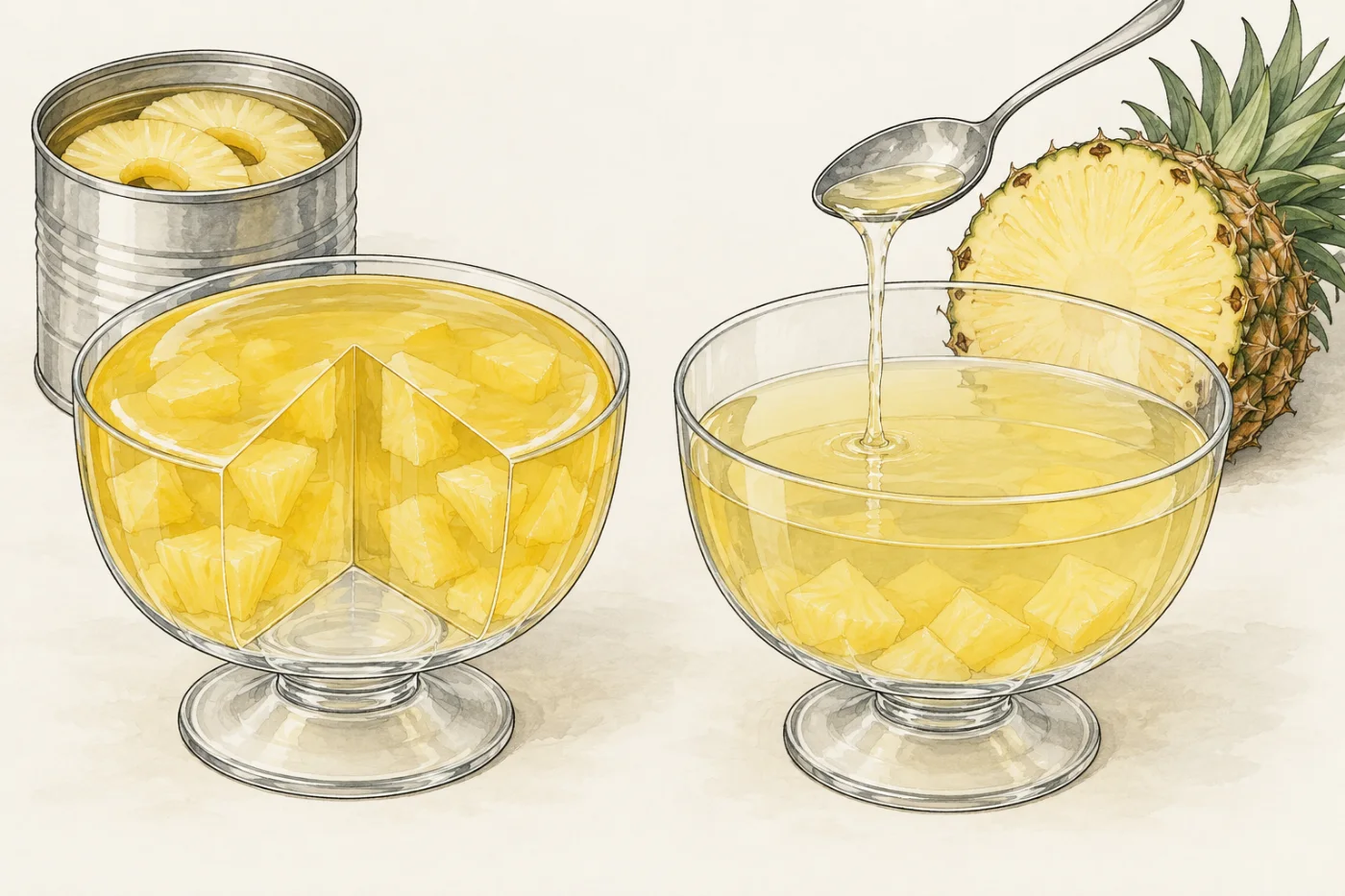
Make a fruit jelly with pieces of fresh pineapple and it never sets (becomes firm): you get a sweet, runny puddle. Make the same jelly with tinned pineapple and it sets firm. Jelly sets because of gelatine, a protein. Fresh pineapple contains a protease, an enzyme that breaks protein down. Tinned pineapple has been heated in the tin. What did the heat do to the enzyme? In this part you find out how temperature changes the rate of an enzyme reaction, and why too much heat stops it for good.
 (enlarge)
Timing amylase
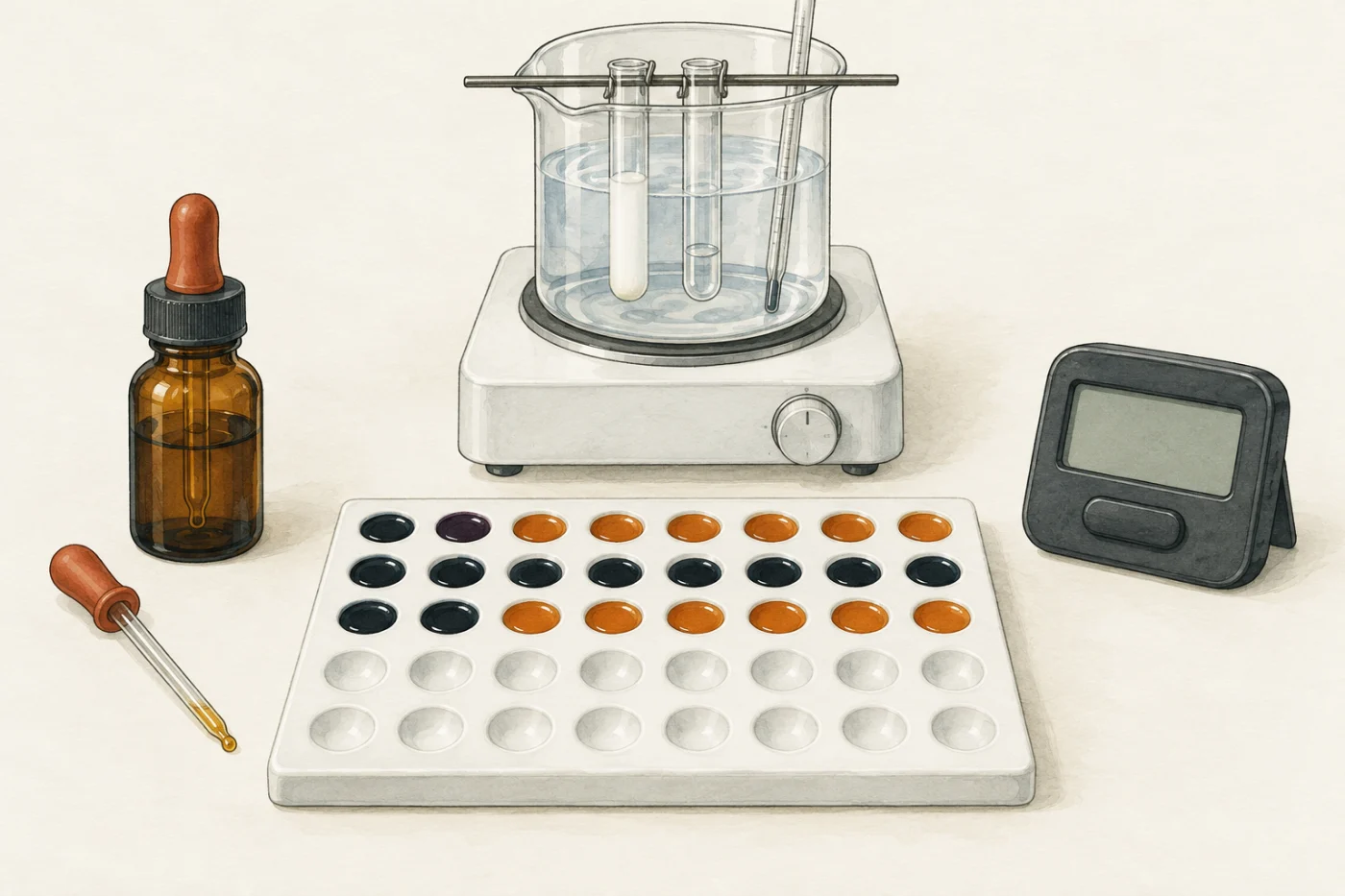
You can follow amylase breaking down starch with iodine solution. Iodine is orange-brown, and it turns blue-black when there is starch. Put one drop of iodine in each well (small hollow) of a white spotting tile. Mix amylase with starch and start a stop-clock. Every 30 seconds, take one drop of the mixture with a dropping pipette and let it fall onto the next well of iodine.
While there is plenty of starch, every drop turns the iodine blue-black. As the starch is broken down, the colour fades through purple and red-brown (with drops 30 seconds apart you may not see every shade). When a drop stays orange-brown, like iodine on its own, starch is no longer detected: this is the end point. The sooner the end point comes, the faster the reaction.
 (enlarge)
To compare temperatures, both tubes stand in a water bath at the chosen temperature for 5 minutes before they are mixed, so the reaction starts at that temperature. Predict first: at which temperature will the starch be gone soonest?
In this investigation:
- the independent variable, the one you change, is the temperature;
- the dependent variable, the one you measure, is the time to the end point;
- the controlled variables are kept the same: the volumes and concentrations of starch and amylase, the pH (the starch is made up in a pH 7 buffer), 5 minutes in the bath, and a drop every 30 seconds;
- a control tube of starch with water instead of amylase shows that without the enzyme the starch is not broken down: its drops stay blue-black.
The first drop that stays orange-brown gives the end-point time. The end point really happened somewhere in the 30 seconds before that drop, so sampling more often would make the time more precise.
A shorter time means a faster reaction, so the rate goes the opposite way to the time. That is why a rate is worked out as 1 ÷ time: halve the time and 1 ÷ time doubles. For an end point at 90 s, 1 ÷ 90 = 0.011 per second, which is small and awkward to compare and to plot. So every result is multiplied by the same number, 1000, and you work out a relative rate: 1000 ÷ time in seconds. The 1000 has no meaning of its own: it only turns 0.011 into 11.1, a number that is easy to read. Because every run is multiplied by the same 1000, a run that is twice as fast still gets a relative rate twice as big, so the comparison between temperatures does not change. For example, if the first orange-brown drop came at 90 s, the relative rate is 1000 ÷ 90 = 11.1; an end point at 45 s would give 1000 ÷ 45 = 22.2, twice as fast. If there is no end point within the 5 minutes you watched, the time is longer than 300 s, so the relative rate is less than 1000 ÷ 300 = 3.3. Record "no end point", not 0: some starch may still have been broken down, but not all of it.
One run is not enough
One run can give a wrong answer. A drop taken a few seconds late, or a tube that stood in the bath for too short a time, changes the result. So in a careful investigation you repeat each temperature, at least three times, and work out the mean (average) time. If three runs at 40 °C give 60 s, 60 s and 90 s, the 90 s run does not match the other two, so it is easy to spot: check the method and repeat that run. Leave a result out of the mean only if you find a reason for it in the method. If the new run gives 60 s, the mean is (60 + 60 + 60) ÷ 3 = 60 s. Results that come out close to each other when repeated are reliable. Sampling more often (for example every 10 seconds) is a different improvement: it makes each time more precise.
Faster, then nothing
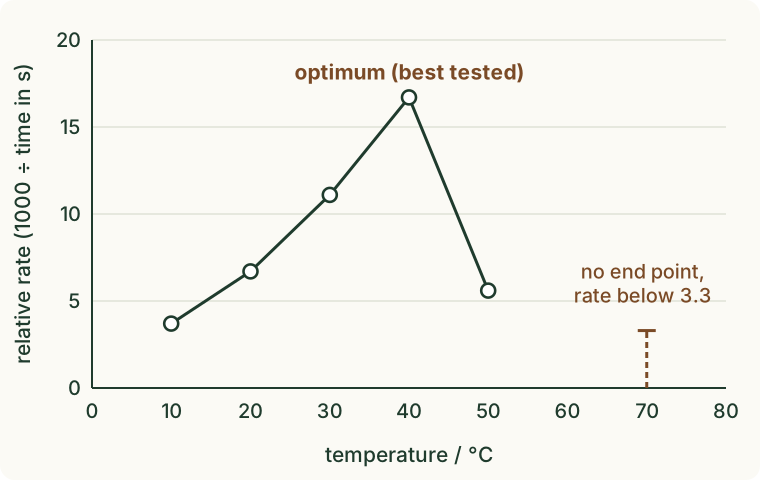
Here are simulated results for amylase, like those from the experiment above, with a relative rate for each temperature.
 (enlarge)
From 10 °C to 40 °C the rate rises steadily, from 3.7 to 16.7. The temperature with the highest rate is the optimum temperature. With these tested temperatures, the best is 40 °C; the true optimum lies somewhere near it, and testing 35 °C and 45 °C would narrow it down. Above the optimum the rate falls much faster than it rose: at 50 °C it is lower than at 30 °C. At 70 °C there is no end point, and the drops never even fade: every drop turns the iodine blue-black, so no breakdown of starch was detected in 5 minutes.
Trap: "Enzymes always work faster when it is hotter." Only up to the optimum. Above it the rate falls quickly, and very hot enzymes stop working altogether.
Why the rate rises
Molecules in a solution are always moving and colliding. The warmer the solution, the more kinetic energy the enzyme and substrate molecules have, so they move faster and collide more often. A collision where the substrate meets the active site and fits, forming an enzyme–substrate complex, is an effective collision. More effective collisions every second means more complexes, more products and a faster reaction. (You may meet the same idea about collisions and temperature in Chemistry.)
Why the rate falls: denaturation
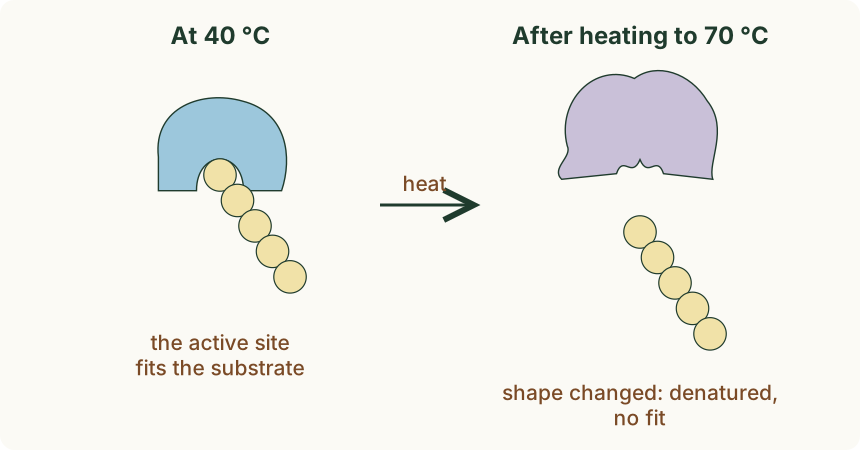
The shape of an enzyme, and of its active site, is held by bonds within the folded protein. As the temperature rises above the optimum, the molecule vibrates so much that some of these bonds break and the protein unfolds a little. The active site changes shape. The substrate no longer fits, so fewer enzyme–substrate complexes form and the rate drops. When the active site has lost its shape for good, the enzyme is denatured. At 70 °C all the amylase was denatured during its 5 minutes in the bath, before it was even mixed with the starch.
 (enlarge)
Denaturation does not undo itself: cool a denatured enzyme and it stays denatured. Cold is different. At 10 °C amylase works slowly because the molecules move slowly and collide less often, but its active site keeps its shape, so it works faster again as soon as it warms up.
Trap: "The heat killed the enzyme." Enzymes are not alive, so they cannot be killed. Heat changes the shape of the active site: the enzyme is denatured.
Trap: "Cold denatures enzymes." Cold only slows them down. Their shape is not changed, and they work again when warmed.
Back to the pineapple
The protease in fresh pineapple breaks down the gelatine, so the jelly cannot set. The tinned pineapple was heated well above the optimum of its protease, which was denatured, and denatured enzymes stay denatured: the jelly sets.
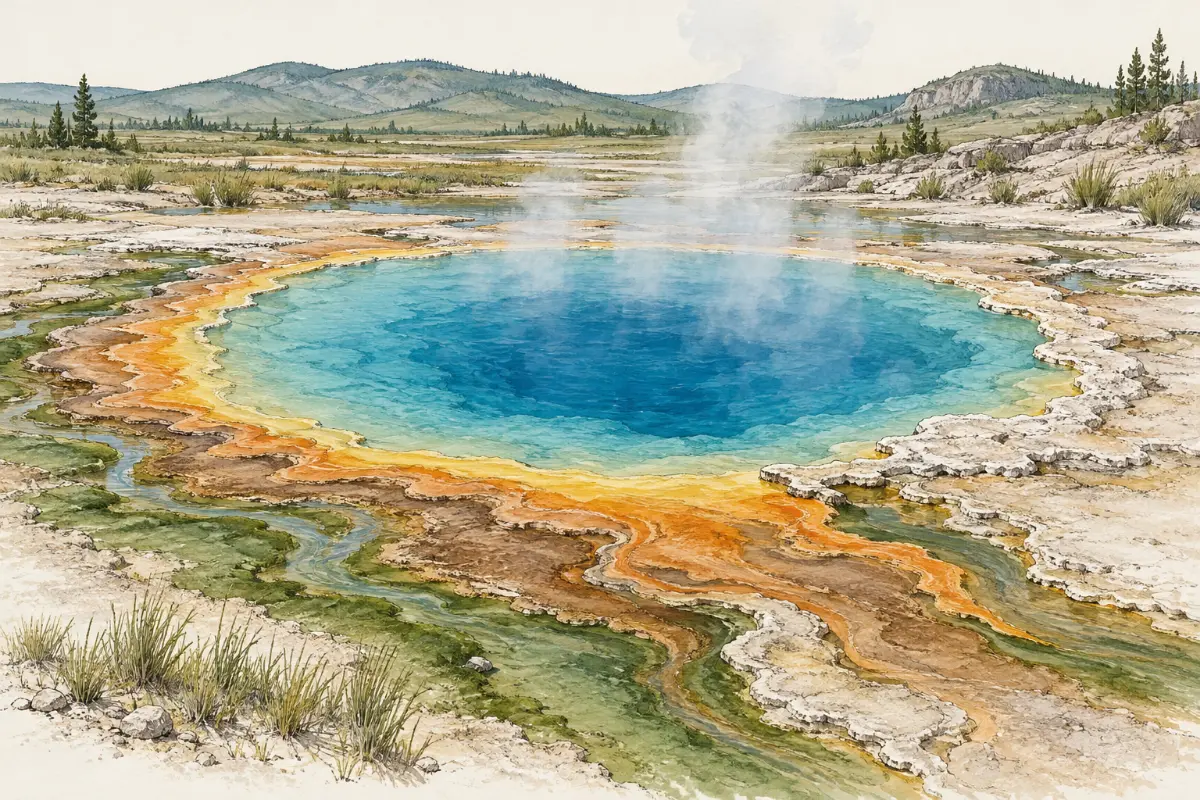
Not every enzyme has an optimum near 40 °C. Your body is at about 37 °C, and most human enzymes work best near that. Bacteria that live in hot springs make enzymes with optimum temperatures of 70 °C or more, whose active sites keep their shape at temperatures that would denature amylase.
 (enlarge)
Key idea: As temperature rises, enzyme and substrate molecules gain kinetic energy and have more effective collisions, so the rate increases up to the optimum temperature. Above the optimum the active site changes shape, the substrate no longer fits, and the enzyme is denatured.