Scope and sources
Cambridge IGCSE Biology 0610 · 2026–2028 v3 · Original learning materials.
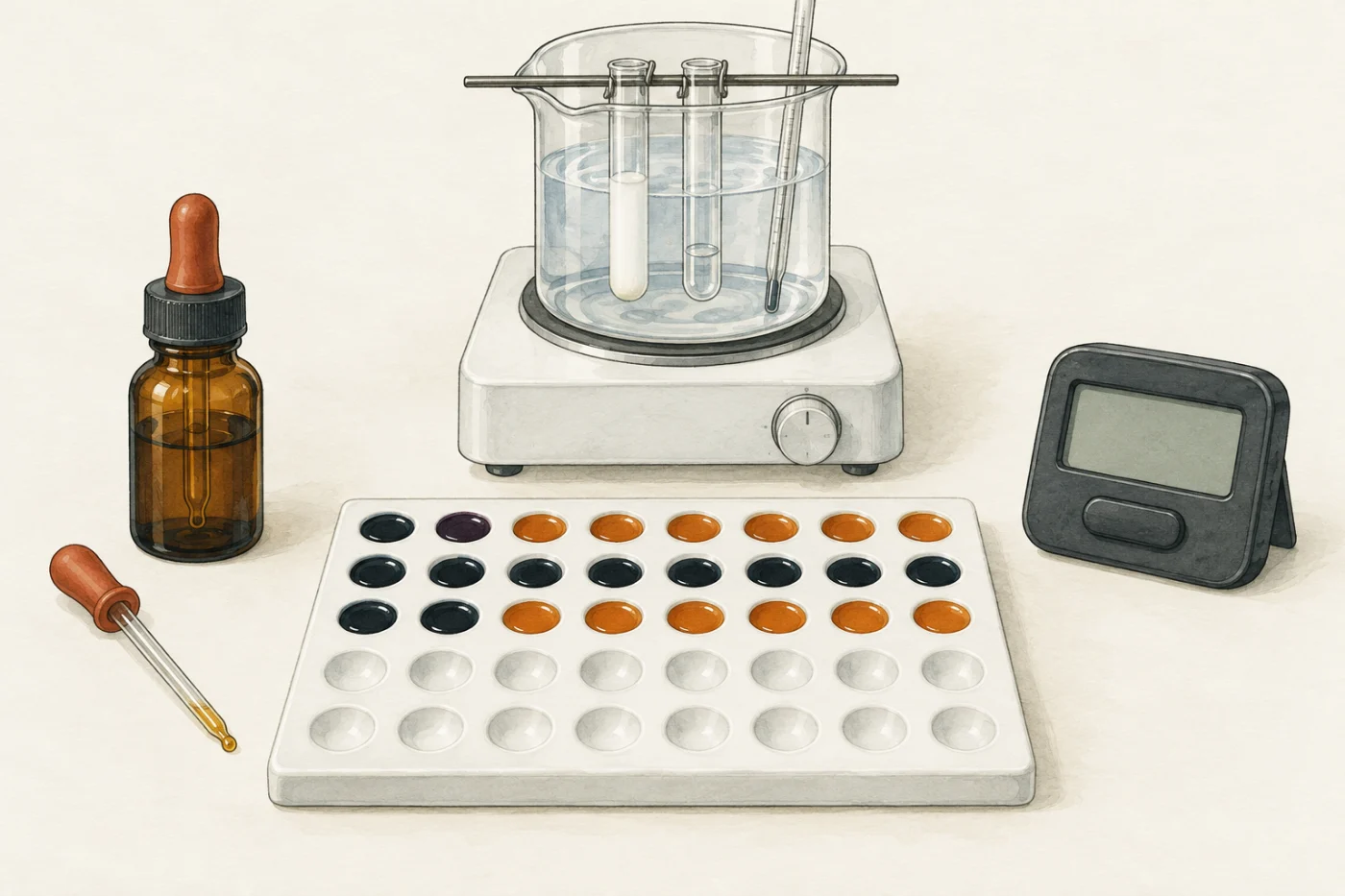
Catalysts (5.1.1); enzymes as proteins and biological catalysts in all metabolic reactions (5.1.2); why life needs enzymes (5.1.3); the active site, substrate and products (5.1.4, Supplement 5.1.6 with the enzyme–substrate complex) and specificity (Supplement 5.1.7) in the reading and practice; the effect of temperature and pH on amylase with optimum and denaturation (5.1.5) through the starch–iodine practical, explained by kinetic energy, effective collisions, shape and fit (Supplement 5.1.8, 5.1.9). Times in the experiment come from a teaching model.
Apparatus, amounts and times in the experiment are illustrative. Real practical work follows a teacher-approved safety method.
Official Cambridge syllabus