Chew a plain cracker slowly, for a minute or two, without swallowing. It starts to taste a little sweet. The cracker is mostly starch, which does not taste sweet at all, so something in your mouth is turning starch into sugar. That something is in your saliva, it works in seconds, and it comes out of the reaction exactly as it went in. This module is about these remarkable molecules: what they do, why life depends on them, and why heat and acid can stop them.
Speeding up a reaction
Starch is a long chain of glucose units joined together. Mix starch with water in a test tube and leave it: days later it is still starch. The reaction that breaks it down into the sugar maltose is possible, but at room temperature it is far too slow to notice. Add a few drops of saliva and the starch is gone in a few minutes.
Saliva contains amylase. Amylase makes the reaction go much faster, and at the end of the reaction the amylase is still there, unchanged, ready to break down more starch. A substance that does this is a catalyst: a substance that increases the rate of a chemical reaction and is not changed by the reaction.
Trap: "A catalyst is used up in the reaction." A catalyst is not changed by the reaction, so the same molecule can be used again and again. That is why a small amount of amylase can break down a lot of starch.
Enzymes: the catalysts of life
Amylase is an enzyme. Enzymes are proteins that work as biological catalysts: catalysts made by living cells. All the chemical reactions in a living thing, building large molecules up or breaking them down, are called metabolic reactions. Enzymes are involved in all of them: respiration in every cell, building proteins, digestion and many more. Each cell makes thousands of different enzymes.
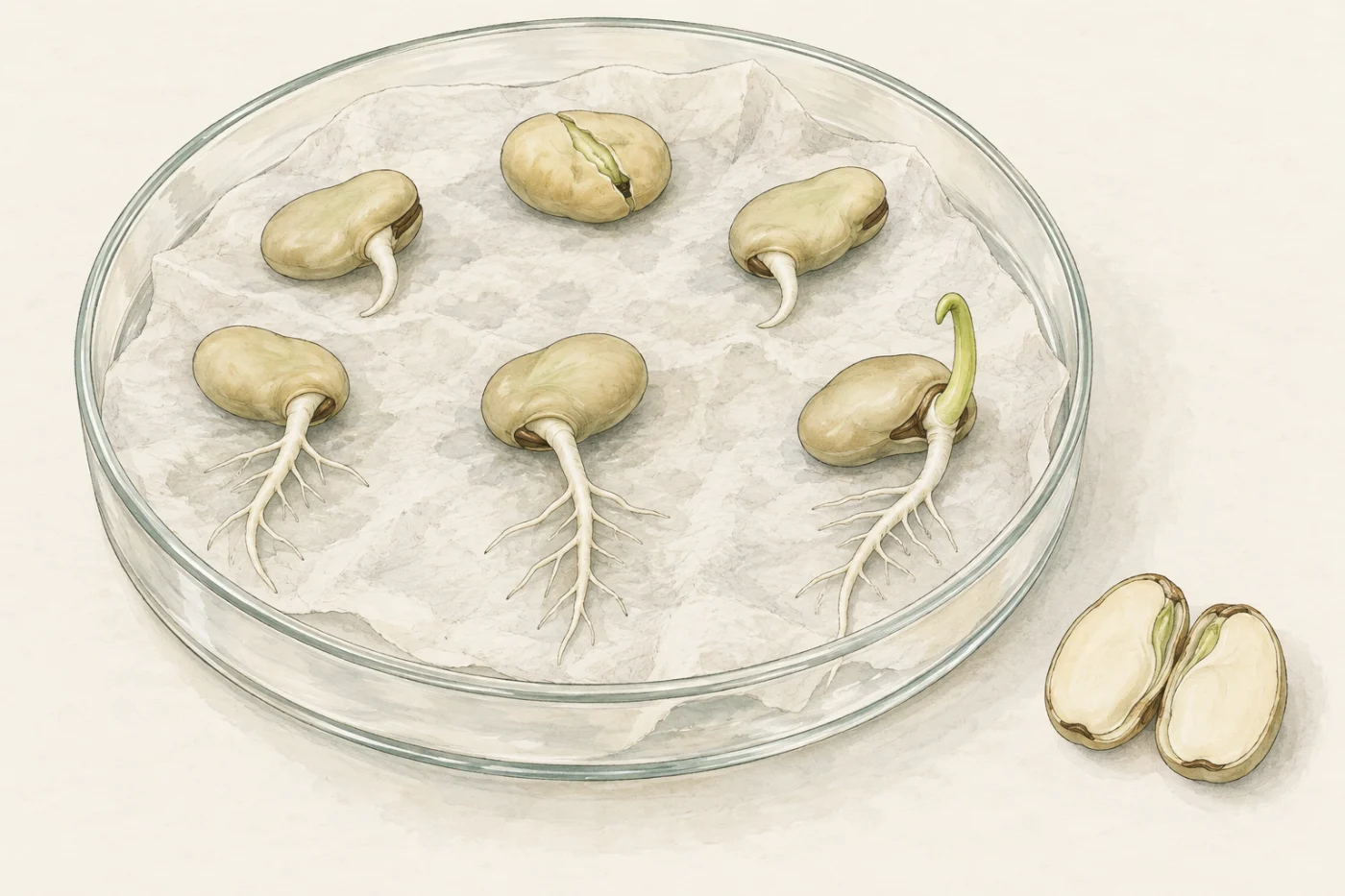
Why does life need them? Living things cannot heat themselves to hundreds of degrees to make reactions go faster, and they cannot wait for days. A seed that has just taken in water must break down its stored starch into sugar quickly, to release energy for the growing root and shoot. Without enzymes, the reactions of digestion, respiration and growth would happen far too slowly to keep an organism alive. Enzymes give these reactions the rate needed to sustain life.
 (enlarge)
Trap: "Enzymes are alive." Enzymes are protein molecules made by living cells. They are not living things, so they cannot be killed, but their shape can be damaged.
The active site
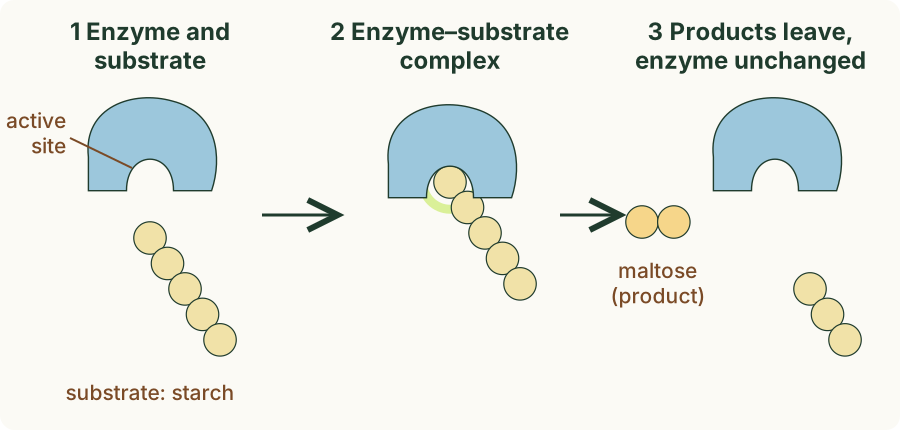
An enzyme molecule is folded into a particular shape. One small part of its surface is a dent called the active site. The molecule the enzyme acts on is its substrate. The active site has a shape that is complementary to the substrate: the substrate fits into it, as a key fits into a lock. While the substrate is held there, the reaction happens, and the new molecules made are the products.
For amylase, the substrate is starch and the product is maltose (two glucose units joined together). The products leave the active site, and the enzyme, unchanged, can take the next substrate molecule.
 (enlarge)
While the substrate is fitted into the active site, the enzyme and substrate together are called an enzyme–substrate complex. So enzyme action is a cycle: enzyme + substrate → enzyme–substrate complex → enzyme + products. The enzyme comes out unchanged, which is exactly what a catalyst does.
Trap: "The substrate has the active site." The active site is part of the enzyme. The substrate is the molecule that fits into it.
One enzyme, one job
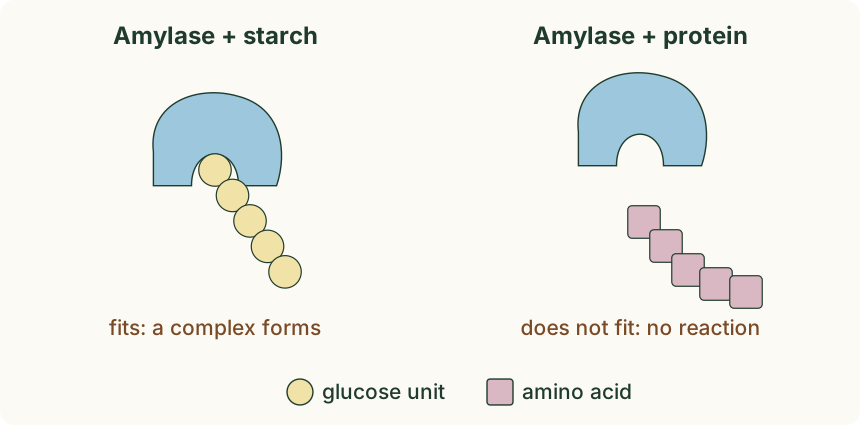
Amylase breaks down starch, but it does nothing to protein or fat. Another enzyme, a protease, breaks down protein, but not starch. Each enzyme is specific: it acts on only one substrate, or a few very similar ones. The reason is the shape of the active site. Only a substrate with a complementary shape fits into it and forms an enzyme–substrate complex; a molecule of another shape does not fit, so it is not changed.
 (enlarge)
That is why a cell needs so many enzymes: one for each reaction. The lock-and-key picture is a model. Real enzymes are not rigid locks. Their active site is part of the protein's own folded chain, so heat and acid can change its shape, as you will see next.
Key idea: A catalyst speeds up a reaction and is not changed by it. Enzymes are proteins that catalyse the reactions of life fast enough to keep organisms alive. The substrate fits an active site of complementary shape, forming an enzyme–substrate complex; the products leave and the enzyme is used again. Each enzyme is specific to its substrate.