When you swallow a mouthful of bread, the amylase from your saliva goes down with it. For a while it keeps breaking starch down. Then the food reaches the stomach, where the contents are strongly acidic, and the amylase stops working. Yet the stomach makes a protease of its own that works best in exactly that acid. Why does acid stop one enzyme and suit another? In this part you test amylase at different pH values and look at what pH does to the active site.
Keeping the pH steady
The pH scale measures how acidic or alkaline a solution is: below 7 is acidic, 7 is neutral and above 7 is alkaline (you meet the pH scale in Chemistry too). To test the effect of pH on an enzyme, the starch is made up in water and each tube of starch gets the same volume of a buffer solution before the amylase is added. A buffer keeps the pH at one value even when other substances are added, so the pH stays the same for the whole run.
Only the pH may change between the runs. Everything else is kept the same: the volumes and concentrations of starch and amylase, the time in the water bath and the temperature. The temperature is set to one value for all three runs, 40 °C, the best of the temperatures tested: if the temperature changed as well, you could not tell which of the two caused a difference.
Amylase at three pH values
The method is the one you used for temperature: amylase and starch, sampled onto iodine every 30 seconds until a drop stays orange-brown. The results at 40 °C:
| Buffer | End point | Relative rate (1000 ÷ time in s) |
|---|---|---|
| pH 4 | none within 5 minutes | below 3.3 (not measured) |
| pH 7 | 60 s | 16.7 |
| pH 9 | 180 s | 5.6 |
Of the three buffers, amylase worked fastest at pH 7. The pH at which an enzyme works fastest is its optimum pH. As with temperature, three runs give only the best tested pH; more buffers between 4 and 9 would show the optimum more exactly. At pH 9 amylase still reached an end point, only more slowly. At pH 4 the drops faded only to red-brown in 5 minutes: the reaction was happening, but very slowly. With just these three values you can say that pH 7 was best and pH 4 slowest, but not exactly where the optimum is or what shape the whole curve has.
Shape and fit again
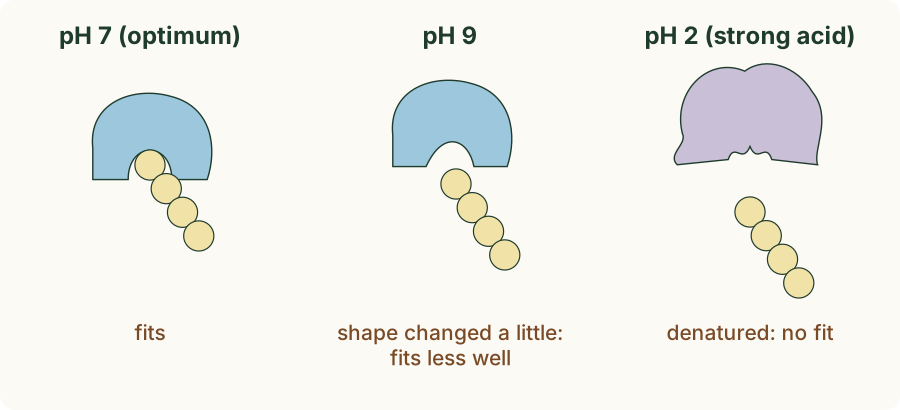
The folded shape of an enzyme is held by bonds between parts of the protein chain, and some of these bonds are affected by the pH (how acidic or alkaline the solution is). Away from the optimum pH, some of these bonds change and the active site changes shape. The substrate fits less well, so fewer enzyme–substrate complexes form and the rate falls. Far enough from the optimum, the active site loses its shape completely: the enzyme is denatured, exactly as by heat, and the substrate no longer fits at all.
 (enlarge)
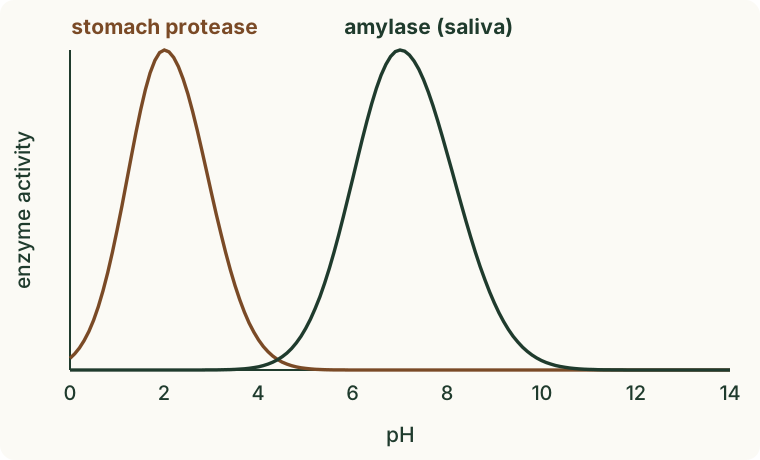
Trap: "Every enzyme works best at pH 7." Each enzyme has its own optimum pH, matched to where it works. Amylase from saliva works best near neutral; a protease from the stomach works best in strong acid.
Different enzymes, different places
The graph compares amylase with a protease from the stomach. Each curve has its own peak.
 (enlarge)
So when amylase reaches the acid of the stomach, its active site loses its shape and it stops breaking down starch. The stomach protease, whose active site keeps its shape in strong acid, takes over the digestion of protein there. (Where each digestive enzyme works, and how pH changes along the gut, is the topic of a later module on digestion.)
Another enzyme, another measurement
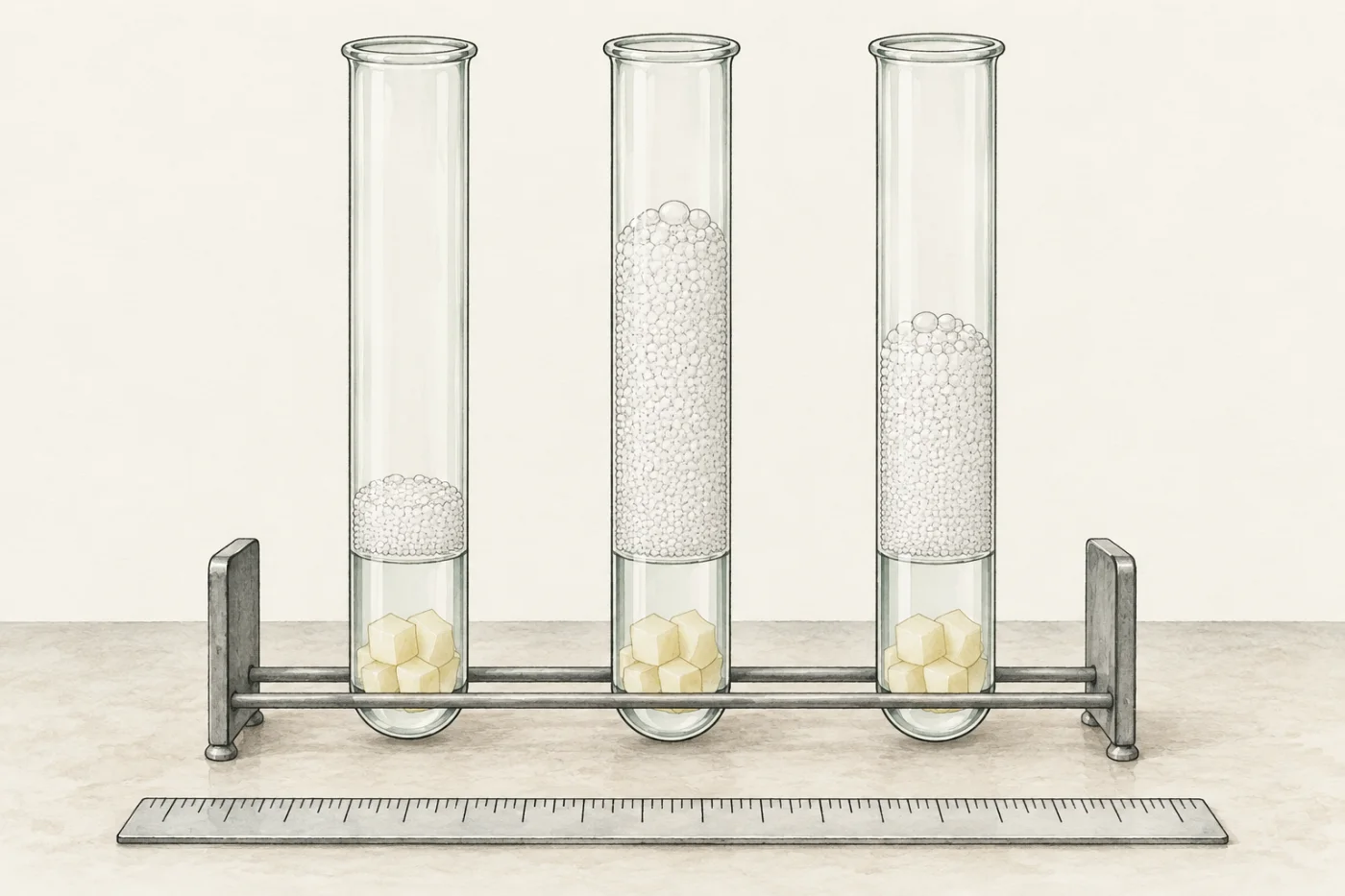
Not every enzyme is followed with iodine. Many plant and animal cells contain catalase, an enzyme that breaks down hydrogen peroxide, a harmful substance made in cells, into water and oxygen. Add small pieces of potato to hydrogen peroxide and the oxygen makes a foam; the faster the reaction, the higher the foam rises in a fixed time. That gives another way to compare pH values or temperatures, as long as the same mass of potato, the same volume of hydrogen peroxide and the same time are used.
 (enlarge)
Safety: Hydrogen peroxide solution irritates the skin and eyes: wear eye protection, and use only the dilute solution your teacher gives you.
Key idea: Each enzyme has an optimum pH. Away from it, the active site changes shape, the substrate fits less well and fewer enzyme–substrate complexes form, so the rate falls. At an extreme pH the enzyme is denatured. To test the effect of pH, change only the pH, using buffers, and keep the temperature and everything else the same.