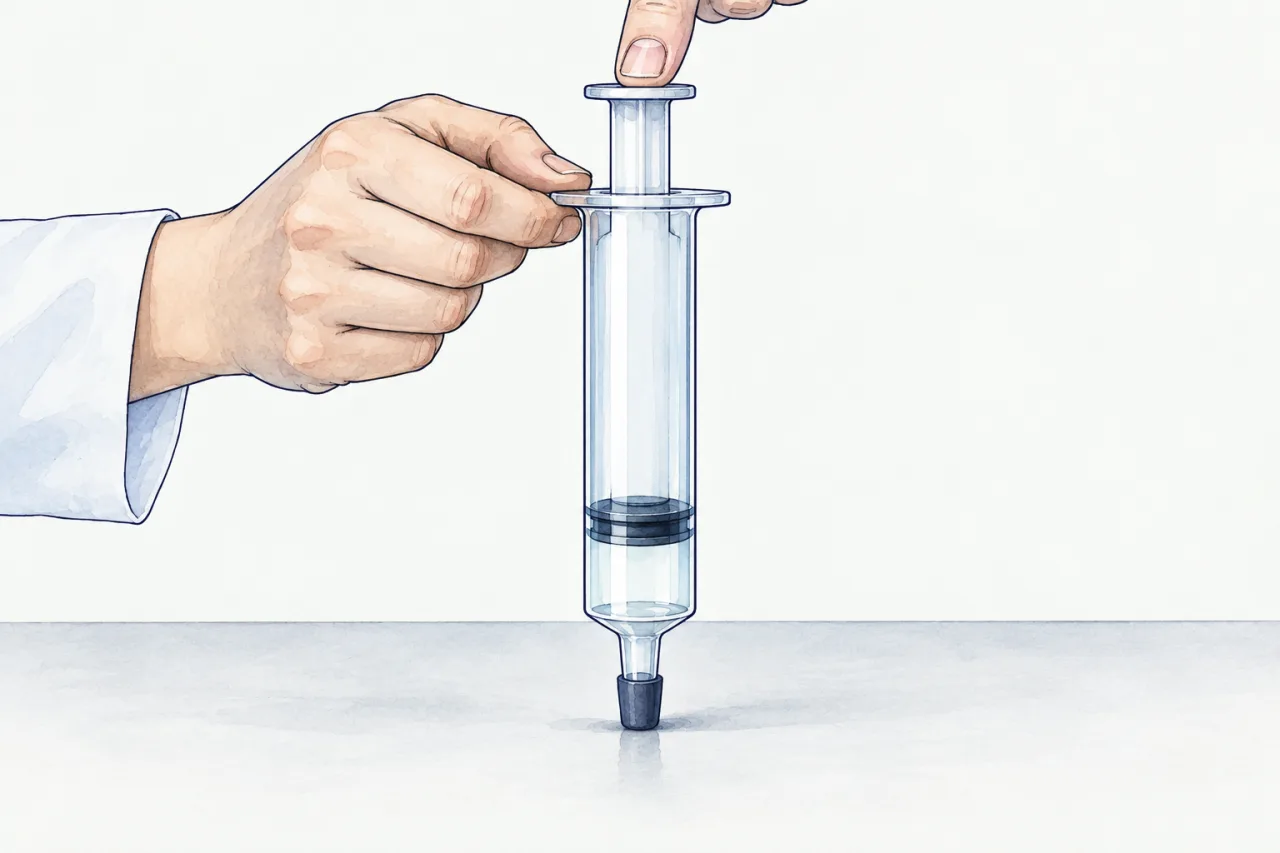
Seal the end of a syringe with a cap, or your finger, and push the plunger. It slides in a little way, then pushes back against your thumb. Let go, and it springs back out. Fill the same syringe with water, and the plunger won't budge. So what is the trapped air doing? In this part you'll squeeze one sealed sample of air, step by step, and find out how its volume depends on how hard you push. Then you'll explain the pattern with particles.
 (enlarge)
Gas particles push
A gas spreads out to fill any closed container. Its particles are far apart, arranged randomly and moving quickly in all directions: at room temperature, air particles travel at about 500 metres per second. This picture of substances as particles that are always moving is called kinetic particle theory (“kinetic” means to do with movement). In a liquid such as water, the particles are already touching, so there's almost no space to squeeze out. That's why the syringe full of water won't budge.
A gas particle moves in a straight line until it hits something: another particle, or a wall of its container. Every hit on a wall gives the wall a tiny push. Each bit of the wall is hit an enormous number of times every second, and together the hits make a steady push. How hard something pushes on each bit of a surface is called pressure. You won't measure it here: more pressure just means more pushing.
The air around us, the atmosphere, pushes on everything it touches.
The gas syringe
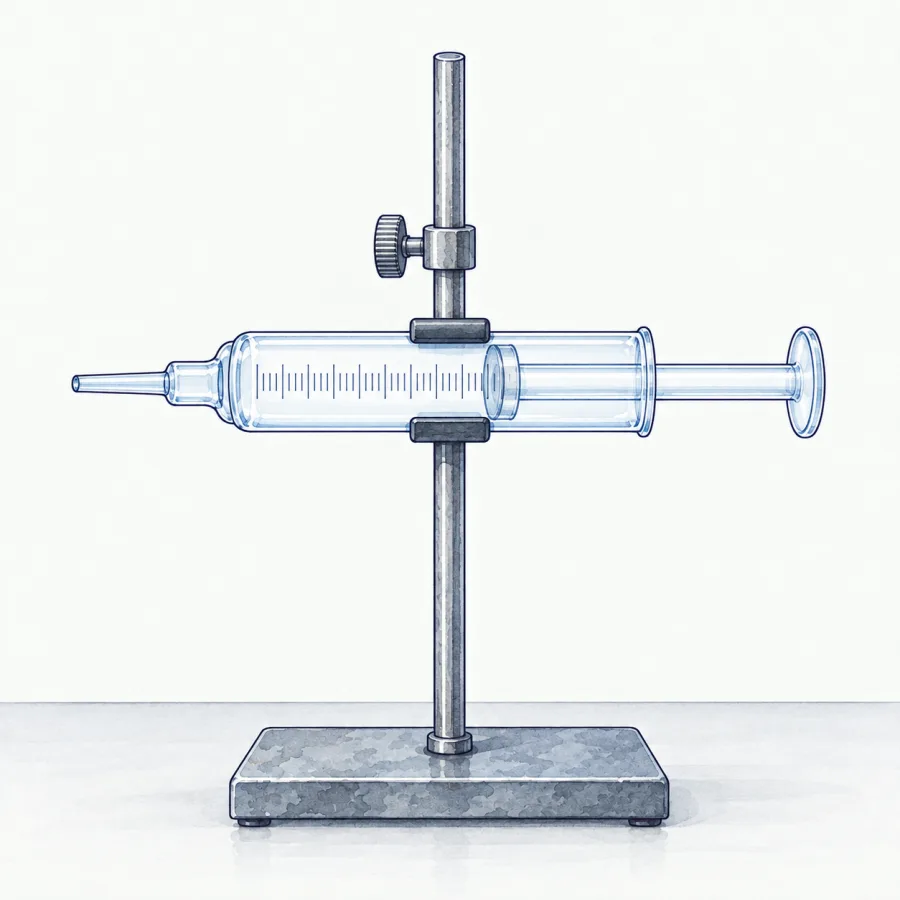
A gas syringe is a glass tube, the barrel, with a plunger that slides in and out. Marks along the barrel measure the volume of the gas inside: how much space it takes up, in cubic centimetres (cm³).
 (enlarge)
In the experiment, the syringe stands upright in a water bath, and a rubber cap seals its nozzle, so no air can get in or out. The amount of air stays the same all the time: the same particles, however much you squeeze them. The water reaches above the plunger seal, so all the trapped air takes the temperature of the water.
Even with nothing on it, the plunger is pushed from both sides. The atmosphere pushes down from outside; the trapped air pushes up from inside. The plunger stays still where the two pushes are equal. At the start, that leaves 50 cm³ of air.
Squeeze it
Each disc weight on the plunger pushes harder on the trapped air: it increases the pressure. To see what pressure alone does, change only the pressure; anything else that could change the volume must stay the same. Changing one thing at a time like this is a fair test. Warming or cooling a gas also changes its volume (you'll test that in part 2). The experiment asks you what must stay the same before you add the weights.
Predict first. What will happen to the volume with one weight? With three? Will each weight squash the air by the same amount?
After each weight, how much does the volume drop? Watch the particles in the magnified view too.
More pushing, less space
| Weights on the plunger | Volume / cm³ |
|---|---|
| none (start) | 50 |
| 1 | 33 |
| 2 | 25 |
| 3 | 20 |
| none (weights off again) | 50 |
The bath stayed at 20 °C and the cap kept the same air inside, so only the pressure changed.
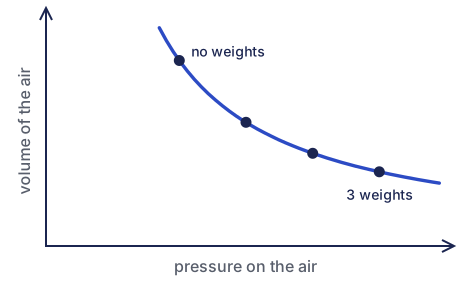
Every weight made the air take up less space. For a fixed amount of gas at constant temperature (the temperature kept the same), increasing the pressure decreases the volume. Decreasing the pressure increases it: with the weights off again, the plunger was back at 50 cm³.
Did you predict equal steps? The first weight squashed the air by 17 cm³, the second by 8 cm³ and the third by only 5 cm³. Each weight adds the same extra push. But the push of the air grows faster and faster as its space shrinks: half the space means twice as many hits. So a smaller and smaller squeeze is enough to balance each extra weight, and on a graph the readings fall along a curve, not a straight line.
 (enlarge)
Key idea: For a fixed amount of gas at constant temperature, more pressure means a smaller volume, and less pressure means a larger volume.
Inside: the same particles, less space
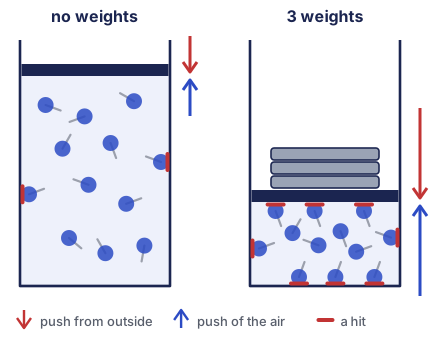
The magnified view always shows the same 12 particles, because none can get in or out. When they're squeezed, are they any smaller? Any slower?
They aren't. The temperature didn't change, so the particles move just as fast on average, and each one is the same size as before. What changes is the space they have. With three weights, the same particles have less than half the space.
Follow one particle. In a smaller space it reaches a wall sooner, bounces off and soon reaches another wall. So every particle hits the walls more often. These hits are called collisions. Each collision is just as hard as before, but there are more collisions every second, so the air pushes harder on the walls and on the plunger: the pressure of the gas is higher.
 (enlarge)
Trap: “Squeezing a gas makes its particles smaller.” The particles stay the same size. Only the empty space between them gets smaller.
Trap: “Crowded particles slow down.” At the same temperature they move just as fast on average. They hit the walls more often because they have less space to cross between hits.
Why the plunger stops
Why doesn't one weight push the plunger all the way to the bottom? Follow the pushes.
The moment you add a weight, the push from outside (the atmosphere plus the weights) is bigger than the push of the air. So the plunger moves in. As it does, the particles have less space and collide with the plunger more often, so the push of the air grows. The plunger stops when the two pushes balance: the air pushes up exactly as hard as the outside pushes down.
Take a weight off and it runs the other way. The air now pushes harder than the outside, so the plunger moves out until the pushes balance again, at a larger volume.
Worked example
Reading the squeeze results
Use the table. Describe how the volume changed, say what was kept the same, and explain how you know that no air leaked out.
Each weight made the volume smaller: 50, then 33, 25 and 20 cm³, with each extra weight squashing the air by less than the one before. The temperature (20 °C) and the amount of air were kept the same, so only the pressure changed.
With the weights off again, the reading was 50 cm³. The same amount of air, at the same temperature and pressure, takes up the same space as before. If any air had leaked out, fewer particles would be left, and the plunger would have come back lower.
Worked example
The crisp packet on the mountain
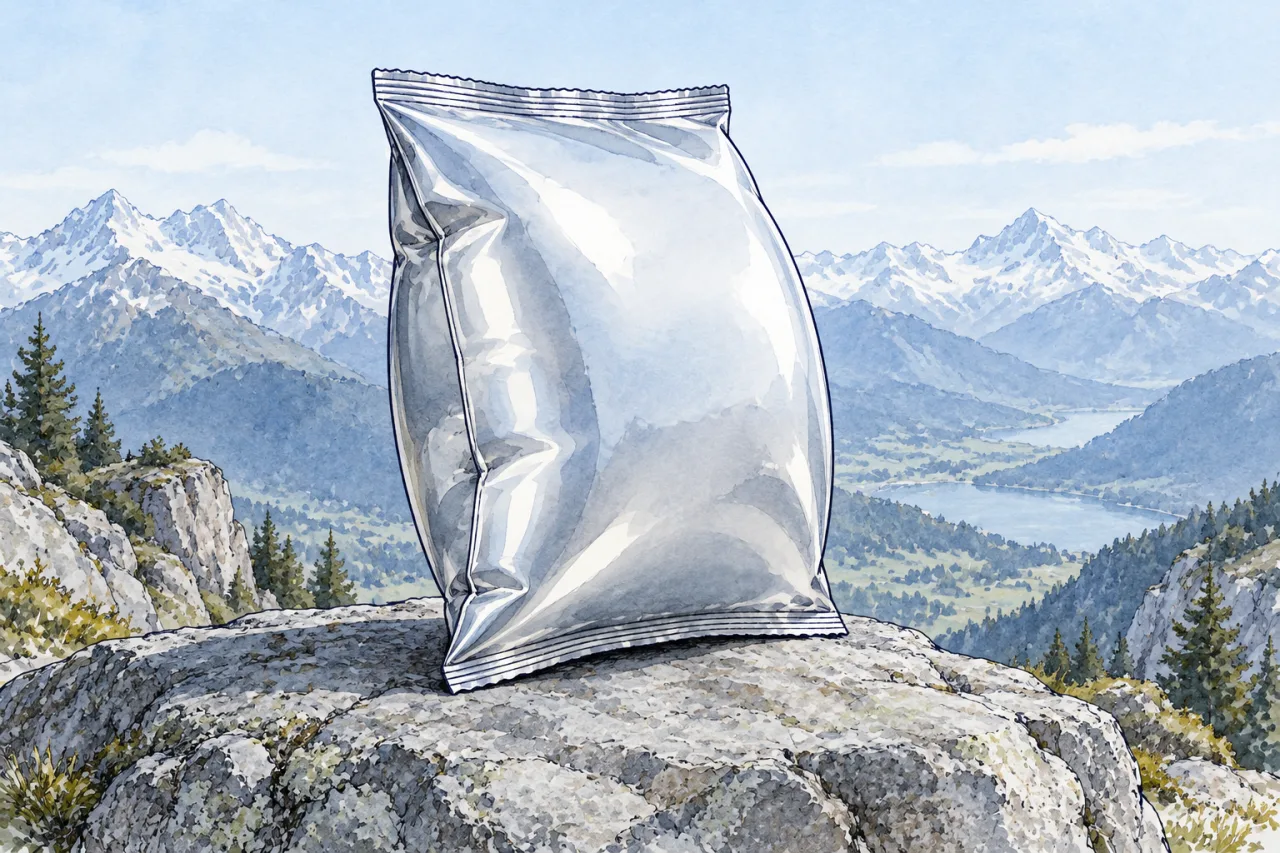
A sealed packet of crisps, bought in a valley, is carried up a high mountain. At the top it has swollen tight, although nobody has opened it. Why?
 (enlarge)
The packet holds a fixed amount of air. High up, there's less air above you, so the atmosphere pushes less: it's like taking weights off the plunger. The air inside now pushes outwards harder than the atmosphere pushes in, so the packet swells. As it swells, the same particles have more space and hit the inside of the packet less often. It stops swelling when the pushes balance, with the foil stretched tight.
It's usually colder up there too, which on its own would shrink the air a little; the drop in pressure has the much bigger effect.
Case closed
To describe what pressure does, say what changed, what was kept the same and what happened to the volume. To explain it, follow the particles: less space, more collisions with the walls, a bigger push from the gas, until the pushes balance.
About this model
The experiment treats air as an ideal gas in a perfectly sealed, frictionless syringe. Each disc weight adds a push equal to half the push of the atmosphere; real ones would weigh several kilograms. The readings are simulated and already settled: a quick squeeze briefly warms real air. The magnified view shows 12 particles, much larger and slower than real ones.