On a sunny afternoon at the beach, the dry sand can be too hot to stand on, while the sea a few steps away is still cool enough to make you gasp. The sand and the sea have had the same sunshine all day. So why has one got so much hotter than the other? Part of the answer is a property of each material: how much energy it takes to warm it up. In this part you heat a block of aluminium, measure the energy it takes, and meet a number that compares materials fairly: the specific heat capacity. The next part measures it for water and answers the module question: why does water take so long to heat up?
 (enlarge)
What heating does
The temperature of an object tells you how hot it is. It is measured with a thermometer, in degrees Celsius (°C). When you heat something, from a flame, a heater or the Sun, you transfer energy to it. That energy does not vanish: it is stored inside the object, by its particles.
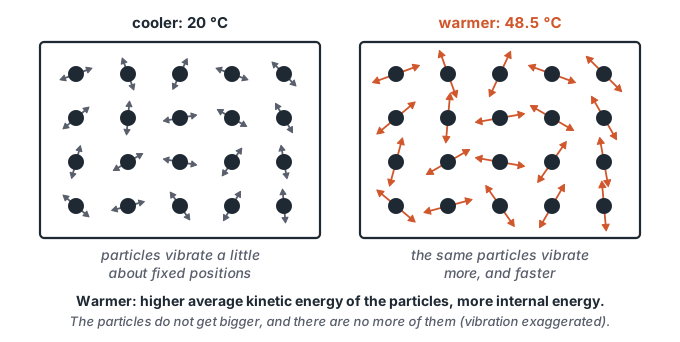
Everything is made of particles: atoms or molecules. In a solid such as aluminium, the particles are packed closely in fixed positions, held there by strong forces. They cannot move from place to place, but they vibrate: each one moves quickly back and forth about its fixed position. The energy stored by all the particles of an object, in their motion and in the forces between them, is called its internal energy. In this module you need one fact about it: when the temperature of an object rises, its internal energy increases. When the object cools, its internal energy decreases again.
What changes in the particles? Anything that moves has kinetic energy, energy because it is moving: the faster it moves, the more kinetic energy it has. As a block warms, its particles vibrate faster. At any moment some particles move faster than others, so we use the average: add up the kinetic energies of all the particles and divide by the number of particles. A rise in temperature means an increase in the average kinetic energy of all the particles in the object. A thermometer reading is, in effect, a measure of that average.
 (enlarge)
Trap: “Temperature and energy are the same thing.” The temperature tells you how fast the particles move on average; the internal energy belongs to all of them together. A bath of water at 40 °C is cooler than a cup of tea at 80 °C, yet it took far more energy to warm the bath from the cold tap, even though its temperature rose less. The bath holds hundreds of times as much water, so far more particles had to speed up.
Worked example
A block warms up
A 1.00 kg block of aluminium is heated from 20 °C to 48.5 °C. State what happens to its internal energy, and describe, in terms of its particles, what has changed and what has not.
The temperature of the block has risen, so its internal energy has increased: the energy supplied by the heater is now stored in the block. The particles of aluminium still vibrate about fixed places in the same regular pattern, but they vibrate faster than before, so the average kinetic energy of all the particles in the block is higher. What has not changed: the number of particles and their size. (The block also expands very slightly, so the particles end up a tiny bit further apart, but that is not what the rise in temperature means.) The block has not gained any particles or any mass; its particles are simply moving faster.
Counting the energy: the joulemeter
Energy is measured in joules (J). One joule is a small amount: lifting an apple by one metre takes about 1 J. So the energies in this module are often given in kilojoules: 1 kJ = 1000 J.
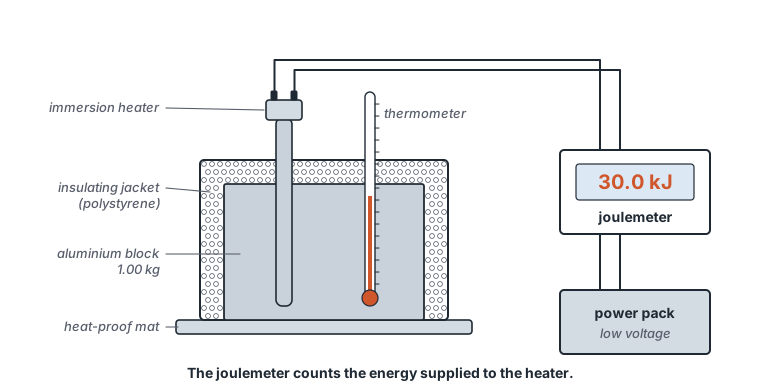
In the experiment the energy comes from an electric immersion heater: a steel tube with a heating wire inside, made to sit in a hole in a block or to stand in a liquid. The heater is connected to a low-voltage power pack through a joulemeter, a meter that counts the energy supplied to the heater, in kilojoules, as it flows. It works like the meter on a petrol pump, which counts the litres. You set it to zero before you start, and it then shows the total energy supplied so far. In this experiment the heater supplies energy at a steady rate, 3.0 kJ every minute, so a 10-minute run supplies 30.0 kJ.
In a later module you will calculate electrical energy from the voltage, the current and the time. Here you do not need to: the joulemeter counts the energy for you. The calculation that follows assumes that all the energy it counts goes into the block. The experiment shows how far that is true.
Heat the block and measure
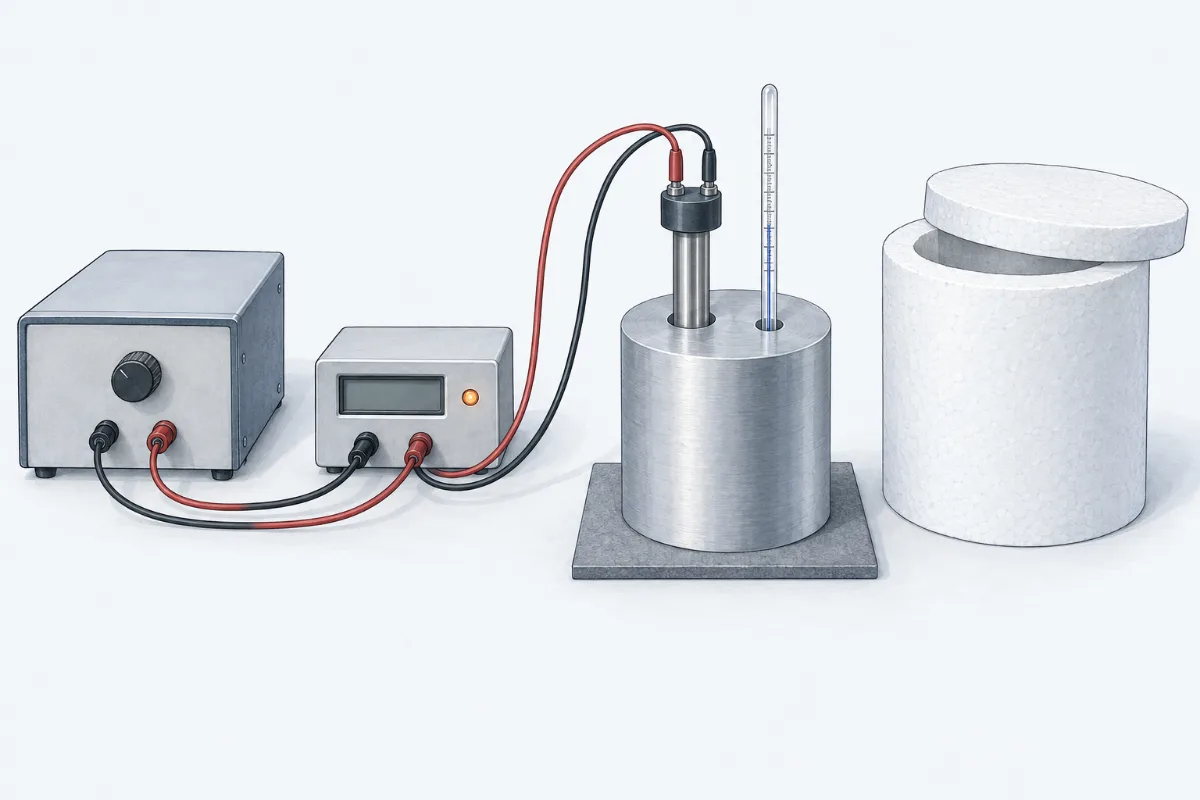
What is on the bench. A 1.00 kg block of aluminium with two holes drilled in it stands on a heat-proof mat. An immersion heater fits one hole and a thermometer the other. Leads join the heater to the joulemeter, and the joulemeter to a low-voltage power pack. A balance, a spare block and an insulating jacket wait at the side, and a magnifier can show a model of the particles in the block. Everything, the blocks included, starts at room temperature, 20.0 °C.
What you do. Weigh the block, then put the heater and the thermometer into their holes and set the joulemeter to zero. Predict first: as the energy goes in, will the temperature rise along a straight line, rise along a line that bends, or stay flat at first? Then switch on. The block gets 30.0 kJ (ten minutes, shown sped up), and you record the temperature every 3.0 kJ, read to the nearest 0.5 °C. Look through the magnifier, work out how much energy each kilogram of aluminium needed for each degree, and decide how to make the measurement better.
 (enlarge)
What the experiment showed
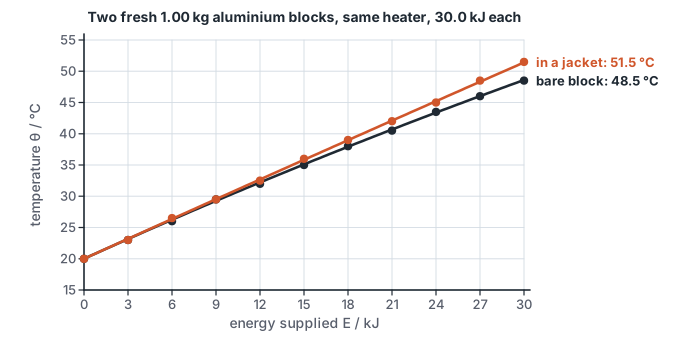
Do the experiment before you read on. The bare block, with nothing round it, warmed from 20.0 °C to 48.5 °C: a rise in temperature of 28.5 °C for 30.0 kJ. Its line on the graph bends gently. The first 3 kJ raised its temperature by 3.0 °C, the last 3 kJ by only 2.5 °C. The hotter the block got, the faster energy escaped from it to the cooler air around it, so less of each kilojoule stayed in the block.
Through the magnifier, the particles of aluminium vibrated faster and faster as the block warmed. They kept vibrating about fixed places in the same pattern, and they kept the same size. (The model leaves out the very slight expansion of the warm block.) The temperature rose, the internal energy rose, and the average kinetic energy of the particles rose with them.
Then a fresh block, also at 20.0 °C, was wrapped in an insulating jacket of polystyrene, a material that lets very little energy escape through it, and heated in the same way. It reached 51.5 °C: a rise of 31.5 °C for the same 30.0 kJ. Its line is steeper and almost straight, because far less energy escaped.
In the table and on the graph, E is the energy supplied, read from the joulemeter in kJ, and θ (the Greek letter theta) stands for the temperature in °C.
| E / kJ | bare block θ / °C | block in a jacket θ / °C |
|---|---|---|
| 0 | 20.0 | 20.0 |
| 3 | 23.0 | 23.0 |
| 6 | 26.0 | 26.5 |
| 9 | 29.5 | 29.5 |
| 12 | 32.0 | 32.5 |
| 15 | 35.0 | 36.0 |
| 18 | 38.0 | 39.0 |
| 21 | 40.5 | 42.0 |
| 24 | 43.5 | 45.0 |
| 27 | 46.0 | 48.5 |
| 30 | 48.5 | 51.5 |
 (enlarge)
Why a fresh block, and not the same block heated again? The second run must start from room temperature, so that the two runs are a fair test: the same mass of the same material, the same heater, the same energy and the same starting temperature. Only the jacket is different. Worked out in the next sections, these readings give about 1050 joules for each kilogram and each degree for the bare block, and about 950 for the block in its jacket.
Specific heat capacity
The bare block's temperature rose by 28.5 °C for 30 000 J. How much energy would one kilogram of aluminium need to warm by one degree? That number is a property of the material, and it lets you compare materials fairly, whatever the size of each sample. The specific heat capacity of a material, c, is the energy required per unit mass per unit temperature increase: the energy needed to raise the temperature of 1 kg of the material by 1 °C.
To work it out, divide the energy supplied, ΔE, by the mass, m, and by the rise in temperature, Δθ:
c = ΔE / (mΔθ)
The symbol Δ, the Greek capital letter delta, means “a change in”. θ, the Greek letter theta, is the usual symbol for a temperature in °C, as in the table, so Δθ is the rise in temperature: the final temperature minus the starting temperature. With the energy in joules, the mass in kilograms and the rise in °C, the specific heat capacity is in joules per kilogram per degree Celsius, written J/(kg °C).
The same equation can be rearranged. To find the energy needed to warm a mass m by Δθ, use ΔE = mcΔθ. To find the rise in temperature that an energy ΔE gives, use Δθ = ΔE / (mc). A material with a high specific heat capacity needs a lot of energy for each degree, so it warms up slowly; a material with a low specific heat capacity warms up quickly for the same energy.
Trap: “Δθ is the temperature at the end.” Δθ is the rise in temperature: 48.5 °C − 20.0 °C = 28.5 °C. Dividing by the final temperature instead gives 30 000 ÷ 48.5 ≈ 619 J/(kg °C), far too small. The block was already at 20 °C before any energy went in.
Trap: “The joulemeter shows 30.0, so ΔE = 30.” The joulemeter counts in kilojoules. Change kJ into J first: 30.0 kJ = 30 000 J. Using 30 gives 30 ÷ 28.5 ≈ 1.05 J/(kg °C), a thousand times too small.
Worked example
The specific heat capacity of aluminium
Use the readings for the bare block to calculate the specific heat capacity of aluminium.
The energy supplied: ΔE = 30.0 kJ = 30 000 J. The mass: m = 1.00 kg. The rise in temperature: Δθ = 48.5 °C − 20.0 °C = 28.5 °C. So c = ΔE / (mΔθ) = 30 000 J ÷ (1.00 kg × 28.5 °C) ≈ 1050 J/(kg °C). Check the size: about a thousand joules for each kilogram and each degree. The two common slips give answers far from this: the final temperature instead of the rise gives 619 J/(kg °C), and 30 instead of 30 000 gives 1.05 J/(kg °C).
Why the answer came out too high
Books give the specific heat capacity of aluminium as about 900 J/(kg °C). The bare block gave 1050 J/(kg °C), about a sixth too much. The calculation assumes that every joule counted by the joulemeter stayed in the aluminium, and two things broke that assumption. Some energy escaped from the warm block to the air around it, more and more as the block got hotter: that is why its line bent. And some energy warmed the heater and the thermometer themselves, not the block. With less energy in the aluminium, its temperature rose less than it would have done: 28.5 °C instead of about 33 °C. (If all 30 000 J had stayed in 1.00 kg of aluminium, with c = 900 J/(kg °C), the rise would have been Δθ = 30 000 ÷ (1.00 × 900) ≈ 33 °C.) A smaller Δθ on the bottom of c = ΔE / (mΔθ) makes c bigger.
Could the thermometer be to blame instead? It was read to the nearest 0.5 °C, so the rise could be out by about half a degree: that changes c by under 2 %, and it could make c a little too low just as easily as a little too high. It cannot explain an answer about 17 % too high. Energy that never reached the aluminium can, and it always pushes c the same way: up.
The fix is to stop the energy escaping: wrap a fresh block in insulation. In its jacket the block rose by 31.5 °C, so c = 30 000 J ÷ (1.00 kg × 31.5 °C) ≈ 952 J/(kg °C), much closer to 900. The rest of the gap is the energy that warmed the heater and the thermometer, and the little that still escaped through the jacket. The joulemeter counts all of it, but only part of it warms the aluminium, so a measured specific heat capacity usually comes out a little too high.
 (enlarge)
Worked example
Warming a saucepan
An aluminium saucepan has a mass of 500 g. How much energy is needed to warm it from 20 °C to 100 °C? The specific heat capacity of aluminium is 900 J/(kg °C).
Change the mass into kilograms: m = 500 g = 0.500 kg. The rise in temperature: Δθ = 100 °C − 20 °C = 80 °C. Then ΔE = mcΔθ = 0.500 kg × 900 J/(kg °C) × 80 °C = 36 000 J, which is 36 kJ. On a real hob it takes more, because some energy escapes to the air while the pan warms.
Trap: “The mass is 500 g, so put m = 500 into the equation.” Specific heat capacity is the energy per kilogram, so the mass must be in kilograms: 500 g = 0.500 kg. Using 500 gives 36 000 000 J, a thousand times too much.
Worked example
How hot will it get?
A 2.0 kg block of copper at 20 °C is given 15.6 kJ of energy, and none of it escapes. The specific heat capacity of copper is 390 J/(kg °C). Calculate the final temperature of the block.
ΔE = 15.6 kJ = 15 600 J. Rearranged, Δθ = ΔE / (mc) = 15 600 J ÷ (2.0 kg × 390 J/(kg °C)) = 15 600 ÷ 780 = 20 °C. That is the rise, so the final temperature is 20 °C + 20 °C = 40 °C. The same energy would warm 2.0 kg of aluminium (900 J/(kg °C)) by only about 8.7 °C: the higher the specific heat capacity, the smaller the rise.
Case closed
When an object warms, its internal energy increases. The energy you supply is stored by its particles, which move faster (in a solid, they vibrate faster), so their average kinetic energy is higher. The specific heat capacity of a material is the energy required per unit mass per unit temperature increase: c = ΔE / (mΔθ), in J/(kg °C). The bare block gave about 1050 J/(kg °C); the block in a jacket gave 952 J/(kg °C), close to the book value of 900, because less energy escaped. The next part measures the same number for water, with the same heater and the same energy, and finds out why the sea stays cool while the sand gets hot.
About this model
The blocks, the heater, the joulemeter and the thermometer are simulated. The temperatures follow a simple rule: each joule from the heater either warms the block, the heater and the thermometer, which together need 940 J for each °C (900 J for the aluminium and 40 J for the heater and the thermometer), or escapes to the air, and energy escapes faster the hotter the block is compared with the room. The jacket cuts that escape to about a seventh. The readings are rounded to the nearest 0.5 °C, as you would read a real thermometer. A real heater takes a little while to warm up, and goes on warming the block for a while after it is switched off; this one does not. The magnifier is a model: a few particles stand for billions of billions, and their vibration is exaggerated so that you can see it.