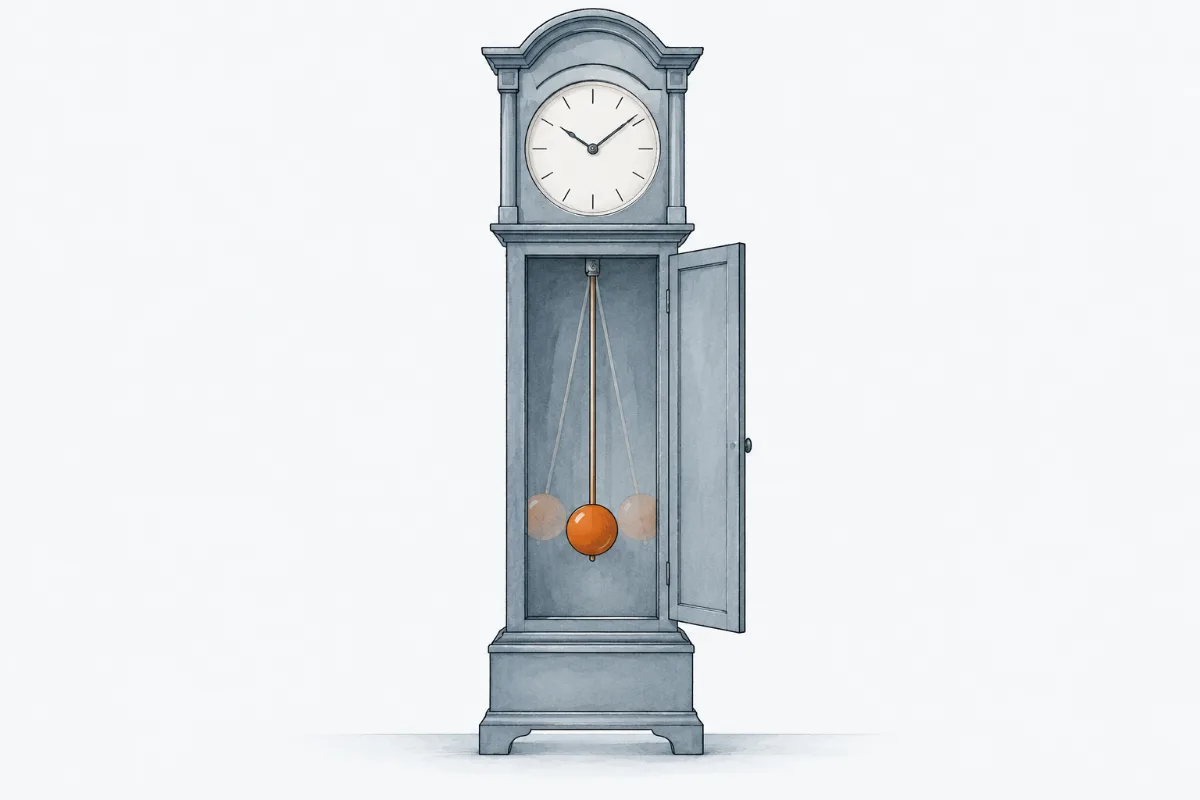
Push a child on a playground swing: big swings or small ones, each takes about the same time. Clocks used that fact for three hundred years, with a pendulum ticking inside them. But try to time one swing of a lab pendulum with a stop-clock, and something odd happens: you get a different answer every time. In this part you'll find out why, and how to time a swing far more precisely than your finger can press.
 (enlarge)
Clocks and timers
A clock with a second hand is fine for long times, such as the minutes it takes water to boil. For a few seconds you need a stop-clock: a digital one shows hundredths of a second (0.01 s). But it is started and stopped by a person, and a person is slow. Between seeing something happen and your finger pressing the button there is a delay, your reaction time: usually about 0.2 s.
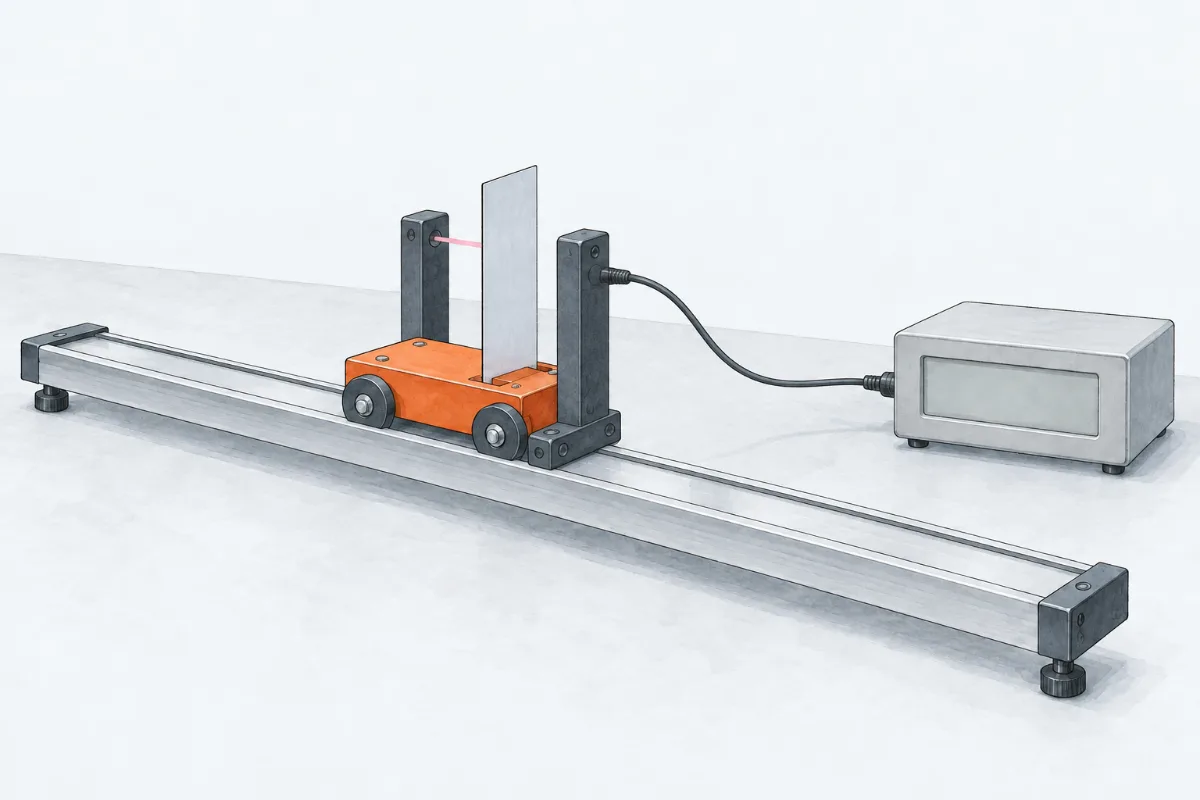
For very short times, such as a ball falling half a metre or a trolley passing a point, no finger is quick enough. Then a light gate does the timing: a beam of light across the path is cut by the moving object, and an electronic timer starts or stops with no human delay at all.
 (enlarge)
What counts as one swing
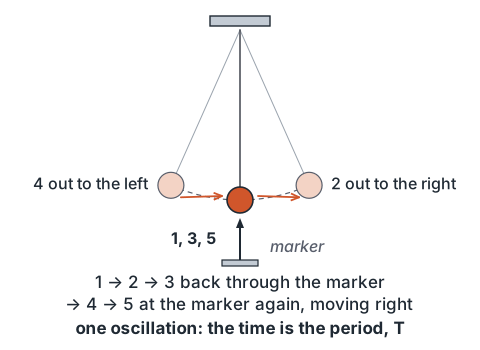
A swing has to be counted the same way every time. One complete swing, or oscillation, goes from a point and back to the same point, moving the same way: for example, from the centre out to the right, back past the centre, out to the left and back to the centre, moving right again. The time for one oscillation is the period, T, measured in seconds.
 (enlarge)
Where should you start and stop the clock? At the ends of the swing the bob slows down, stops and turns, so it's hard to judge the exact moment. Near the centre it moves fastest and passes in a flash. That's why a marker, a pointer right under the bob's lowest point, helps: start and stop as the bob passes the marker, moving the same way.
Predict first. Time one swing three times by pressing the stop-clock yourself. Will your three readings agree?
How much did your single swings differ? A tenth of a second or more, probably, on a swing that takes only about 1.3 s. You'll time twenty swings in the full experiment.
Twenty swings, then divide
Your reaction time adds a delay of about 0.2 s at the start and at the stop, and it is never quite the same twice: one press may come 0.15 s late, the next 0.25 s. Errors like this, which change by a different amount each time, are random errors. On one swing of 1.27 s, an error of 0.2 s is about one-sixth of the answer.
Now time twenty oscillations in one go. Start the clock as the bob passes the marker and count that pass as “zero”, not “one”. Stop the clock at the twentieth pass. The reaction errors are still there, but only once at the start and once at the stop, and they are now shared out over twenty swings:
T = (time for 20 oscillations) ÷ 20
If twenty swings take 25.4 s, then T = 25.4 s ÷ 20 = 1.27 s. An error of 0.2 s in 25.4 s is less than 1 % of the answer. Repeat the twenty swings and take the mean of the times: random errors make some runs a little long and some a little short, so averaging cuts them further. This is the same trick as measuring a stack of paper, used on time instead of length.
Suppose three timings of twenty swings come out as 25.38 s, 25.41 s and 25.40 s: they agree to within a few hundredths of a second. Readings like these are precise: repeats agree closely with each other. A result is accurate when it is close to the true value. Timing many swings and averaging repeats makes your period both more precise and more accurate.
Trap: “Start counting at one.” If you say “one” as you start the clock, you'll stop after only nineteen swings and your period will be too short. The pass when you start is zero.
Longer and shorter pendulums
Does the length of the string change the period? Measure it: time twenty swings for several lengths, measuring each length from the pivot to the centre of the bob. Keep the swing small and the bob the same, so that only the length changes.
| length / m | time for 20 oscillations / s | period / s |
|---|---|---|
| 0.100 | 12.68 | 0.63 |
| 0.200 | 17.94 | 0.90 |
| 0.400 | 25.40 | 1.27 |
| 0.500 | 28.38 | 1.42 |
Each column heading gives the quantity and its unit, separated by a slash, so the numbers below are plain numbers. All the periods are given to the same precision, 0.01 s.
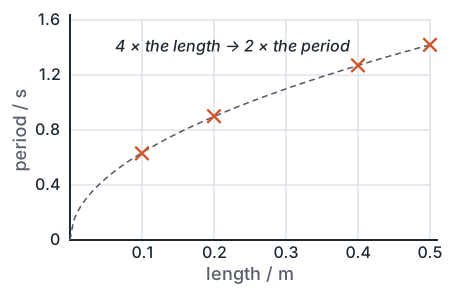
To draw the graph yourself, put the quantity you changed (length) on the horizontal axis and the one you measured (period) on the vertical axis. Choose scales so that the points fill more than half of the grid in each direction, with equal steps such as 0.1 m and 0.2 s per square.
Mark each point with a small neat cross (×), as in the graph below. Then draw one smooth curve (or a straight line, if the points lie on one) through or close to all of them, never a dot-to-dot zigzag. Now you can read off values between your readings.
 (enlarge)
A longer pendulum swings more slowly, but the period is not proportional to the length: making the pendulum four times as long, from 0.100 m to 0.400 m, only doubles its period, from 0.63 s to 1.27 s. That's why the points lie on a curve, not on a straight line through the origin.
Worked example
From a stop-clock reading to a period
A pupil times 20 oscillations of a pendulum three times: 28.32 s, 28.47 s and 28.39 s. Find the period.
First take the mean of the three times: (28.32 + 28.47 + 28.39) s ÷ 3 = 85.18 s ÷ 3 = 28.39 s (to 0.01 s). Then divide by the number of oscillations: T = 28.39 s ÷ 20 = 1.42 s. The three times differ by up to 0.15 s, but divided by 20 that is less than 0.01 s per swing.
Worked example
Which timer?
Choose a way to time each of these. (a) How long a kettle takes to boil. (b) A friend running 100 m. (c) A steel ball falling 0.50 m.
(a) Minutes long: a clock or watch with a second hand is plenty (a stop-clock would also do), because a fraction of a second doesn't matter. (b) About 15 s: a stop-clock is fine, though your reaction time at the start and the finish can add a few tenths of a second. At the finish line, start the clock when you see the starter's signal (a flag or the puff of smoke), not when the sound reaches you: sound takes about 0.3 s to travel 100 m. (c) The fall takes only about 0.3 s, about the same as your reaction time, so a stop-clock would be useless: use light gates or a timer started and stopped by the ball itself.
Worked example
Plotting the pendulum results
Plot the four results in the table on a graph of period against length and estimate the period for a length of 0.300 m.
Length goes along the bottom, from 0 to 0.5 m at 0.1 m per large square; period goes up the side, from 0 to 1.6 s at 0.2 s per large square, so the points spread over most of the grid. Plot (0.100, 0.63), (0.200, 0.90), (0.400, 1.27) and (0.500, 1.42) as small crosses. The points don't lie on a straight line, so draw one smooth curve through them. Go up from 0.300 m to the curve and across to the period axis: about 1.10 s.
Case closed
To time a short, repeating event: start and stop where the motion is fastest (at a marker), count from zero, time many repeats and divide by how many, and repeat and average. For events too short or too quick for a finger, use light gates. In a results table, head each column with the quantity and its unit, and give the values to the same precision.
About this model
In the experiment the stop-clock records your own presses: any spread in your readings comes from your reactions, not from the model. The pendulum swings about 8° each side with no air resistance, so its period stays the same throughout a run; a real one slowly loses its swing, and very large swings take a little longer. A press counts as “at the marker” if it comes up to 0.15 s before or 0.30 s after the bob passes it (a little less on the shortest pendulums); any other run is not recorded. The optional simulated timer adds a human-like delay of about 0.2 s at each press and is marked as simulated. The apparatus is simulated.