A carton of orange juice says "no added sugar" on the front, yet the juice tastes sweet. So is there sugar in it or not? And what else is in it that you cannot see: starch, protein, fat? You cannot tell by looking, and tasting is no use in a laboratory. In this part you learn five simple tests that show which nutrients a food contains, and you use them to find out what is really in orange juice.
How a food test works
Drop some orange-brown iodine solution onto a cut potato and it turns blue-black: the iodine has detected starch in the potato. That is a food test: a test that shows whether a particular nutrient is in a sample of food. The iodine is a reagent, a chemical chosen because it changes colour (or appearance) when that nutrient is there. A positive result is the colour change that shows the nutrient is present. A negative result means the reagent keeps its own colour: the nutrient was not detected.
Each food is tested mixed with water: dissolved, as a solution, or as tiny solid bits spread through the water, as a suspension (starch does not dissolve well, so starch is used as a suspension). Solid food is first crushed or ground with a little water, so the reagent can reach the molecules.
Every test needs a control: the same test done at the same time on water instead of the food. The control shows what the reagent looks like when there is nothing to detect. If the control changes colour too, something is wrong: a dirty tube, a contaminated pipette or an old reagent. So you can only call a result positive when it is different from the control.
Use a fresh portion of the sample for each test and a clean pipette for each liquid, so one test does not contaminate the next.
Trap: "You do not need a control, because you already know what the reagent looks like." The control is your evidence. It shows the colour of a negative result under exactly the same conditions, and it shows if the glassware or reagent is contaminated.
Working safely
- Wear eye protection for every test: several reagents irritate the eyes, and hot liquids can spit.
- Never taste anything in the laboratory, even a food sample. The glassware and reagents are not food-safe.
- Some people are allergic to egg. Tell your teacher if you are, and do not handle the egg-white sample.
- There are no flames in this practical. The heating is done with a beaker of hot water on a hotplate.
Starch: iodine solution
Iodine solution is orange-brown. Put a drop or two of the sample in a well (small hollow) of a white spotting tile, and water in the next well as the control. Add 2 drops of iodine solution to each.
If there is starch, the iodine turns blue-black: that is the positive result. If no blue-black appears, starch is not detected, whatever other colour you see. Usually the iodine simply stays orange-brown, like the control. Some substances in fruit juice can react with iodine and make its brown paler, so a well may look lighter or take on some of the juice's colour. That is still a negative result for starch: only blue-black counts.
Predict first: will orange juice give a positive result for starch?
With orange juice, no blue-black appears, while the control stays orange-brown. (The brown may also look paler, because a substance in the juice can make iodine fade.) So no starch is detected. That makes sense: juice is squeezed from the fruit, and an orange stores its sugar dissolved in the juice, not as starch.
Trap: "Iodine tests for sugar." Iodine detects starch only. Glucose and other sugars give no blue-black with iodine. Sugar needs a different test.
Reducing sugars: Benedict's solution
Benedict's solution is blue. It detects reducing sugars, a group of sugars that includes glucose and the sugar in fruit. Table sugar (sucrose) is not a reducing sugar, and nor is starch, so neither gives a positive result.
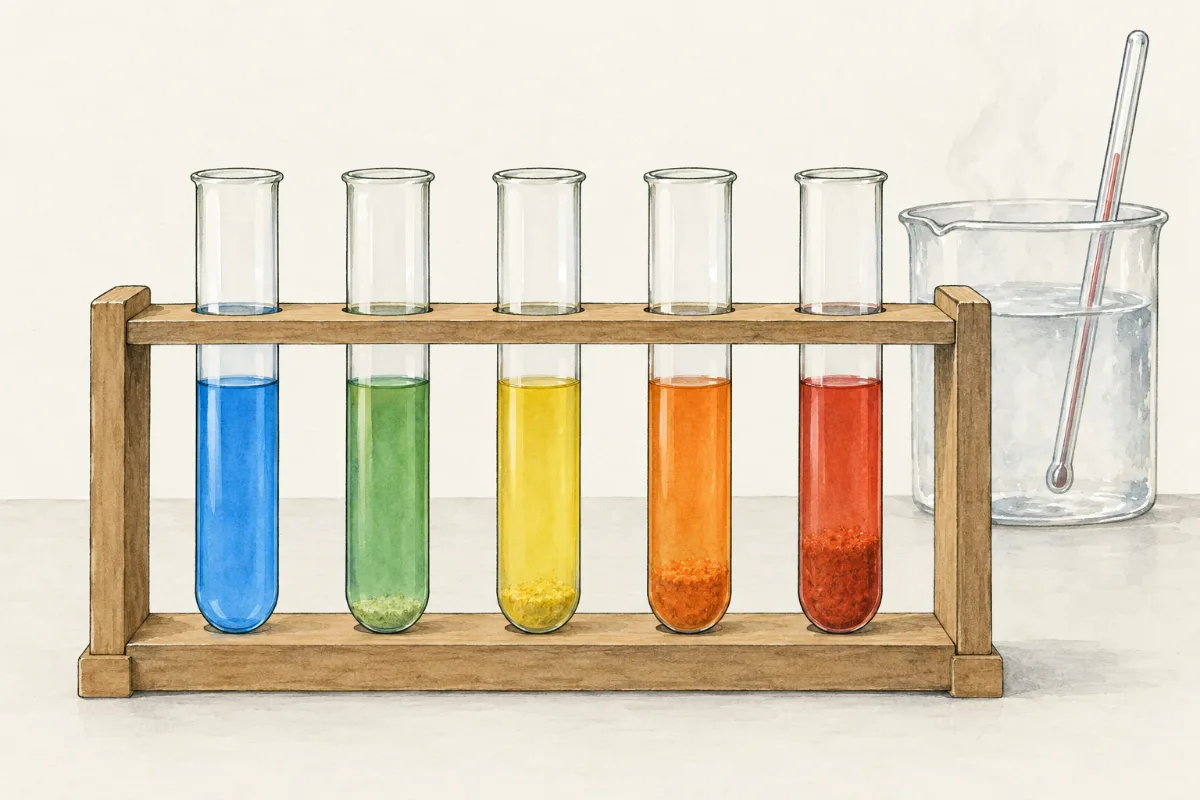
Put 2 cm³ of the sample in a test tube and 2 cm³ of water in a second tube as the control. Add 2 cm³ of Benedict's solution to each. Then, holding the tubes with a test-tube holder, stand them in a water bath, a beaker of hot water kept at about 80 °C, for 5 minutes. The test needs the heat: without heating, nothing happens even when sugar is there.
If there is a reducing sugar, the blue changes colour and a precipitate forms: tiny solid particles that make the liquid cloudy and settle at the bottom of the tube. The colour gives only a rough idea of how much reducing sugar there is, and only when every tube had the same volumes, temperature and time. A little reducing sugar gives green, more gives yellow, then orange, and a lot gives brick-red. If there is none, the mixture stays blue, like the control.
 (enlarge)
Lift the hot tubes out with the holder, not your fingers, and stand them in a rack to cool.
Predict first: will orange juice turn Benedict's solution green, yellow, orange or brick-red, or leave it blue? You find out in the experiment.
Trap: "Benedict's works straight away, like iodine." Benedict's must be heated in the water bath. A cold tube stays blue even when there is plenty of sugar, which would be a false negative.
Trap: "Starch is a sugar, so Benedict's detects it." Starch is a long chain of glucose units, and it does not give a positive Benedict's result. Test for starch with iodine.
Proteins: biuret solution
Biuret solution is pale blue. Put 2 cm³ of the sample and 2 cm³ of water (the control) in two tubes, add 2 cm³ of biuret solution to each and shake gently. No heating is needed. If there is protein, the mixture turns purple (lilac). If there is none, it stays blue. With a coloured food, the blue may mix with the food's own colour, but without purple the result is still negative.
Predict first: will orange juice turn biuret solution purple? You find out in the experiment.
Trap: "The tube is blue, so there is protein." Biuret solution is blue before you start, so blue is the negative result. Only purple shows protein.
Fats and oils: the emulsion test
This test uses ethanol, which is highly flammable. Keep the ethanol bottle well away from the hotplate and the hot water, and never near a flame.
Put a small amount of the sample in a dry tube with 2 cm³ of ethanol and shake it. Fats and oils dissolve in ethanol, though not in water. Let any solid settle, then pour the clear ethanol into a second tube containing 2 cm³ of water. Do the same with water instead of the sample as the control.
If there was fat or oil, it comes out of solution as it meets the water and forms an emulsion: millions of tiny droplets of fat spread evenly through the water. The droplets scatter light, so the whole liquid turns evenly cloudy white, like milk. If there was no fat, the liquid stays clear, like the control.
Predict first: will orange juice give a cloudy white emulsion? You find out in the experiment.
Trap: "A positive emulsion test is a white solid at the bottom, or a layer of oil on top." The emulsion is tiny droplets spread evenly through the whole liquid, which make it cloudy white all the way through. It is not a deposit and not a separate layer.
Vitamin C: DCPIP
DCPIP is a blue solution. It loses its colour when it reacts with vitamin C, a substance your body needs to keep skin and gums healthy.
Put 1 cm³ of DCPIP in a test tube. Add the sample drop by drop with a pipette, shaking after each drop, and count the drops until the blue colour disappears. With a coloured food, the tube ends the colour of the food rather than colourless. If the blue is still there after 20 drops, stop: no vitamin C is detected. Do the same with water as the control; it is still blue after 20 drops.
Drop counts can only be compared when every test uses the same volume of DCPIP (1 cm³), DCPIP of the same concentration, and the same pipette, so the drops are the same size. Then the fewer drops it takes, the more concentrated the vitamin C in the sample, because each drop brings more vitamin C to react with the DCPIP.
Vitamin C is a reducing substance too, so it can also give a positive Benedict's result (in this module's vitamin C solution, Benedict's turns green), and it can make iodine's brown fade. A Benedict's colour gives only a rough amount, and both a little sugar and some vitamin C can turn it green. So a positive Benedict's result on its own cannot tell you whether a sample contains sugar or vitamin C; the DCPIP test can.
Predict first: will orange juice make the blue of DCPIP disappear within 20 drops? You find out in the experiment.
Trap: "DCPIP went colourless, so there is no vitamin C." It is the other way round. The blue disappears because vitamin C is there: DCPIP losing its colour is the positive result.
Trap: "Fewer drops means less vitamin C." With the same DCPIP and the same drop size, fewer drops means more vitamin C per cm³, because a smaller volume of the sample was enough to remove the colour from the same 1 cm³ of DCPIP.
After the experiment: what is in orange juice?
Here are the five results for orange juice in this module's model experiment, beside the water control:
| Test | Orange juice | Water control | Meaning |
|---|---|---|---|
| Iodine | no blue-black (the brown may look paler) | orange-brown | no starch detected |
| Benedict's (5 min, 80 °C) | orange with a red-brown precipitate | blue | reducing sugar present |
| Biuret | dull blue-green, no purple | blue | no protein detected |
| Emulsion | clear | clear | no fat detected |
| DCPIP (1 cm³) | pale orange after 12 drops (model data) | blue after 20 drops | vitamin C present |
Benedict's turned orange with a red-brown precipitate, so orange juice contains a fair amount of reducing sugar, even with "no added sugar": the sugar was in the oranges. Biuret gave no purple: the blue reagent mixed with the orange of the juice to a dull blue-green, so no protein was detected. (Orange juice does contain a tiny amount of protein, but too little for this test to show.) The emulsion test stayed clear, so no fat was detected. DCPIP lost its blue after 12 drops and ended pale orange, the colour of the juice, so vitamin C is present.
In the same model experiment, a solution of pure vitamin C made the blue disappear in only 6 drops, and that tube ended colourless. (These drop counts are teaching-model data: a real practical gives its own counts.) For these two solutions, tested with the same volume of the same DCPIP and the same drop size, the vitamin C solution needed half as many drops as the juice, so it contains about 12 ÷ 6 = 2 times as much vitamin C per cm³.
So orange juice contains reducing sugar and vitamin C. Starch, protein and fat were not detected. Say "not detected" rather than "none": a test can miss a very small amount, as biuret misses the trace of protein in juice.
Each test detects one kind of substance, not a food. Most foods contain several nutrients, so one food can give several positive results. Potato crisps, for example, give a positive iodine test (starch from the potato) and a positive emulsion test (fat from the frying oil). To find out what is in a food, you run all five tests.
 (enlarge)
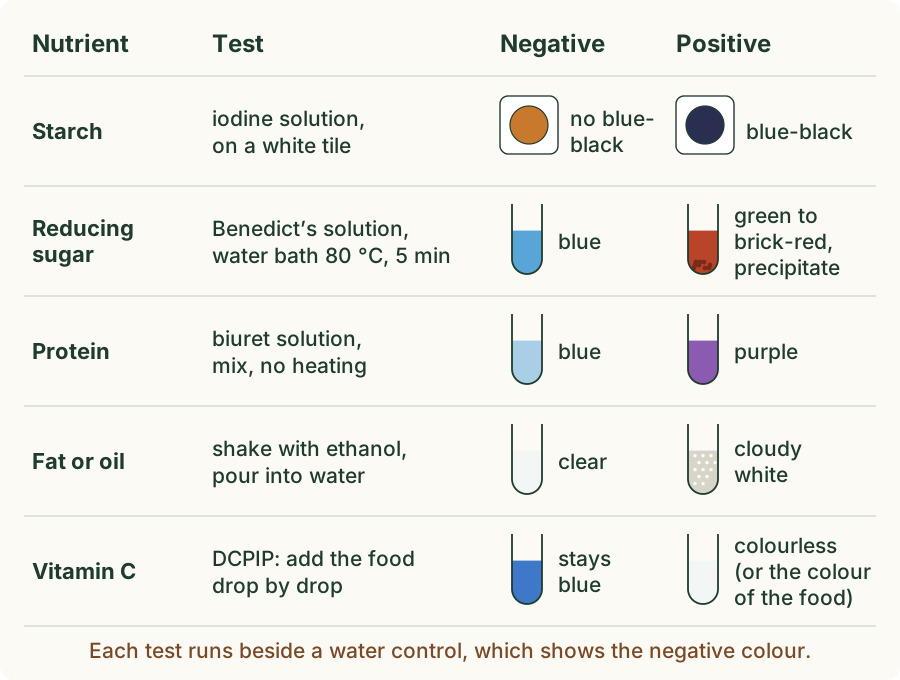
Key idea: Iodine solution turns blue-black with starch, and no blue-black means no starch detected; Benedict's solution, heated in a water bath, turns green to brick-red with a precipitate when there is a reducing sugar; biuret solution turns purple with protein; ethanol poured into water gives a cloudy white emulsion with fats and oils; DCPIP loses its blue colour with vitamin C, and, with the same DCPIP and drop size, the fewer drops needed, the more vitamin C. Each test is compared with a water control, and each detects a substance, not a food.