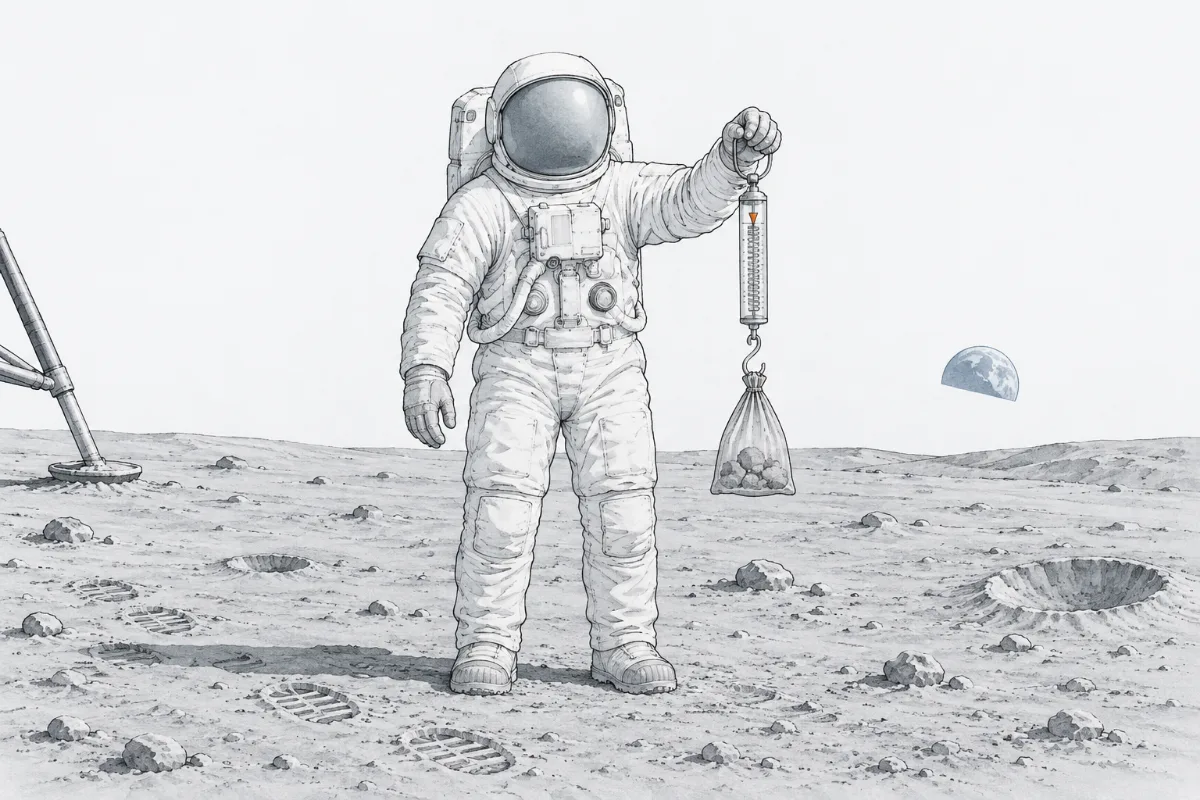
On the Moon, an astronaut hangs a bag of rock samples on a spring balance. On Earth the same bag stretched the spring six times as far. Nobody took a single rock out of the bag. So what changed: the bag, or the Moon? By the end of this part you'll know the difference between how much there is of something and how hard it is pulled, and you'll be able to work out what anything weighs on another world.
 (enlarge)
How much stuff: mass
The bag on the Moon holds exactly the same rocks as it did on Earth. Nothing was added and nothing was taken away, so the amount of matter in it is the same. That amount of matter is the bag's mass.
Mass is measured in kilograms (kg); 1 kg = 1000 g. An object's mass stays the same wherever you take it: on a mountain, on the Moon, in a spacecraft. It changes only if you add matter or take some away. Physicists say this for an object that is not moving past the person measuring it (“at rest relative to the observer”). At everyday speeds that makes no difference.
The pull of the Moon: weight
So why does the spring stretch less on the Moon? Because the spring isn't measuring the rocks. It is measuring how hard they are pulled down.
The Earth pulls every object that has mass towards its centre. The Moon does the same, but much more weakly. This pull is the object's weight: the gravitational force on an object that has mass. Weight is a force, so it is measured in newtons (N), the unit of force. On Earth a 100 g apple weighs about 1 N.
Trap: “I weigh 50 kg.” In everyday speech, yes, but in physics kilograms measure mass. Weight is a force, in newtons. A person with a mass of 50 kg has a weight of about 490 N on Earth, and only about 80 N on the Moon. Their mass is 50 kg in both places.
The same masses on three worlds
Try it. Below, the same masses hang on a spring balance, and sit on an equal-arm balance beside it. Before you start, predict: which reading will change when you move from Earth to the Moon, and which one won't? Then try all three masses on each world.
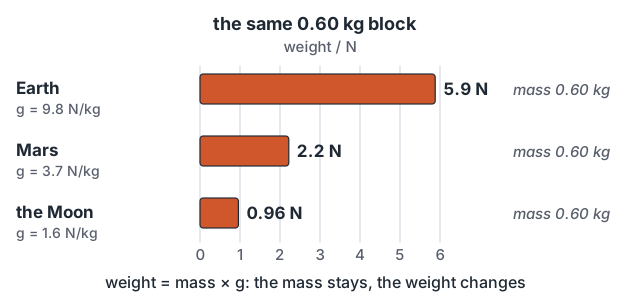
On Earth, the 0.60 kg wooden block pulls the spring balance down with 5.9 N. The equal-arm balance stays level: the same mass sits on each side.
| where | mass / kg | weight / N | weight ÷ mass / N/kg |
|---|---|---|---|
| Earth | 0.60 | 5.9 | 9.8 |
What did you notice? The spring balance reading depends on where you are, but on one world it follows a simple rule: ten times the mass (0.10 kg → 1.0 kg) gives ten times the weight. Look at the last column of your table. Weight divided by mass is the same for every mass on the same world: 9.8 on Earth, 1.6 on the Moon, 3.7 on Mars. That number belongs to the place, not to the object.
Gravitational field strength
That number is the gravitational field strength, g: the gravitational force on each kilogram of mass, or force per unit mass.
g = W / m
Here W is the weight in newtons and m is the mass in kilograms, so g is in newtons per kilogram (N/kg). On Earth g = 9.8 N/kg: every kilogram is pulled down with 9.8 N. Turn the equation round and you can find any weight: W = m × g.
 (enlarge)
The same number turns up when things fall. Drop a stone (with no air resistance to slow it) and its speed grows by 9.8 m/s every second: its acceleration is 9.8 m/s². The gravitational field strength and the acceleration of free fall are the same quantity, so g = 9.8 N/kg = 9.8 m/s². You'll use the second form when you study falling.
Where does the pull come from? Every object with mass is surrounded by a gravitational field, a region where any other mass feels a force. The Earth's field reaches far into space; the Moon's is weaker. Put a mass in a field and the field pulls on it: that pull is its weight. So weight is the effect of a gravitational field on a mass. Move the same mass into a weaker field and its weight falls, while its mass stays the same.
Trap: “There is no gravity on the Moon.” There is. The Moon's field pulls on every kilogram with 1.6 N, about a sixth of Earth's pull. That is why astronauts could walk there, and why a dropped hammer fell to the ground.
Compare masses with a balance
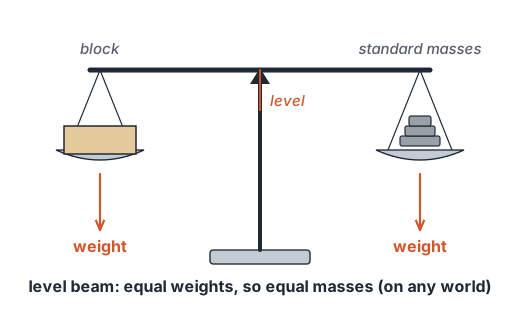
An equal-arm balance is a beam on a pivot with a pan hanging from each end. Put the object on one pan and standard masses on the other. When the beam is level, the two pans are pulled down equally hard: their weights are equal.
 (enlarge)
Both pans sit in the same gravitational field, so equal weights mean equal masses. A balance compares weights, and so it compares masses too. Take it to the Moon and both weights shrink by the same amount: it still balances. That is why the balance in the interactive stayed level on every world.
A spring balance is different: it measures the weight itself. Even an electronic kitchen scale really measures how hard the pan is pushed down, then shows that as grams using Earth's g. On the Moon it would show about a sixth of the true mass.
Worked example
A rock sample on the Moon
A rock sample has a mass of 1.5 kg. Find its weight on Earth (g = 9.8 N/kg) and on the Moon (g = 1.6 N/kg). What is its mass on the Moon?
Weight is mass × gravitational field strength. On Earth: W = 1.5 kg × 9.8 N/kg = 14.7 N, about 15 N. On the Moon: W = 1.5 kg × 1.6 N/kg = 2.4 N. Its mass is still 1.5 kg: the same rock, the same amount of matter, in a weaker field.
Worked example
Finding g on Mars
A rover with a mass of 900 kg rests on Mars. Its wheels push on the ground with its weight, 3330 N. What is the gravitational field strength on Mars?
g = W / m = 3330 N ÷ 900 kg = 3.7 N/kg. Each kilogram on Mars is pulled with 3.7 N, a little over a third of the pull on Earth.
Case closed
The bag on the Moon kept its mass: the same amount of matter, in kilograms. What changed was its weight, the gravitational force on it, in newtons, because the Moon's field is weaker. The gravitational field strength g = W / m tells you the pull on each kilogram, and it equals the acceleration of free fall. An equal-arm balance compares weights, and so masses, in the same way on every world.
So a big log on Earth has a much bigger weight than a small stone. Then why does the log float and the stone sink? Not because of weight. The next part finds out what really decides.
About this model
The interactive uses g = 9.8 N/kg on Earth, 1.6 N/kg on the Moon and 3.7 N/kg on Mars, and rounds each weight to two significant figures. The balances are simulated.