A fallen log can weigh more than a person, yet it floats down the river. A pebble the size of your thumb drops straight to the bottom. So floating can't be about how heavy something is. Something else about the log and the pebble must decide it. By the end of this part you'll be able to put a number on that something, for a block, a stone or a liquid, using a balance, a rule and a measuring cylinder.
Mass packed into space: density
Start with two pieces of the same size. A block of pine wood 20 cm long, 10 cm wide and 5 cm high takes up 1000 cubic centimetres and has a mass of about 600 g. A block of stone the same size would have a mass of about 2600 g. Every cubic centimetre of the pine holds 0.60 g of matter; every cubic centimetre of the stone holds 2.6 g. The stone's matter is packed far more tightly.
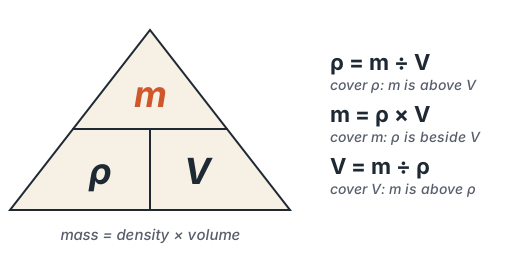
That mass in each unit of volume is the density of a material: its mass per unit volume.
density = mass ÷ volume, or ρ = m / V
ρ is the Greek letter rho. With the mass in grams and the volume in cubic centimetres, density is in grams per cubic centimetre (g/cm³). With kilograms and cubic metres it is in kg/m³, and 1 g/cm³ = 1000 kg/m³. Water's density is 1.00 g/cm³: each cubic centimetre of water has a mass of 1 g.
 (enlarge)
Trap: “A bigger block of wood has a bigger density.” Cut the pine block in half and each half has half the mass and half the volume, so mass ÷ volume stays 0.60 g/cm³. Density belongs to the material, not to the size of the piece.
To find a density you always need two measurements: the mass, from a balance, and the volume. How you find the volume depends on the shape.
A regular solid: measure its sides
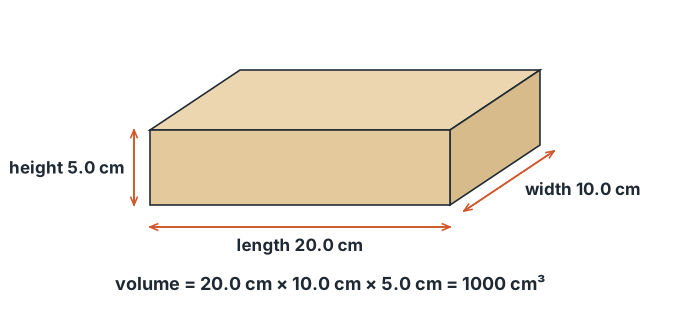
A block with flat faces and square corners is a regular solid. Measure its length, width and height with a rule, eye level with each mark, and multiply them.
 (enlarge)
Worked example
The pine block
A pine block has a mass of 598.4 g. Its sides are 20.0 cm, 10.0 cm and 5.0 cm. Find its density.
Volume = 20.0 cm × 10.0 cm × 5.0 cm = 1000 cm³. Density = mass ÷ volume = 598.4 g ÷ 1000 cm³ = 0.598 g/cm³. Round it to 0.60 g/cm³, 2 significant figures (count the digits from the first one that is not zero), because the height, 5.0 cm, was measured to 2 significant figures. That is 600 kg/m³.
An irregular solid: let the water measure it
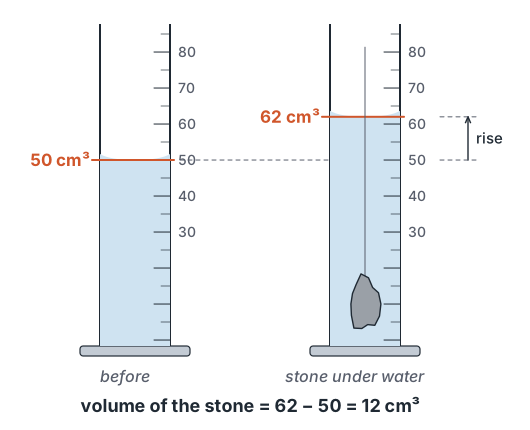
A stone has no flat faces and no straight edges, so a rule can't give its volume. Water can. Put some water in a measuring cylinder and read the level. Then lower the stone in on a thread until it is completely under water. The stone pushes aside its own volume of water, so the level rises by exactly the stone's volume. This is the displacement method: the volume of water displaced, pushed aside, equals the volume of the stone.
Read each level the same way. Water curves up where it touches the glass; this curved surface is the meniscus. Put your eye level with the surface and read the bottom of the meniscus.
 (enlarge)
Weigh the stone first, while it is dry: water clinging to it would add mass. And this method needs a solid that sinks, so that it ends up completely under water.
Trap: “The stone's volume is the new reading, 62 cm³.” The new reading includes the 50 cm³ of water that was already there. The stone's volume is only the rise: 62 cm³ − 50 cm³ = 12 cm³.
Try it on the bench: weigh the stone, read the level before and after, and work out its density.
Did you get 2.6 g/cm³? The stone is small and light, 31.2 g, but each of its cubic centimetres holds more than four times as much matter as the pine.
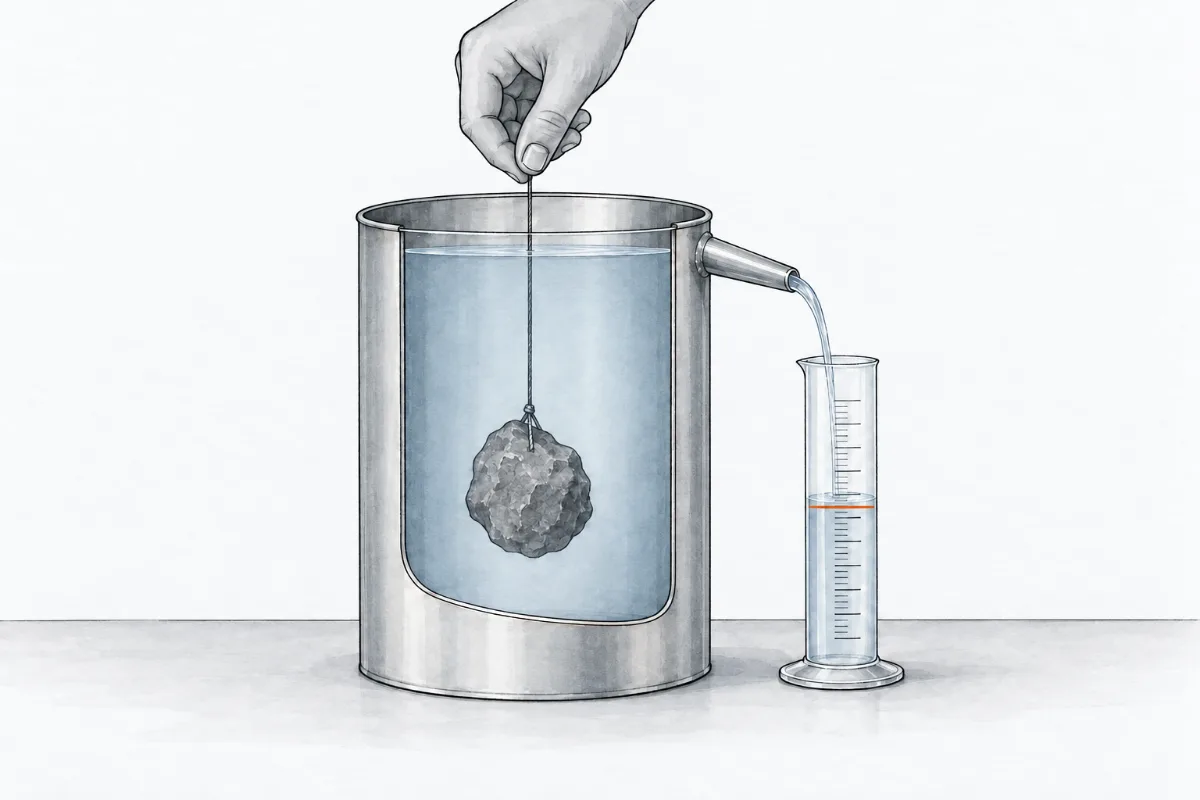
A stone too big for a measuring cylinder goes into a displacement can instead: a can with a spout, filled with water up to the spout. Lower the stone in, and the water it pushes aside runs out of the spout into a measuring cylinder. The volume collected is the stone's volume.
 (enlarge)
Worked example
The stone
A dry stone has a mass of 31.2 g. A measuring cylinder holds 50 cm³ of water; with the stone completely under water the level is 62 cm³. Find the stone's density.
Volume = 62 cm³ − 50 cm³ = 12 cm³. Density = 31.2 g ÷ 12 cm³ = 2.6 g/cm³.
A liquid: zero the balance first
A liquid has to be weighed in a container, and the balance would weigh the container too. So put the empty, dry measuring cylinder on the balance and press its zero button. Zeroing the balance with a container on it is called tare. Now pour in the liquid: the balance shows the mass of the liquid alone, and the cylinder shows its volume. (Without a tare button, weigh the cylinder empty and then full, and subtract.)
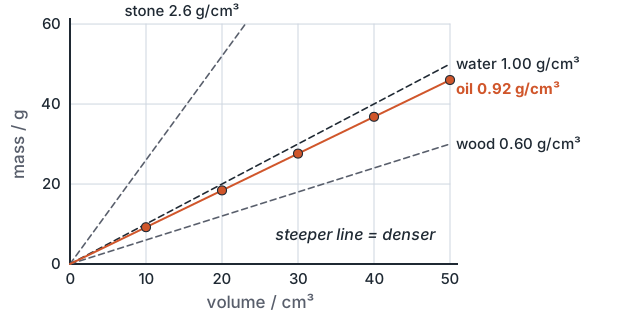
Pour 10 cm³ at a time and the mass goes up by the same amount each time. Plot mass against volume and you get a straight line through zero. Its steepness, the mass added by each cubic centimetre, is the density. A steeper line means a denser material.
 (enlarge)
Worked example
Cooking oil
An empty measuring cylinder on a balance reads 118.6 g. After tare, 50 cm³ of cooking oil is poured in and the balance reads 46.0 g. Find the density of the oil in g/cm³ and in kg/m³.
After tare the balance shows only the oil: m = 46.0 g. Density = 46.0 g ÷ 50 cm³ = 0.92 g/cm³. In kg/m³, multiply by 1000: 920 kg/m³. Without the tare, a careless reading of 164.6 g would have given 3.3 g/cm³, denser than stone.
Case closed
Density is mass per unit volume, ρ = m / V. A balance always gives the mass; the volume needs a method that suits the object: length × width × height for a regular solid, the rise in water level for an irregular solid that sinks, and the scale of a measuring cylinder for a liquid weighed in a tared container. The big pine block and the small stone now have numbers: 0.60 g/cm³ and 2.6 g/cm³. The next part asks what those numbers do in water.
About this model
The experiment's readings are the values a school set would give: pine 598.4 g for 1000 cm³, a stone of 31.2 g and 12 cm³, cooking oil of 0.92 g/cm³. Real readings scatter a little, a wet stone carries water, and air bubbles on a stone add to its volume. The apparatus is simulated.