Pupil sheet · Paper chromatography
What can the pattern tell you? — questions
Name ______________________ Date ____________
Try every question before you use a nudge. Write in full sentences where you are asked to explain.
1. Explain
U gives blue and yellow spots on the lesson paper. A matches its blue spot; B matches its yellow spot. State what those matches support. Explain why solvent, paper and temperature must match too.
What the two spots show
What the known samples support
Conditions and limitation
Nudge (only if you are stuck): What do two separated spots show? Does matching position give a unique identity?
2. Explain
Choose every statement supported by the chromatogram. Then explain why one visible spot isn't enough to guarantee purity.
Tick every correct statement.
- Two separated spots demonstrate at least two substances
- One visible spot guarantees purity in all conditions
- A colourless component can be invisible without a suitable locating method
- Matching colour alone identifies a substance
Why is a one-spot result not a guarantee of purity?
Nudge (only if you are stuck): Could two components overlap? Could a separated substance be colourless?
3. Explain
Use the new chromatogram to interpret X. Compare its spots with P and Q, then state one limit of your identification.
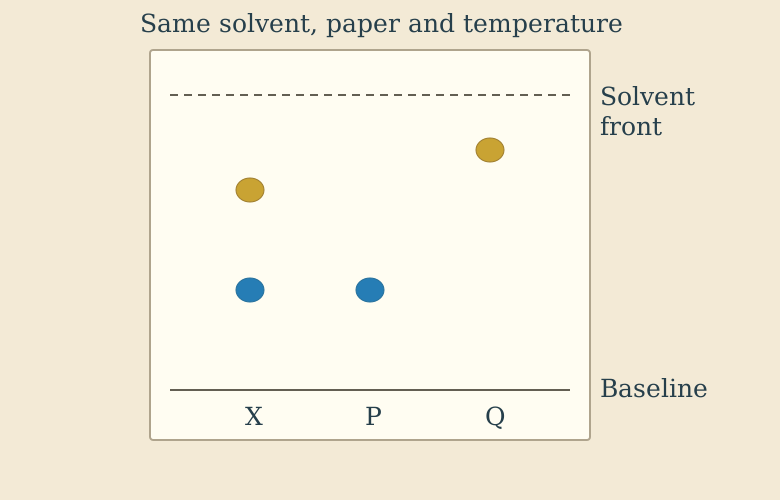
Nudge (only if you are stuck): Count X's separated spots. Which reference matches both position and colour under these conditions?
4. Explain
M and N both give red spots on the same paper, but at different heights. A pupil says N must be M because the colours match. Evaluate that claim.
Nudge (only if you are stuck): What does the position tell you that colour alone doesn't?
5. Explain
X gives one spot in solvent S. A fresh portion gives two in solvent T. Another unknown, tested in T, reaches the same height as X did in S. Explain what you can conclude about X and whether the unknown matches it. Suggest a fair comparison.
Nudge (only if you are stuck): Which run separated more components? Were the two equal heights measured under matching conditions?