In part 1, ammonia spread through the still air of a closed tank, because its particles move at random and keep colliding. But do all gases spread equally fast? Here's a neat way to race two of them.
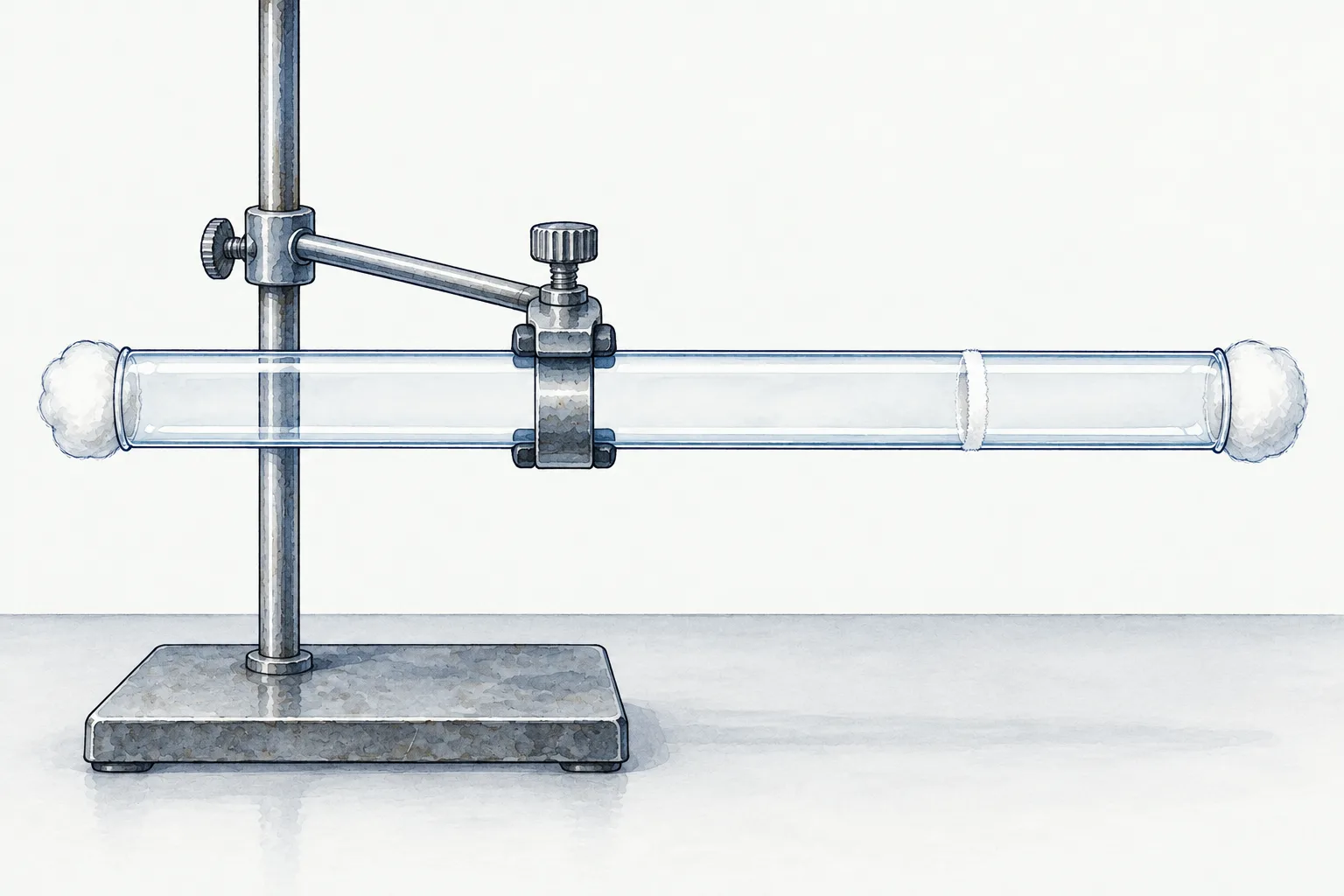
Push cotton wool soaked in concentrated ammonia solution into one end of a long glass tube, and cotton wool soaked in concentrated hydrochloric acid into the other. Ammonia gas spreads from one end and hydrogen chloride gas from the other. Both are colourless, but where they meet they react to make a white solid, so a white ring forms inside the tube.
In this part you'll find out what decides where the ring forms, and use it to predict the ring for other pairs of gases.
How heavy is a molecule?
To compare the two gases, you need the masses of their molecules. Relative molecular mass, written Mr, does that: add up the relative atomic masses of the atoms in the formula. Relative atomic masses (from the Periodic Table): H 1, N 14, Cl 35.5 (an average, because chlorine atoms come in two masses).
- ammonia, NH3: 14 + (3 × 1) = 17
- hydrogen chloride, HCl: 1 + 35.5 = 36.5
So a hydrogen chloride molecule has roughly twice the mass of an ammonia molecule. Mr has no units, because it only compares masses.
Where will the ring form?
When the two gases meet, they react:
ammonia + hydrogen chloride → ammonium chloride
NH3(g) + HCl(g) → NH4Cl(s)
Both plugs go in at the same moment, so each gas has the same time to spread, and the ring marks where they meet. Predict before you read on. Will the ring form nearer the ammonia end, in the middle, or nearer the hydrogen chloride end? Will the heavier molecules get further, or less far?
Safety: Concentrated ammonia solution and concentrated hydrochloric acid are corrosive, and their fumes harm the eyes and lungs. This is a teacher demonstration in a fume cupboard.
What the tube shows
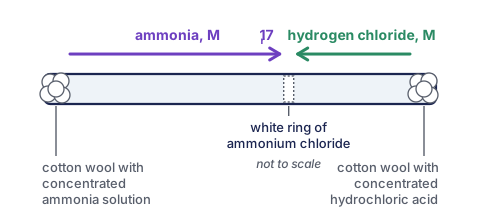
The white ring forms nearer the hydrogen chloride end. So in the same time, the ammonia spread further along the tube than the hydrogen chloride did: ammonia diffused faster. How quickly a gas spreads by diffusion is its rate of diffusion.
 (enlarge)
In the labelled diagram, the two arrows show how far each gas spread before they met.
 (enlarge)
Ammonia has the lower Mr of the two, and it diffused faster. That's the general rule for gases.
Key idea: At the same temperature, a gas with a lower relative molecular mass has a higher rate of diffusion.
Inside: lighter particles move faster
Why should mass matter? Warming a gas makes its particles move faster: they gain kinetic energy, the energy of movement. In gases at the same temperature, the particles have the same average kinetic energy, whatever the gas.
But kinetic energy depends on mass as well as speed. A heavy particle has that energy at a lower speed; a light particle has it at a higher speed. Give a tennis ball and a bowling ball the same energy, and the tennis ball flies off much faster. Particles aren't balls, but the same rule links their mass, speed and energy.
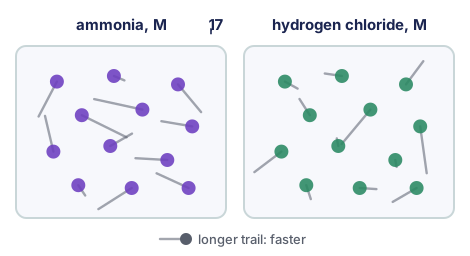
So at the same temperature, ammonia particles (Mr 17) move faster on average than hydrogen chloride particles (Mr 36.5). “On average” matters: at any moment some hydrogen chloride particles are faster than some ammonia particles, but taken together the ammonia particles are faster.
 (enlarge)
Both gases still zigzag through the air, colliding with air particles all the time; neither travels straight down the tube. But a faster particle covers more zigzag path every second, so on average it ends up further from where it started. That's why the ammonia spreads further in the same time, and the gases meet nearer the hydrogen chloride end.
Trap: “Heavier particles push harder, so they travel further.” The ring shows the opposite. At the same temperature, heavier particles move more slowly on average, so a heavier gas diffuses more slowly.
Trap: “The ammonia rushes towards the acid to react with it.” Neither gas can tell where the other is. Each gas spreads at random from where it is concentrated, and the ring forms wherever they happen to meet.
Worked example
Ammonia and hydrogen bromide
The teacher repeats the race with hydrogen bromide (Mr 81) instead of hydrogen chloride. (Its concentrated solution is corrosive too, so this is also a fume-cupboard demonstration.) Ammonia and hydrogen bromide react to make white ammonium bromide. Where will the ring form this time?
Compare the Mr values: ammonia 17, hydrogen bromide 81. Ammonia has the lower Mr, so at the same temperature its particles move faster on average and ammonia diffuses faster. In the same time it spreads further, so the ring forms nearer the hydrogen bromide end.
How does it compare with the first tube? The ammonia is the same, but hydrogen bromide (81) is heavier than hydrogen chloride (36.5), so it diffuses more slowly. The ammonia gets further before they meet, and the ring forms even closer to the hydrogen bromide end than the first ring was to the hydrogen chloride end.
Worked example
The slow brown jar
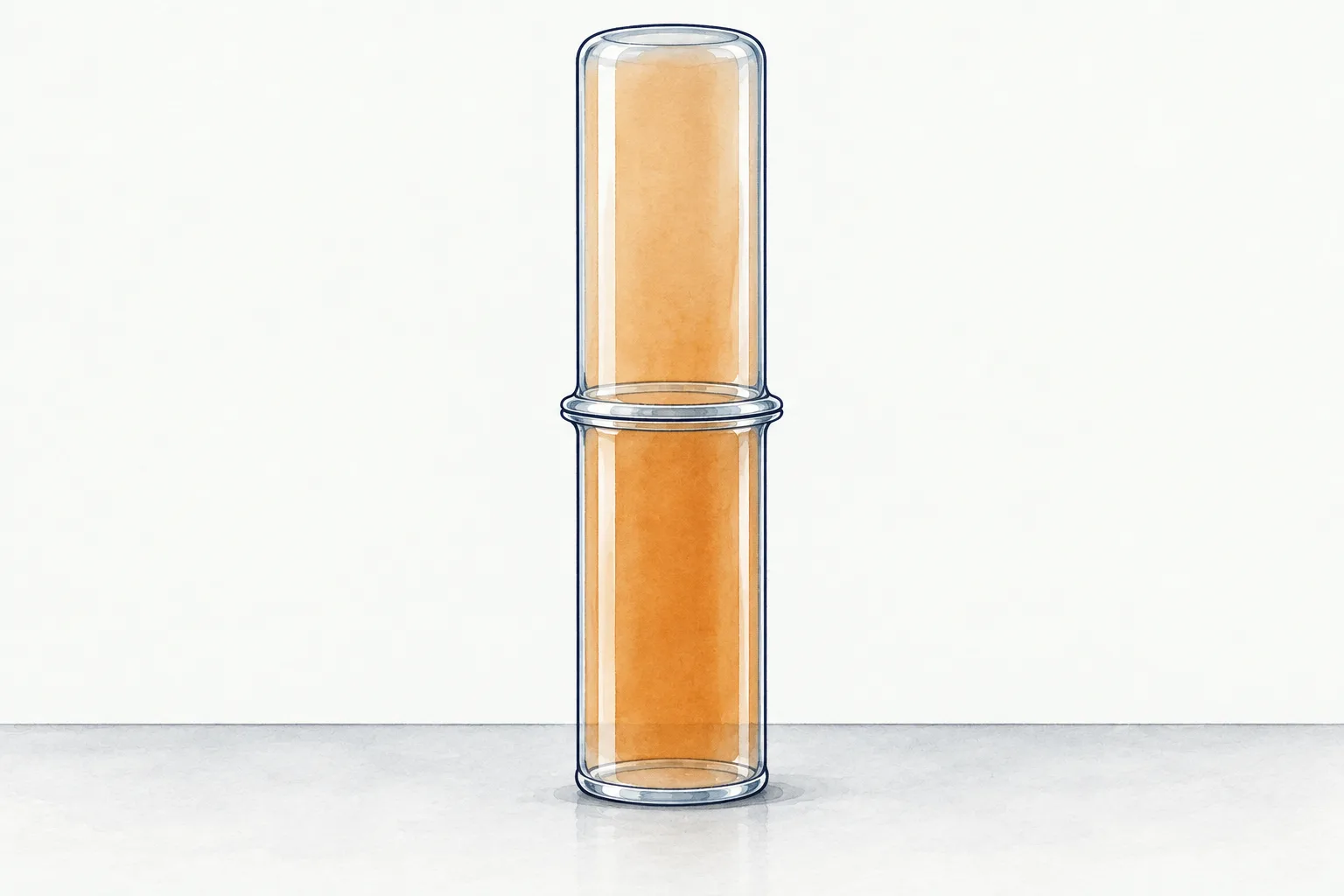
Bromine is a red-brown liquid that evaporates easily; its vapour is orange-brown, with Mr 160. A gas jar of bromine vapour stands under a jar of air, mouth to mouth, with a glass plate between them. The plate is pulled out. Why does the colour creep up so slowly, and why does it go up at all, when bromine vapour is much denser than air?
Safety: Bromine is very toxic and corrosive. This is a teacher demonstration in a fume cupboard.
 (enlarge)
Every gas spreads slowly by diffusion alone. Air is mostly nitrogen (Mr 28) and oxygen (Mr 32). Bromine molecules are about five times heavier, so at the same temperature they move more slowly on average, and bromine spreads more slowly still.
It still spreads upwards. Each bromine molecule moves at random and collides with air molecules, so it is as likely to head up as down. There are many more bromine molecules in the bottom jar than in the top one, so more cross upwards than back. That net movement needs no draught, and it goes on until the colour is even in both jars.
Case closed
- Compare gases at the same temperature: the lower the Mr, the faster the particles move on average, and the faster the gas diffuses.
- In a ring tube, the faster gas covers more of the tube, so the ring forms nearer the end where the gas with the higher Mr started.
- No particle aims anywhere. Both gases still spread by random motion, from higher to lower concentration.