Pupil sheet · Diffusion
A smell you can't see — questions
Name ______________________ Date ____________
Try every question before you use a nudge. Write in full sentences where you are asked to explain.
1. identify / state
A pad of concentrated ammonia solution is put near the left end of the closed tank, and the lid is closed. The table lists the six damp red litmus strips in the order they turned blue; strip 1 is nearest the pad. Choose the statement that describes how the ammonia moved. Then state whether the amount of ammonia in the tank changed as it spread.
| Strip (in turning order) | Wait since the one before |
|---|---|
| 1 | — |
| 2 | short |
| 3 | longer |
| 4 | longer still |
| 5 | even longer |
| 6 | longest |
Circle one answer.
- It reached all six strips at the same moment, because a gas fills its container at once.
- It moved along the tank at a steady speed, so the waits between the strips were equal.
- It spread out from the pad: the nearer strips turned first, and the waits got longer.
- It shot straight to the far end first, then filled the tank back towards the pad.
Did the amount of ammonia in the closed tank change as it spread? Say how you know.
Nudge (only if you are stuck): Which strip turned first? Then read down the last column: are the waits equal?
2. explain
The pad is near the left end of the closed tank. Every ammonia particle moves at random, yet the ammonia as a whole spreads away from the pad. Put the steps in order to explain why.
Write the number of each step in order.
- Near the pad there are many ammonia particles; further along the tank there are few.
- So the ammonia has a net movement away from the pad, until its concentration is the same everywhere.
- Each ammonia particle moves in a straight line until it collides with another particle.
- So more ammonia particles cross any point from the pad side than from the far side.
- Every collision sends it off in a new, random direction.
- First: ______
- Second: ______
- Third: ______
- Fourth: ______
- Fifth: ______
Do any ammonia particles move back towards the pad? Explain.
Nudge (only if you are stuck): Start with how one particle moves. Finish with what happens to the gas as a whole.
3. identify / explain
The pad is near the left end of the closed tank, and the strips are still turning blue. Three of these statements about the ammonia particles are correct. Which statement is wrong?
Circle one answer.
- Each ammonia particle changes direction every time it collides with another particle.
- The ammonia particles make their way to the emptier end of the tank because they need more room.
- Some ammonia particles are moving back towards the pad.
- More ammonia particles cross the middle of the tank from the pad side than from the far side.
Explain what is wrong with the statement you chose, and give the correct reason why the ammonia spreads towards the far end.
Nudge (only if you are stuck): Which statement would be true of a person walking through a crowd, but not of a particle?
4. describe / explain / predict
The pad is put in the centre of the closed tank. The sketch graph shows the concentration of ammonia along the tank at two times: X, soon after the pad went in, and Y, later. (a) Describe how the concentration changes from X to Y, at the centre and near the ends. (b) Explain, using the motion of the particles, why the curve gets lower and wider, and why it stays symmetrical. (c) Predict the shape of the graph in the end, after a very long time, and say whether the particles are still moving then.
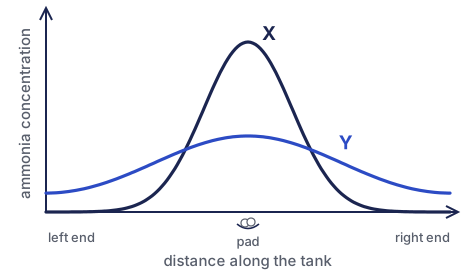
(a) How the concentration changes from X to Y
(b) Why the ammonia spreads equally towards both ends
(c) The graph in the end, and whether the particles are still moving
Nudge (only if you are stuck): For (b), compare how many particles there are at the centre and further out. Is a particle moving at random more likely to go left or right?
5. explain
A crystal of potassium manganate(VII) is placed at the bottom of a beaker of still water. The purple colour takes days to spread evenly through all the water, while ammonia spreads along the tank much faster. (a) Explain, using particles, why diffusion is much slower in a liquid than in a gas. (b) A pupil starts again and stirs the beaker. The purple spreads through the water in a few seconds. She says this shows that diffusion in liquids is fast. Explain why she is wrong.
(a) Why diffusion is much slower in a liquid than in a gas
(b) Why the pupil is wrong about the stirred beaker
Nudge (only if you are stuck): For (a), how close together are the particles in a liquid, and what does that do to each purple particle? For (b), what is the spoon moving?
6. describe / explain
A small hole is cut in the centre of a dish of clear jelly, and a drop of purple dye is put in the hole. The jelly is mostly water, but it can't flow. After 1 hour there is a purple circle about 1 cm across around the hole. After 4 hours the circle is about 2 cm across and paler. (a) Describe how the dye moves through the jelly, using both observations. (b) Explain, using particles, why the circle grows equally in every direction and gets paler. (c) Explain why it matters, for showing diffusion, that the jelly can't flow.
(a) How the dye moves through the jelly
(b) Why the circle grows equally in every direction and gets paler
(c) Why it matters that the jelly can't flow
Nudge (only if you are stuck): This is like the tank with the pad in the centre, but flat, and in a liquid. What does the circle tell you about direction?