Cook pasta in salted water with a lid on the pan, then lift the lid. Drops of water run off its underside. Most of them formed from water that left the pan as invisible vapour, the gas form of water, and turned back into liquid on the cooler lid. Salt can't leave as vapour, so those drops carry no salt. Only a splash could carry salty water up to the lid.
Chemists use the same trick on purpose when they want the water from a solution: they catch the vapour, cool it and collect the liquid in a separate container. In this part you'll set that up, predict what collects, and then check where the water and the salt ended up.
What leaves the flask, and what stays
Start with salt water. The water is the solvent, the liquid that the salt dissolves in. The salt, sodium chloride, is the solute, the substance that is dissolved. Together they make a solution. It looks clear because the dissolved salt is spread through the water as particles far too small to see. So a clear liquid isn't necessarily water only.
Now heat the solution in a flask. The water boils and turns into water vapour. Changing from a liquid to a gas is called vaporisation, and boiling is vaporisation all through the liquid, which is why you see bubbles. Water vaporises easily when you heat it, so we say it's volatile. Salt is nonvolatile: at the temperature of boiling water it doesn't turn into vapour, so it stays dissolved in the flask. The water leaves and the salt stays, so the same salt ends up in less water. That's why the solution left in the flask becomes more concentrated.
Next, cool the vapour. It turns back into liquid water, a change called condensation. The drops run into a separate container, the receiver, and the liquid you collect there is the distillate. Boiling a liquid and then condensing its vapour like this is distillation. When the apparatus is just a flask, a condenser to cool the vapour and a receiver, it's called simple distillation.
Before you go on, predict: will any salt reach the receiver?
 (enlarge)
Trap: “The drops I can see are water vapour.” Water vapour is invisible. Any drops you can see are already liquid, and so is a visible mist: it's made of tiny droplets of liquid water.
Two water paths that must stay separate
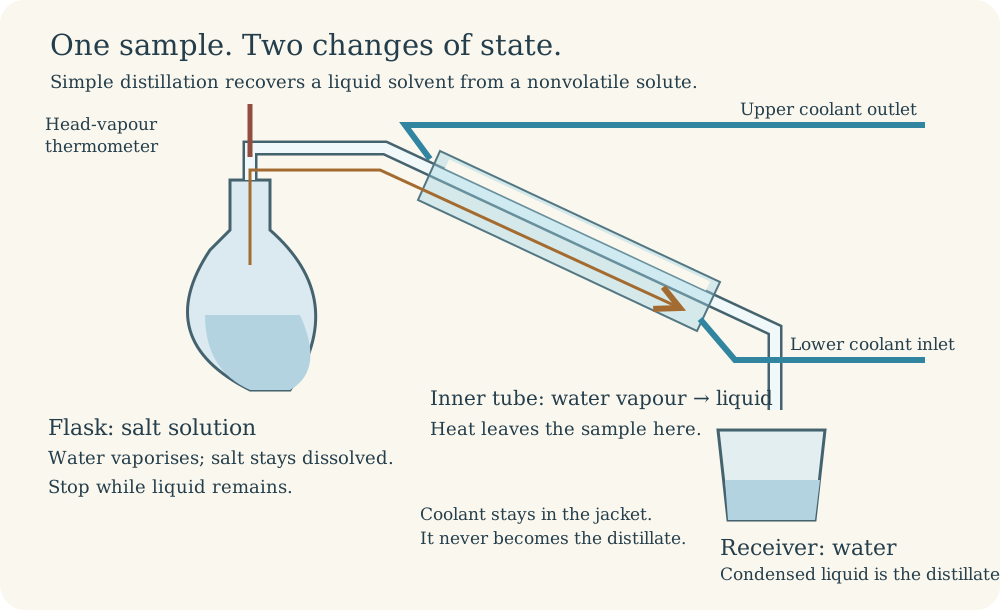
The condenser is a glass tube inside a wider glass tube. Trace the vapour first. It rises to the top of the apparatus, the head, and turns into a short outlet tube, the sidearm. From there it travels down the condenser's inner tube and drips out of the end into the receiver.
Now trace the cooling water. Cold water from the tap flows through the space between the two tubes, called the jacket, and then out to the sink. Heat passes from the hot vapour through the glass into the cold water, so the vapour cools and condenses inside the inner tube. This cooling water is called the coolant. It only takes heat away. It never touches the sample, so it never ends up in the receiver.
The coolant goes in at the lower nozzle and out at the upper one. Water let in at the bottom has to fill the whole jacket before it can leave at the top, so there are no air pockets and the whole tube stays cold. If you let it in at the top instead, it would run straight down and out of the lower nozzle. Most of the jacket would stay full of air, so the vapour would cool poorly. The hose from the upper nozzle goes to the sink, never into the receiver.
Trap: “The water in the receiver came from the cooling hose.” The coolant and the sample travel in separate tubes. The jacket only takes heat away; it doesn't add any water to the distillate.
The thermometer sits in the head, with its bulb level with the sidearm, right in the vapour that is leaving. So it measures the head-vapour temperature: the temperature of the vapour going into the condenser. It doesn't measure the hotplate, or the liquid at the bottom of the flask. While pure water distils at normal pressure, it reads 100 °C.
Try it now. First choose the nozzle for the hose from the tap, then predict what will collect in the beaker. Heat the flask and watch three places: the thermometer, the condenser and the beaker. Two extra views help you. When the flask heats up, a round magnifier on the bench shows the liquid inside it: circles are water particles, and squares are the salt particles. Salt particles are ions, which carry an electric charge, so they're marked + or −. Watch which particles leave the surface. The graph in the card plots the thermometer reading against the volume of liquid collected. At the end, test a drop of each liquid on a watch glass.
What the watch glasses show
What did your two watch glasses show? The drop of distillate dried without leaving any salt you could see. The drop from the flask left white salt behind. While the drops collected, the thermometer read 100 °C, the boiling point of pure water at normal pressure. In this model only the water comes over, so the water came back without its salt, and all the salt is still in the flask, dissolved in less water than before.
With a real sample, a clean watch glass is good evidence, but it can't prove the water is pure. An amount too small to see could still be there, so a claim that the water is pure needs a proper test.
Keeping a real distillation safe
A few more details keep a real distillation safe. Clamps hold the flask and the condenser steady. A few anti-bumping granules go into the cold liquid before you heat it, because they help it boil smoothly instead of in sudden bursts. The receiver end stays open to the atmosphere, which means open to the air, because heating a closed apparatus would build up pressure until the glass could burst. And you never heat the flask until it's dry. The salt would bake onto the hot glass, and an empty flask can overheat and crack. That's why the experiment stopped while there was still liquid in the flask.
Worked example
Choose the product first
You have dilute sodium chloride solution, and you want the water. Which method actually collects it?
Filtration won't work: the salt is dissolved, so it passes through the filter paper together with the water. Leaving the solution to evaporate in an open dish won't work either, because the water escapes into the room and only the salt is left. Simple distillation works. The water vaporises, condenses in the condenser and collects in the receiver, while the nonvolatile salt stays in the flask.
The same idea works for any volatile liquid with a nonvolatile solid dissolved in it, as long as the solid stays stable when heated, which means it doesn't break down into something else. If you wanted the salt instead of the water, you'd evaporate some of the water and let the salt crystallise, as in the Crystallisation module. Same starting mixture, a different product you want, so a different method.
Worked example
Account for both containers
Water and salt are the two components of this mixture: the separate substances in it. A careful account follows each component on its own. Start with 100 g of water with 5 g of salt dissolved in it. In an ideal run, with no leaks or splashes, you collect 40 g of water. What's left in the flask?
60 g of water, and all 5 g of salt. The water is now shared between the receiver and the flask: 40 g + 60 g = 100 g. The salt didn't move, so the same 5 g is dissolved in less water, and the solution in the flask is more concentrated. The salt hasn't turned into water, and the coolant hasn't added any water to the receiver.
Read the starting amounts carefully, though. If the label said “105 g of solution, including 5 g of salt”, you'd first work out the water: 105 g − 5 g = 100 g. Then you subtract the collected water from the water, not from the whole solution.
Claiming 40 g in the receiver and 100 g still in the flask would count the same 40 g twice. In real apparatus, a little liquid also stays on the inside of the glass, in the head and the condenser. That liquid is called apparatus hold-up, and a careful account includes it.
Case closed
- Want a volatile solvent back from a nonvolatile solute? Vaporise the solvent, cool its vapour and collect the distillate in a receiver.
- Keep the two paths apart. The sample travels through the inner tube; the coolant flows through the jacket, in at the bottom and out at the top.
- Account for every place a substance can be: the receiver, the flask and the liquid left on the glass.
About this model
The virtual salt solution starts dilute, and the run stops before crystals form or the flask runs dry. It assumes no splashing, leaks or losses. Time is speeded up, and the drawn liquid levels don't predict a real yield. The thermometer shows the head-vapour temperature at normal pressure: 100 °C while pure water distils. Never taste water collected in a laboratory: looking clear doesn't prove it's pure or safe to drink.