Pupil sheet · Gases under pressure
Warm it, cool it — questions
Name ______________________ Date ____________
Try every question before you use a nudge. Write in full sentences where you are asked to explain.
1. describe / state
These readings come from the same sealed syringe of air, with no weights on the plunger. Use them to complete each answer.
| Water bath | Volume / cm³ |
|---|---|
| 20 °C (start) | 50 |
| 80 °C (warm bath) | 60 |
| 2 °C (ice bath) | 47 |
When the air was warmed, its volume…
When the air was cooled, its volume…
Apart from the amount of air, what was kept the same?
Nudge (only if you are stuck): Compare each reading with the start. What was on the plunger in every reading?
2. identify
Compare the trapped air at the start (20 °C) with the air warmed to 80 °C and the air cooled to 2 °C. There are no weights on the plunger. Match each statement to the air it describes: the warmed air, the cooled air, or both.
Write the number of the matching option.
- Warmed air
- Cooled air
- Both
- The particles move faster on average.: ______
- The particles hit the plunger less hard.: ______
- The plunger moves out until the pushes balance.: ______
- The plunger moves in until the pushes balance.: ______
- The same particles, each the same size as at the start.: ______
Nudge (only if you are stuck): Which way does the temperature change the speed of the particles? What can't change in a sealed syringe?
3. identify / explain
The trapped air is warmed from 20 °C to 80 °C with no weights on the plunger. Which statements are correct?
Tick every correct statement.
- The particles get bigger.
- The particles move faster on average.
- New particles form, so there is more air.
- At first, the particles hit the plunger harder and more often.
- The spaces between the particles get bigger.
- The push from outside on the plunger increases.
Explain why the plunger moves out and then stops higher.
Nudge (only if you are stuck): Which statements are about the particles themselves, and which about how they move? For the explanation, start with the speed of the particles and end with the pushes.
4. explain / suggest
A pupil wants to find out what warming does to a gas. She starts with 50 cm³ of air at 20 °C in a sealed syringe. She switches on the hotplate and, at the same time, puts one weight on the plunger. At 80 °C her reading is 40 cm³. She concludes: “Warming a gas makes it take up less space.” (a) Explain why her conclusion is not valid. (b) Suggest how she should change her method.
| Reading | Water bath | Weights on the plunger | Volume / cm³ |
|---|---|---|---|
| Start | 20 °C | 0 | 50 |
| After warming | 80 °C | 1 | 40 |
(a) Why her conclusion is not valid
(b) How she should change her method
Nudge (only if you are stuck): Count the things that changed between her two readings.
5. identify
Graphs A to D show four possible shapes. Each has the volume of a fixed amount of gas on the vertical axis and the quantity being changed on the horizontal axis. Choose the graph that shows each relationship.
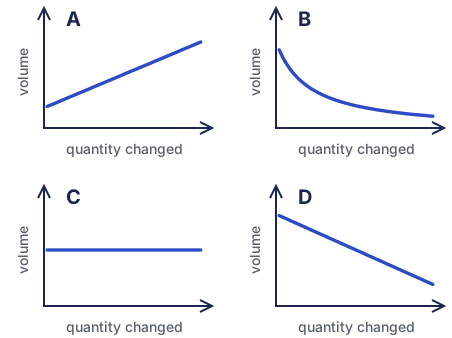
Write the number of the matching option.
- Graph A
- Graph B
- Graph C
- Graph D
- Volume as the pressure increases, at constant temperature: ______
- Volume as the temperature increases, at constant pressure: ______
What feature of each graph did you look for?
Nudge (only if you are stuck): Which of your two experiments made the volume go down? Did each weight squash the air by the same amount?
6. describe / explain
A table-tennis ball has a dent in it but no crack, so no air can get in or out. When it is dropped into a bowl of hot water, the dent pops out and the ball is round again. (a) Describe what happens to the air inside the ball. (b) Explain, using kinetic particle theory, why the dent pops out.
(a) What happens to the air inside the ball
(b) Why the dent pops out, using kinetic particle theory
Nudge (only if you are stuck): Which part of the syringe experiment is this like? What does the dented part of the ball do instead of the plunger?