Pupil sheet · Mixtures and separation
Where did the salt go? — questions
Name ______________________ Date ____________
Try every question before you use a nudge. Write in full sentences where you are asked to explain.
1. Identify / Explain
Salt has fully dissolved in water. Fill the gaps to identify the solvent and explain its role.
The solvent is …
It is the solvent because …
Nudge (only if you are stuck): Which substance did the salt dissolve in?
2. Identify / Explain
The salt crystals are no longer visible. Fill the gaps to explain what happened to the salt.
The solute is …
After dissolving, it is spread through …
No visible crystals does not mean …
Nudge (only if you are stuck): Which ingredient began as crystals? Does spreading out mean it has gone?
3. Identify / Explain / Describe
This is a written case, not an experiment to try. A little iodine dissolves completely in liquid ethanol. Only these two substances are present. Identify the solvent and solute. Describe everything the solution contains.
Solvent — identify it and explain its role
Solute — identify it and explain its role
Solution — describe everything it includes
Nudge (only if you are stuck): What dissolves in what? Use that relationship, even though the solvent isn't water.
4. Explain
A pupil stirs salt into water until no crystals can be seen. They write: ‘The salt was destroyed.’ Later, a teacher removes the water and recovers salt. Explain why that evidence challenges the pupil's claim.
Nudge (only if you are stuck): What must have been in the clear liquid for salt to come out later?
5. Describe / Explain
A contains pure water only. B contains water with all its sugar dissolved. C contains water and visible, undissolved sand. Classify B and C, then give one reason for each choice.
Write the number of the matching option.
- Pure substance
- Homogeneous mixture (a solution in these cases)
- Heterogeneous mixture
- Sample B: ______
- Sample C: ______
Give one reason for each classification.
Nudge (only if you are stuck): B has two components: how are they mixed? What separate part remains in C?
6. Explain
X is a clear liquid with unknown contents. Y is clear blue liquid containing only water and fully dissolved copper(II) sulfate. Choose the conclusions the evidence supports. Explain your choices.
Tick every correct statement.
- X must be pure because it is clear.
- Appearance alone cannot establish whether X is pure.
- Y is a solution even though it is blue.
- A blue liquid cannot be a solution.
Use the composition and appearance to explain your conclusions about both samples.
Nudge (only if you are stuck): For which sample do you know the contents? Does ‘clear’ mean the same as ‘colourless’?
7. Identify / Explain
Consider a written sample of water with a little oxygen gas dissolved evenly through it. There are no bubbles or other substances. Identify the solvent and solute, then name both parts of the solution. Explain why seeing nothing doesn't mean there's no solute.
Nudge (only if you are stuck): Does a solute have to begin as a solid? What is the difference between dissolved gas and a separate bubble?
8. Identify / Explain
Read the component-map key. Classify A, B and C, then explain each choice using the contents. The symbols label components; they aren't actual particle shapes, sizes or numbers.
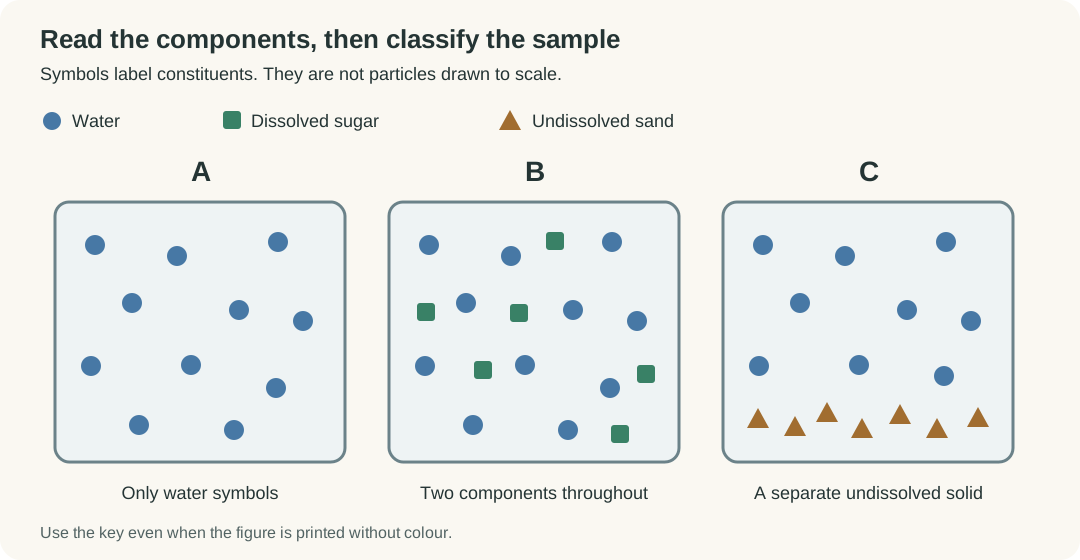
Write the number of the matching option.
- Pure substance
- Homogeneous mixture (a solution in these cases)
- Heterogeneous mixture
- Map A: ______
- Map B: ______
- Map C: ______
Explain each choice using component identity and whether the second component is dissolved.
Nudge (only if you are stuck): First count the kinds of component. If there are two, is the second dissolved or separate?