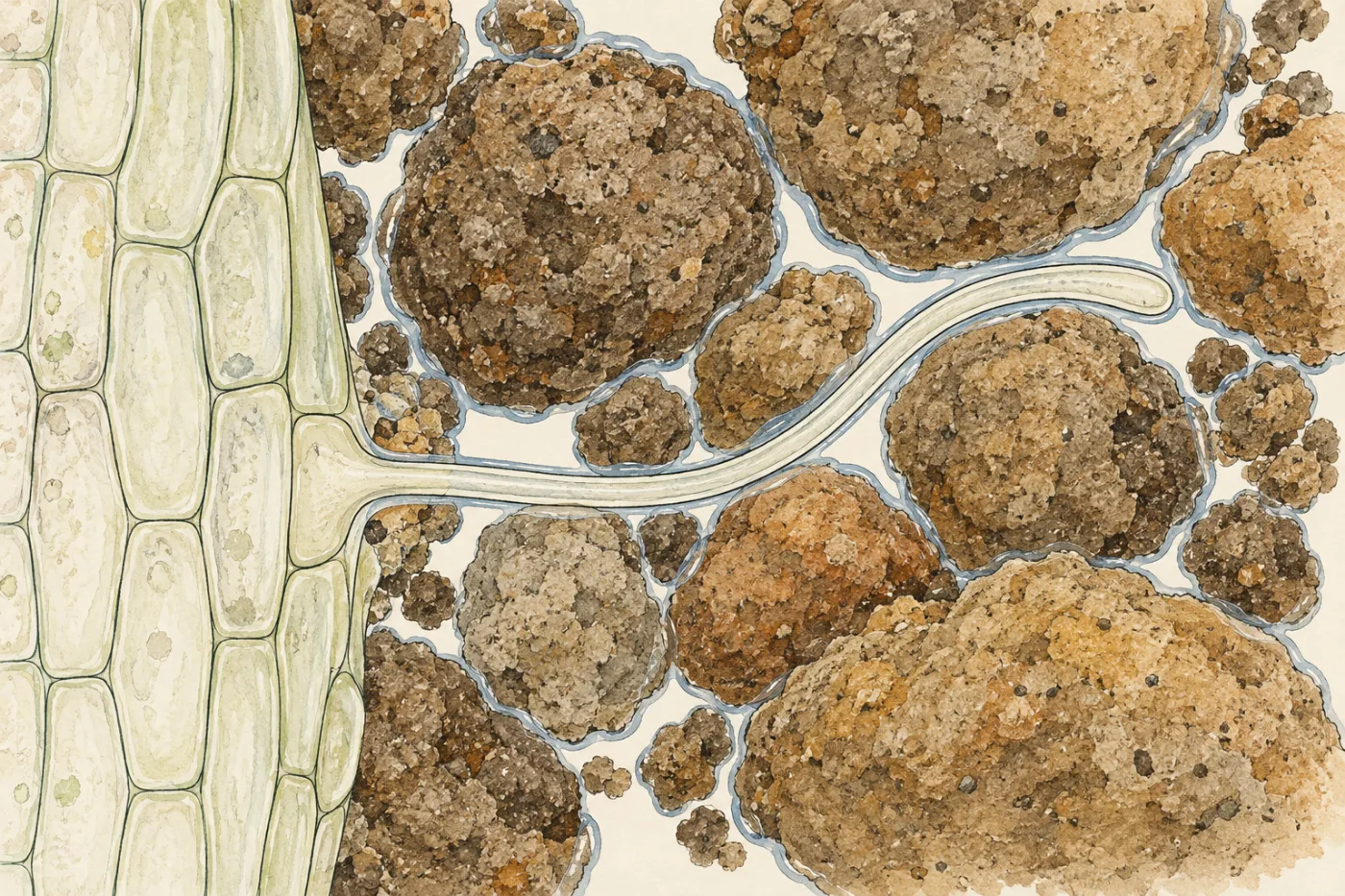
A plant root takes in mineral ions, such as nitrate ions, from the water in the soil. Measure the nitrate ions, and you find something strange: there are more of them inside the root hair cells than in the soil water outside. Diffusion would carry them out of the root, down the gradient, not in. So how does a root keep taking in more?
 (enlarge)
Against the gradient
The root hair cell uses active transport: the movement of particles through a cell membrane from a region of lower concentration to a region of higher concentration, against a concentration gradient, using energy released during respiration. Respiration is a series of chemical reactions in every living cell that releases energy from glucose. Most of it is aerobic respiration, which uses oxygen and happens mainly in the mitochondria. Diffusion needs no energy from respiration (its particles move with their own kinetic energy); active transport does.
| Diffusion | Active transport | |
|---|---|---|
| Direction | down a concentration gradient (high to low) | against a concentration gradient (low to high) |
| Energy from respiration | not needed | needed |
| Carrier proteins in the membrane | not needed | needed |
Trap: "Active transport is fast diffusion." It moves particles the opposite way to diffusion, against the gradient, and it stops if the cell cannot respire.
Carrier proteins
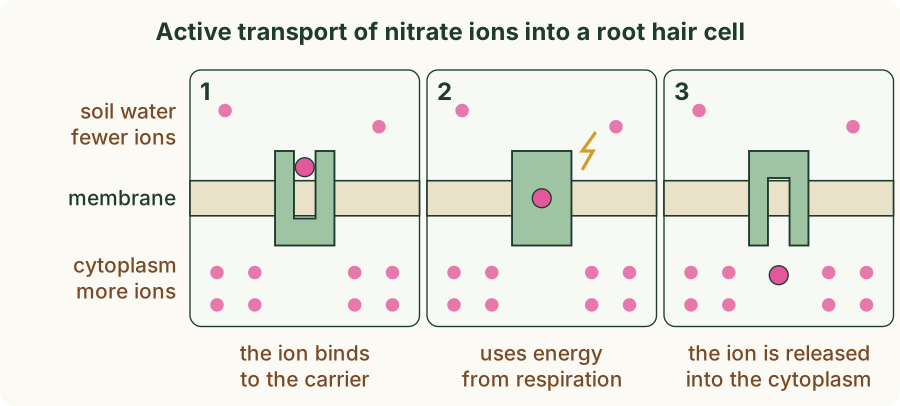
How can a cell push ions the "wrong" way? The cell membrane contains special protein carriers. A carrier picks up a particular ion on one side of the membrane, changes its shape using energy from respiration, and releases the ion on the other side. Then it changes back and is ready for the next ion. Each kind of carrier moves only certain substances.
 (enlarge)
Why it matters
Root hair cells use active transport to take in mineral ions that are scarce in the soil water. Without it, a plant could not collect enough nitrate ions to make proteins. In the same way, cells lining the small intestine use active transport to take up the last of the glucose from digested food, even when there is more glucose in the cells than in the gut.
Because active transport needs energy, a root needs oxygen for aerobic respiration. A plant in waterlogged soil, where the air spaces are full of water and oxygen is scarce, takes in fewer ions.
Key idea: Active transport moves particles against a concentration gradient, through protein carriers in the cell membrane, using energy from respiration.