About 380 years ago, Jan van Helmont planted a small willow tree in a tub of dried soil that he had weighed, and for five years he gave it nothing but water. By the end, the tree had gained about 74 kilograms, yet the soil had lost less than 100 grams. So where did almost all of the new wood, bark and leaves come from? Make a guess and keep it in mind as you read. In this part you find out what a plant builds its food from, and what it needs to do it.
Food made from air and water
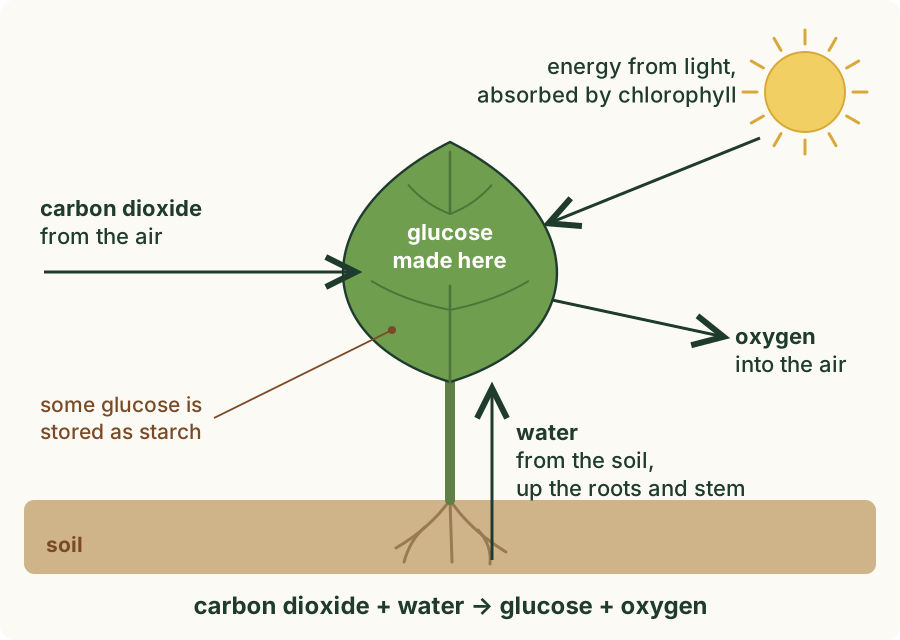
A plant makes its own food. In its leaves it takes two simple substances, carbon dioxide and water, and builds them into a sugar called glucose. These two substances are the raw materials: what the plant starts from. Building larger molecules from smaller ones takes energy, and the leaf gets that energy from light. So photosynthesis is the process by which plants synthesise (build up) carbohydrates from raw materials using energy from light. (Carbohydrates are sugars, starch and similar substances, made of carbon, hydrogen and oxygen.)
The carbon dioxide comes from the air. It enters the leaf through tiny pores, mostly on the underside. The water comes from the soil: the roots take it up, and it travels up the stem to the leaves. Glucose is a carbohydrate, built from carbon, hydrogen and oxygen atoms, and those atoms all come from the carbon dioxide and the water. Oxygen is made as well. The plant does not need all of it, so most of it is released into the air.
 (enlarge)
So van Helmont's willow was built mostly from carbon dioxide taken from the air, together with water. The plant turns glucose into the other substances of its body, such as the cellulose of its cell walls (part 3). The soil gave the tree water and only small amounts of mineral ions, which is why the soil hardly lost any mass.
Trap: "Plants get their food from the soil." The soil gives a plant water and small amounts of mineral ions, but not its food. The plant makes its food, carbohydrates, itself, in its leaves, from carbon dioxide and water.
The word equation
Photosynthesis is summed up in a word equation. The raw materials go on the left of the arrow, and the products, the new substances made, go on the right:
carbon dioxide + water → glucose + oxygen (in the presence of light and chlorophyll)
"In the presence of" means these two must be there, but neither is a raw material: no atoms from them end up in the glucose. Light is energy, not a substance. Its energy is passed into the glucose, so light has to keep falling on the leaf for photosynthesis to go on. Chlorophyll is the green substance in leaves that absorbs the light; it is not changed by photosynthesis, so the same chlorophyll works again and again. When an equation is written by hand, light and chlorophyll often go above and below the arrow.
The glucose stays in the plant. Much of it is turned into starch for storage, often within minutes and in the leaf itself, and some is used straight away. (Part 2 uses that starch as evidence of photosynthesis, and part 3 follows where the rest of the glucose goes.) The oxygen is released into the air, and nearly all the oxygen in the air was made by photosynthesis.
Trap: "Light is a raw material, like carbon dioxide and water." Light supplies the energy that builds glucose, but it is not a substance, so it is not a raw material. That is why light is written beside the arrow, not on the left of it.
Trap: "Photosynthesis is the way plants breathe." Photosynthesis makes glucose and gives out oxygen. Respiration is a different process: it breaks glucose down to release energy, and it goes on in every living cell of the plant, day and night. Photosynthesis happens only in the light, and only in cells with chlorophyll.
Chlorophyll: the green pigment
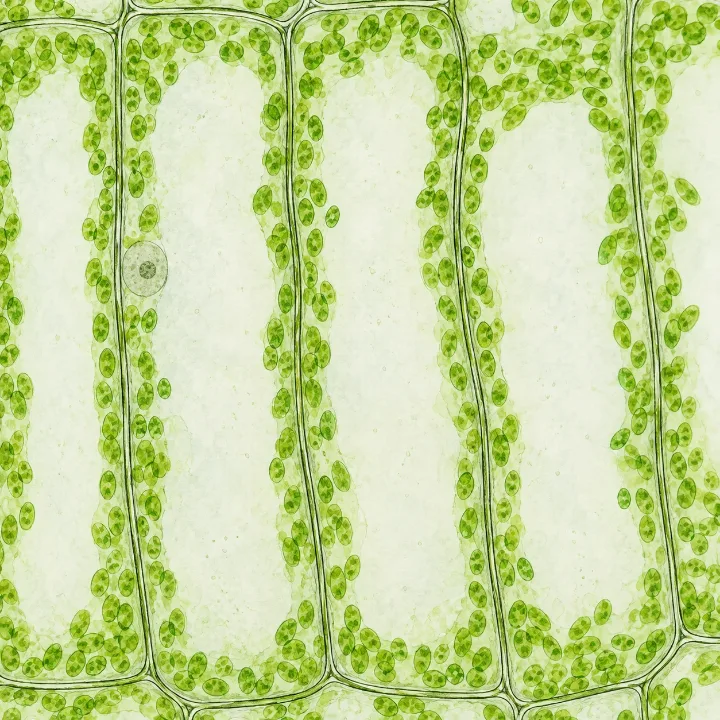
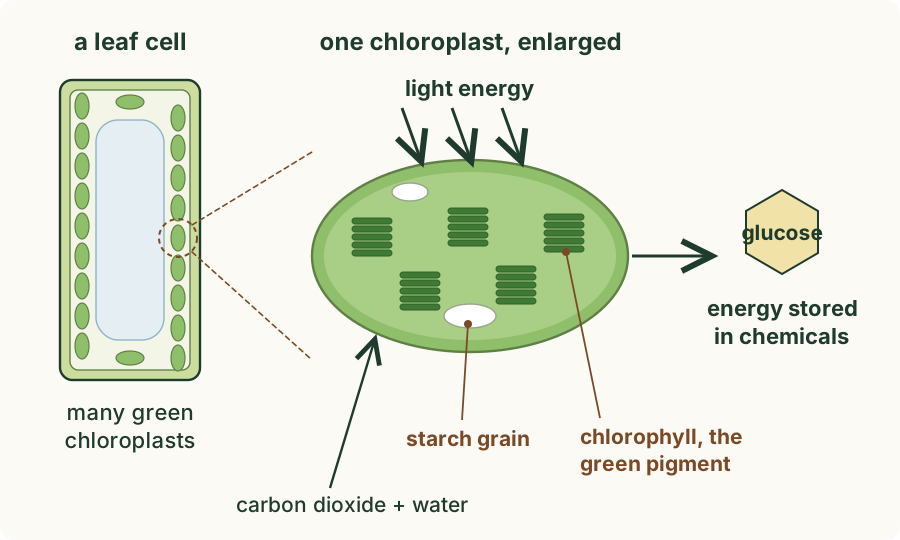
A pigment is a coloured substance. Chlorophyll is a green pigment, and it is found in chloroplasts: small structures inside plant cells, most of all in the leaf cells near the upper surface, where the light falls. Not every plant cell has them: root cells, underground in the dark, have no chloroplasts and make no food. Under a microscope, a leaf of pondweed shows dozens of chloroplasts in every cell.
 (enlarge)
Chlorophyll absorbs light, mostly red and blue light. It reflects most of the green light, which is why leaves look green. Some leaves look red or purple: another pigment hides the green, but the chlorophyll is still there underneath and still absorbs light. The energy it absorbs does not stay as light. Chlorophyll transfers energy from light into energy in chemicals: the energy is used to build glucose from carbon dioxide and water, so it ends up stored in the glucose molecules. That stored energy is what the plant, and every animal that eats a plant, releases later in respiration.
 (enlarge)
Trap: "Chlorophyll is used up to make glucose." Chlorophyll is not a raw material. It absorbs the light and passes its energy on, and then it absorbs more light. The atoms of glucose come only from carbon dioxide and water.
Supplement: the balanced equation
This section is Supplement content (syllabus 6.1.10).
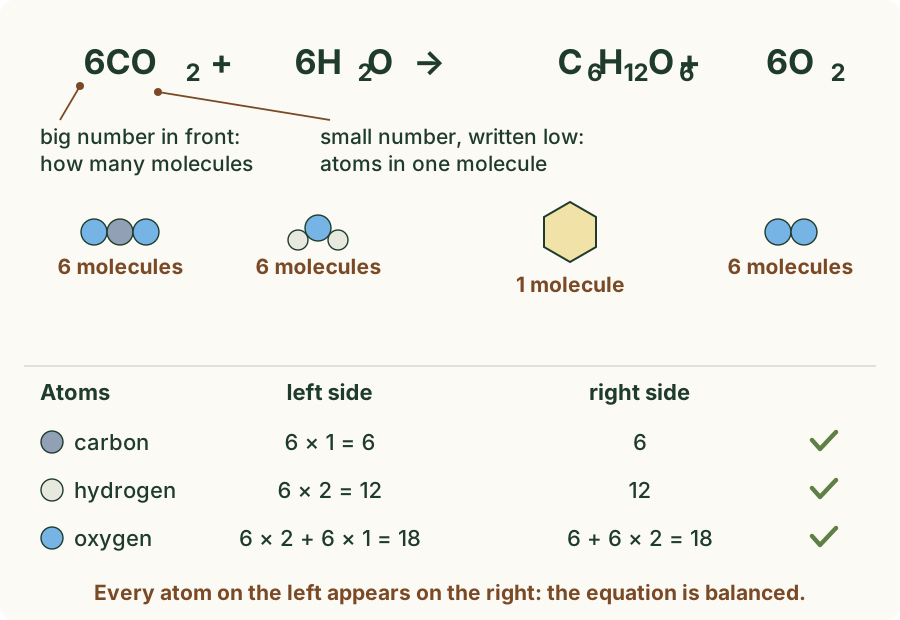
The word equation can also be written with formulas. Carbon dioxide is CO2, water is H2O, glucose is C6H12O6 and oxygen is O2. The balanced chemical equation for photosynthesis is:
6CO₂ + 6H₂O → C₆H₁₂O₆ + 6O₂
There are two kinds of number here. A small number written low, such as the 2 in CO2, tells you how many atoms of the element just before it are in one molecule: one carbon dioxide molecule has one carbon atom and two oxygen atoms. A big number in front, such as the 6 in 6CO₂, tells you how many molecules there are. The 6s come from counting atoms, not from an experiment: atoms are not created or destroyed in a reaction, so every atom on the left must appear on the right. Count them: 6 carbon atoms on each side, 12 hydrogen atoms on each side, and 18 oxygen atoms on each side (12 in the carbon dioxide plus 6 in the water; 6 in the glucose plus 12 in the oxygen).
 (enlarge)
Trap: "To balance it, change CO2 into CO3." Changing a small number changes the substance itself: CO3 is not carbon dioxide. Balance an equation only by changing the big numbers in front.
Key idea: Photosynthesis is the process by which plants synthesise carbohydrates from raw materials using energy from light: carbon dioxide + water → glucose + oxygen, in the presence of light and chlorophyll. Chlorophyll is a green pigment found in chloroplasts; it transfers energy from light into energy in chemicals, for the synthesis of carbohydrates. (Supplement) The balanced equation is 6CO₂ + 6H₂O → C₆H₁₂O₆ + 6O₂.