A potato grows underground, in the dark, where no photosynthesis can happen. Yet a potato is packed with starch: put a drop of iodine solution on a cut potato and it turns blue-black. So where did that starch come from? The leaves above ground made glucose, and the plant sent sugar down the stem to the swelling potato, where it was built into starch. In this part you follow the glucose from the leaf to its five main uses. You also meet the two mineral ions a plant needs to turn sugar into the rest of its body.
Where the glucose goes
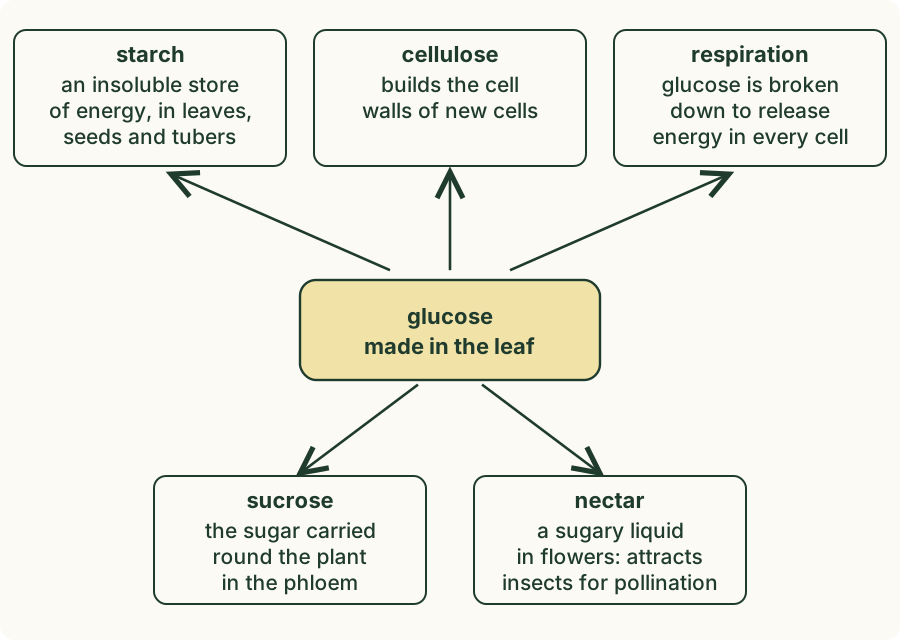
Some of the glucose is used at once, in respiration. Every living cell of the plant respires, all day and all night, in the roots and flowers as much as in the leaves. Respiration breaks glucose down to release energy, which the cells use to build new substances and to grow. Cells with no chlorophyll, such as root cells underground and the cells of most coloured petals, cannot photosynthesise, so they depend on sugar sent from the leaves.
The plant keeps much of its glucose as starch, an energy store. Starch is made of many glucose units joined together, and it is insoluble. Glucose dissolves, so a cell full of glucose would draw in water by osmosis; starch does not, so a cell can store a great deal of it. Leaves store starch during the day and use it up at night. Seeds and storage organs such as potatoes store starch for months. When the energy is needed, the starch is broken back down to glucose.
Glucose is also used to make cellulose: long, straight chains of glucose units, which build the cell walls. Every new cell needs a wall, so a growing plant uses a lot of its glucose this way.
To travel round the plant, glucose is first turned into sucrose, another sugar. Sucrose is carried in the phloem: tubes that run from the leaves to every other part, such as roots, growing tips, fruits and potatoes. Where it arrives, the sucrose is turned back into glucose, to be used or stored.
Flowers make nectar, a sugary liquid. Insects such as bees come to feed on it, and while they do, pollen sticks to their bodies. When they visit the next flower, some of that pollen rubs off. So the nectar attracts the insects that carry out pollination.
 (enlarge)
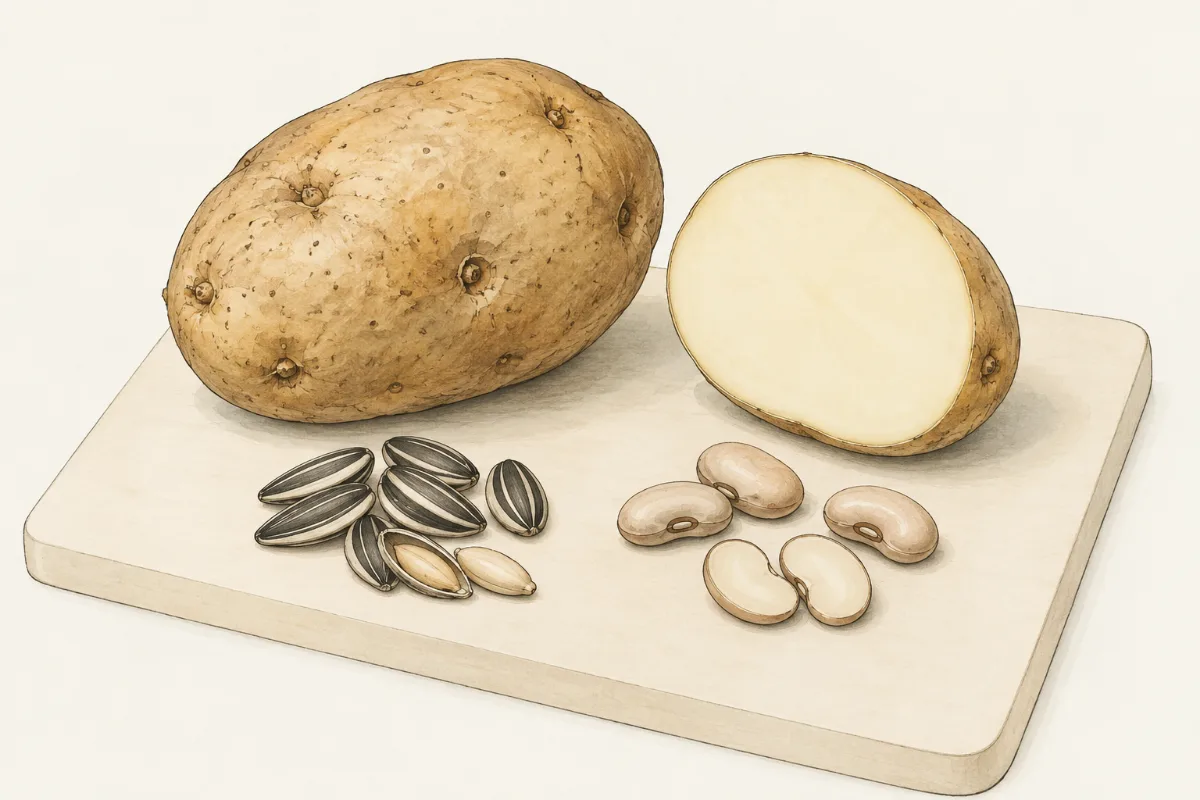
Plant stores feed us too. A potato and a bean seed both store mostly starch, and beans store protein as well. A sunflower seed stores mostly oil, which the plant also makes from its sugar.
 (enlarge)
Trap: "Plants respire only at night, when they cannot photosynthesise." Every living cell respires all the time, day and night. In bright light, photosynthesis is simply faster, so it hides the respiration.
Trap: "The plant stores its glucose as glucose." Glucose dissolves, and stored in large amounts it would draw water into the cells by osmosis. So the plant stores it as starch, which is insoluble.
Trap: "The phloem carries glucose." The phloem carries sucrose. Glucose is turned into sucrose for the journey and back into glucose where it arrives.
Mineral ions from the soil
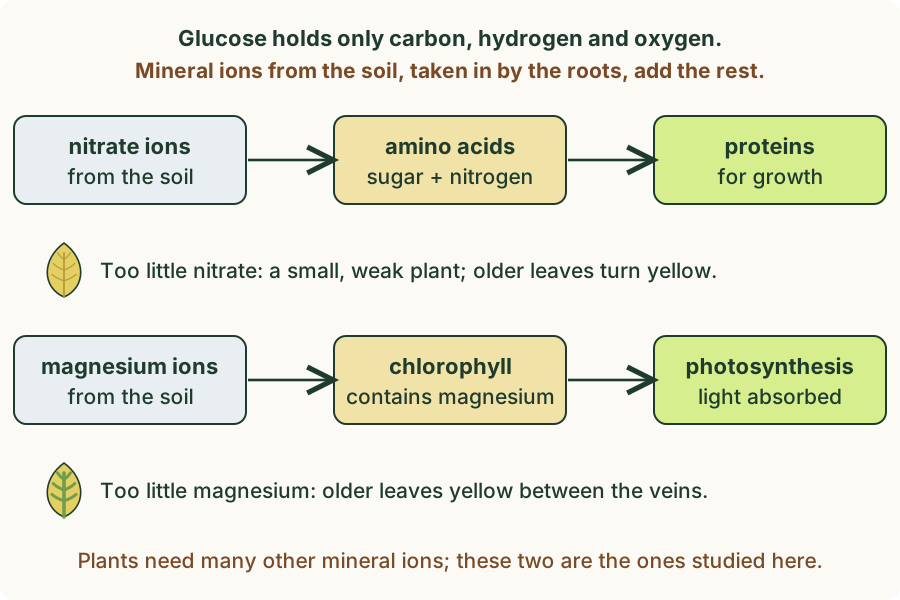
Glucose is made of only three elements: carbon, hydrogen and oxygen. But a plant's body contains other elements too. Every protein contains nitrogen, and every chlorophyll molecule contains magnesium. The plant takes these elements from the soil as mineral ions, dissolved in the soil water and taken up by the roots.
Nitrate ions supply nitrogen. The plant combines that nitrogen with sugar from photosynthesis to make amino acids, and it joins amino acids together to make proteins. Proteins build new cells, and enzymes are proteins too, so a plant cannot grow without them. A plant short of nitrate grows slowly and stays small and weak, and its older leaves turn yellow.
Magnesium ions are needed to make chlorophyll: there is one magnesium atom at the centre of every chlorophyll molecule. A plant short of magnesium cannot make enough chlorophyll, so its older leaves turn yellow between the veins. With less chlorophyll, its leaves absorb less light and make less glucose.
 (enlarge)
Why the older leaves first? When an ion is scarce, the plant moves nitrogen or magnesium out of its old leaves and into its new growth. And why does a lack of nitrate turn leaves yellow? Chlorophyll molecules contain nitrogen as well as magnesium, and so do the proteins of the chloroplasts.
Trap: "Fertiliser is plant food." A fertiliser supplies mineral ions, such as nitrate and magnesium. A plant's food is the sugar it makes itself by photosynthesis. The ions let it turn that sugar into proteins and chlorophyll.
Testing which ion a plant needs
Yellow leaves are a sign that something is wrong, but they do not say what. A shortage of another mineral, too much or too little water, cold, disease or simple old age can all turn leaves yellow. So to show that a plant needs one ion, you test it like the leaves in part 2: change one thing and keep everything else the same.
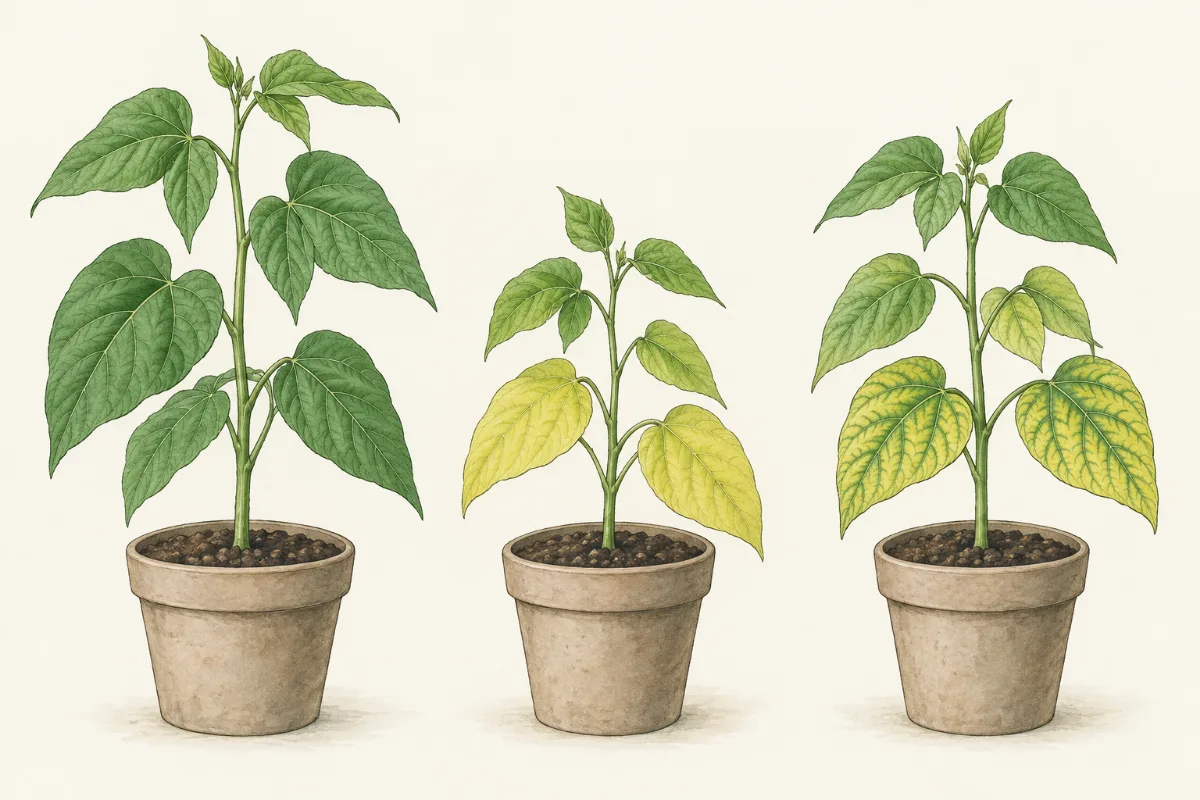
Seedlings of the same kind and size are grown in water with mineral ions dissolved in it. One group gets a complete solution, with every ion a plant needs: that is the control. A second group gets the same solution without nitrate, and a third without magnesium. Every group has the same light, temperature and volume of solution. Each group has several seedlings, not just one, because seedlings vary: one odd seedling must not decide the result. After a few weeks, you record the leaf colour of each seedling and measure its height. Then you compare each group with the control.
To compare groups of several seedlings, work out the mean height of each group: add up all the heights in the group, then divide by the number of seedlings. For example, three seedlings 4 cm, 5 cm and 9 cm tall add up to 18 cm, and 18 ÷ 3 = 6 cm, so their mean height is 6 cm. (The middle value, 5 cm, is the median, which is not the same thing.)
 (enlarge)
Trap: "Yellow leaves always mean too little magnesium." Yellowing has many causes, including too little nitrate. Only a comparison with a control, where the plants differ in one ion, shows which ion is missing.
Key idea: The glucose made in photosynthesis is used in respiration to provide energy; stored as starch, an insoluble energy store; built into cellulose for cell walls; turned into sucrose for transport in the phloem; and used to make nectar, which attracts insects for pollination. Nitrate ions supply the nitrogen to make amino acids, and so proteins; magnesium ions are needed to make chlorophyll. A plant short of nitrate grows small and weak with yellow older leaves; a plant short of magnesium has older leaves yellow between the veins.