A note written in green ink turns up on a desk, and three green pens lie nearby. Which pen wrote it? All three inks look the same green, so looking won't settle it. A forensic scientist could put a tiny sample of the note's ink beside a sample from each pen on one piece of chromatography paper, and compare the patterns.
In part 1 your green dye U split into a blue spot and a yellow spot. In this part you'll learn to read a pattern like that: what a match with a known sample tells you, what a single spot can and can't tell you, and where the evidence stops.
Read lanes under the same conditions
The dried paper with its separated spots is called a chromatogram. Each sample has its own lane, which starts from its own labelled spot on the baseline. To compare lanes fairly, every sample must travel under the same conditions: the same solvent, the same kind of paper and the same temperature. That matters because each of them changes how far a substance travels. The simplest way to keep the conditions the same is to run the unknown sample and the known samples side by side, on one sheet of paper, at the same time. The known samples are your references.
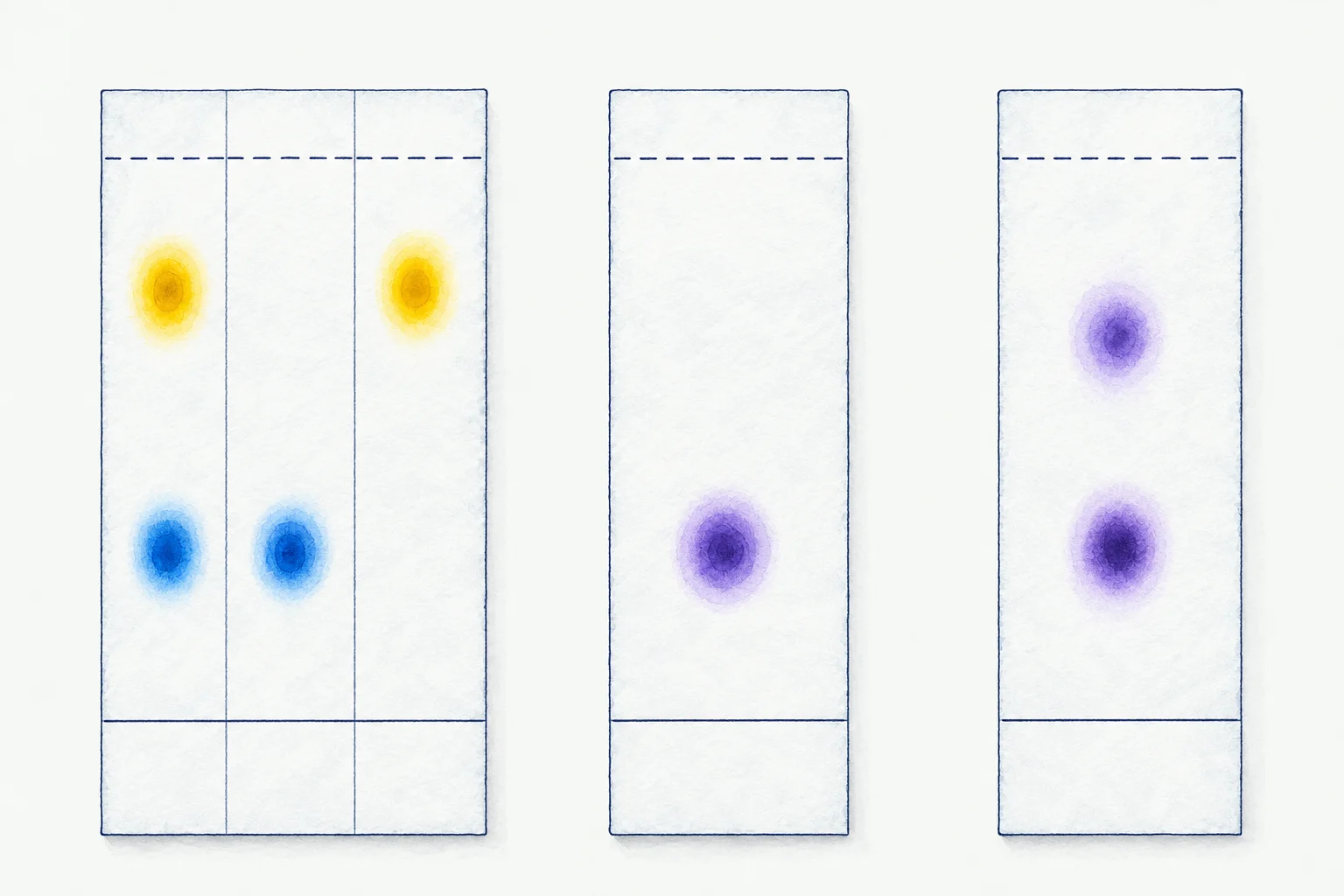
In your run, U's blue spot is level with A's spot, and U's yellow spot is level with B's. The same colour at the same height on the same paper supports the idea that U contains A and B: it's evidence for it. It doesn't prove it, though, because two different substances can happen to travel the same distance under the same conditions. So a match isn't unique, belonging to one substance only, the way a fingerprint belongs to one person. Back at the desk, a match between the note and one pen supports that pen. Any other pen filled with the same ink would match too, though.
A match needs both things at once: the same colour and the same height on the same paper. Two red spots at different heights don't match, however alike they look.
 (enlarge)
More than one spot, or only one?
Remember from part 1: a pure substance contains only one substance, and a mixture contains more than one. Here a mixture can also be called an impure sample. Before you read on, predict which claim is stronger: “two separated spots show a mixture”, or “one spot proves purity”.
Two separated spots from one sample are strong evidence. They show at least two different substances, so the sample is a mixture. One spot is weaker evidence. It's consistent with purity, meaning it fits a pure sample, but it doesn't guarantee it, because two things can hide a second substance. First, two substances might travel the same distance in this solvent, so their spots overlap and look like one. Second, some substances are colourless: they travel up the paper but leave no stain you can see. Either way the mixture is concealed, or hidden. So one visible spot is just that: one spot you can see, and it may still hold more than one substance.
Colourless spots can be found, though. Once the run is over and the paper is dry, a chemist can spray it with a locating agent, a chemical that turns the hidden spots coloured. Any way of making invisible spots show like this is a locating method. Before it the lane looks blank; after it, spots appear where the colourless substances stopped. Part 3 shows how it's done.
Trap: “One spot means definitely pure.” You may have detected only one spot, rather than every component. A blank lane doesn't prove the sample was empty either: its substances may be colourless, and only a suitable locating method would show them.
Worked example
a match with a limit
J gives a red spot and a blue spot. On the same paper, known R gives a red spot level with J's red spot. Known K gives a blue spot, but at a different height from J's blue one. What can you conclude?
J is a mixture, because it separated into two spots. The red match supports R being present in J. K doesn't match J's blue spot under these conditions, because the heights differ, even though the colours are the same. Matching colour alone isn't enough.
Worked example
question a single spot
X gives one spot in solvent S. A fresh portion of X, run in solvent T, gives two spots. What does that show?
X is a mixture. Solvent T separated two components that solvent S didn't pull apart, so in S they stayed together as one spot. Notice what you shouldn't do with these papers, too. Don't compare heights between the S paper and the T paper to identify a dye, because changing the solvent changes how far each substance travels. Those two runs weren't under the same conditions.
Choose evidence for the question
Want to compare the soluble dyes in a food colouring? Use chromatography, because it separates small amounts into a pattern you can compare with references. Filtration lets the dissolved dyes run straight through with the liquid, so it can't give you the separated spots you need.
Case closed
- More than one separated spot? The sample is a mixture.
- One visible spot? Purity is possible, not proven.
- Matching spots? Compare them under the same conditions, and say what the match can't prove.
About this model
These patterns are made up to teach you how to read a chromatogram. The number of spots tells you the smallest number of visible substances that separated. A match supports an identity only under the stated conditions. It doesn't prove a unique identity, and one spot doesn't prove complete purity.