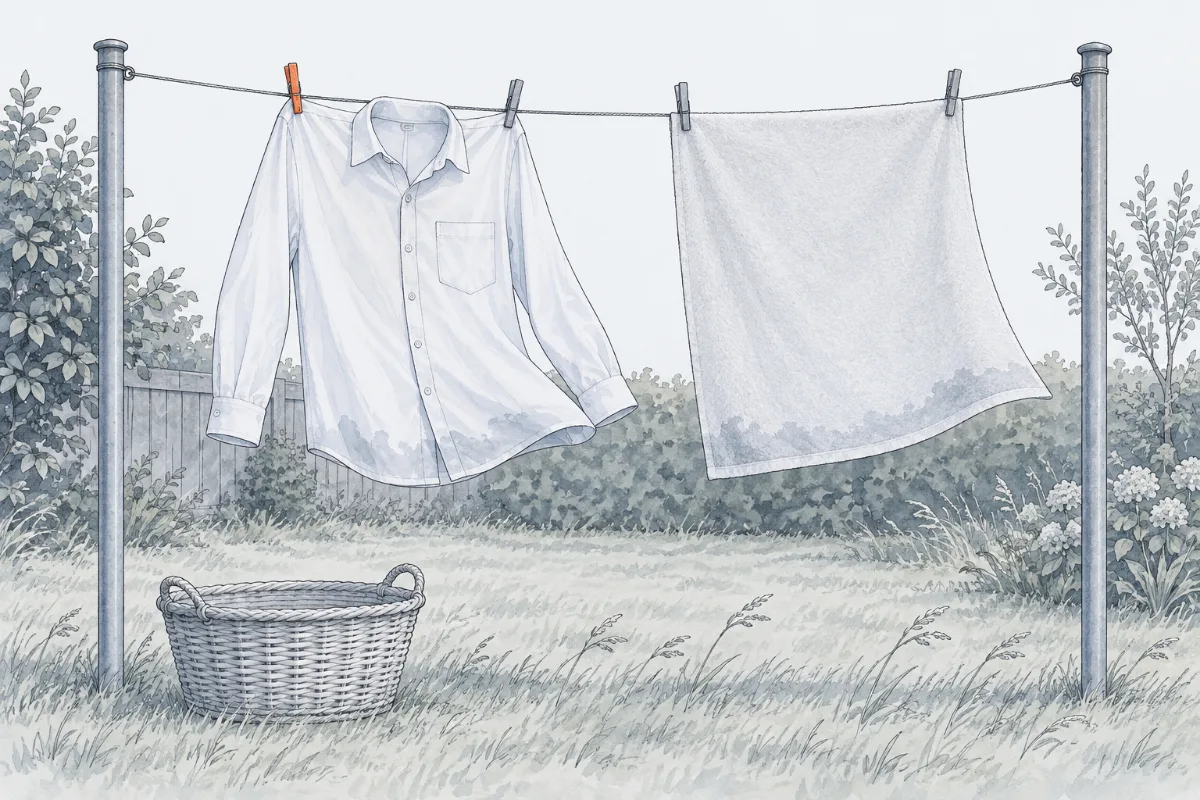
Washing hung out on a warm, breezy morning can be dry by lunchtime. On a cold, still day the same washing can still be damp in the evening, and a shirt left folded in the basket hardly dries at all. In every case the water in the clothes is evaporating, but at very different rates. In the last part, sweat cooled the skin by evaporating, so anything that speeds up evaporation should cool you faster. What makes evaporation faster or slower? In this part you change one thing at a time on the same wet towel and weigh how much water it loses. Then you compare evaporation with boiling, and see how people and animals use evaporation to keep cool.
 (enlarge)
Change one thing at a time
What is on the bench. The same two tubes, towels, balances and thermometers as in part 2, the beakers of water at 70 °C and 50 °C, the dropper, the fan, a bowl for emptying the tubes, and a sleeve of cling film that fits over the top half of towel B. The room is still at 20 °C.
What you do. The first run, in still air from 70 °C, is already done: towel B lost 0.64 g of water in 5 minutes. Now change one thing at a time, in three more runs. First, switch on the fan, which blows on both tubes, and run for 5 minutes from 70 °C. Next, with the fan off, slide the cling-film sleeve over half of towel B, and run again from 70 °C. Last, with the fan off and no film, fill both tubes from the beaker of water at 50 °C. Before each of these runs, say what must stay the same, then predict: will towel B lose more water than in still air, less, or about the same? Each run starts the same way: both tubes are emptied into the bowl and filled again with fresh water, and towel B is topped back up to 3.00 g with the dropper. After each run, compare the mass of water towel B lost, shown in the table of runs, with the 0.64 g in still air, and use the magnifier to explain the result. Finally, compare boiling with evaporation.
What the experiment showed
Do the experiment before you read on. Each run changed one thing. In every run towel B started with 3.00 g of water, and every run lasted 5 minutes, so the mass of water lost in that time compares the rates of evaporation fairly. None of the runs came near drying the towel: the most it lost was 0.92 g of the 3.00 g.
| run | balance B at the start / g | balance B after 5 minutes / g | water lost / g | tube A fell by / °C | tube B fell by / °C |
|---|---|---|---|---|---|
| still air, from 70 °C | 81.23 | 80.59 | 0.64 | 11.0 | 25.5 |
| fan on, from 70 °C | 81.23 | 80.31 | 0.92 | 19.0 | 36.0 |
| half of towel B covered, from 70 °C | 81.58 | 81.19 | 0.39 | 11.0 | 21.5 |
| both tubes from 50 °C | 81.23 | 80.88 | 0.35 | 6.5 | 15.0 |
The cling film itself added 0.35 g, so in the half-covered run balance B started at 81.58 g. The water lost is still the start minus the end: 81.58 g − 81.19 g = 0.39 g.
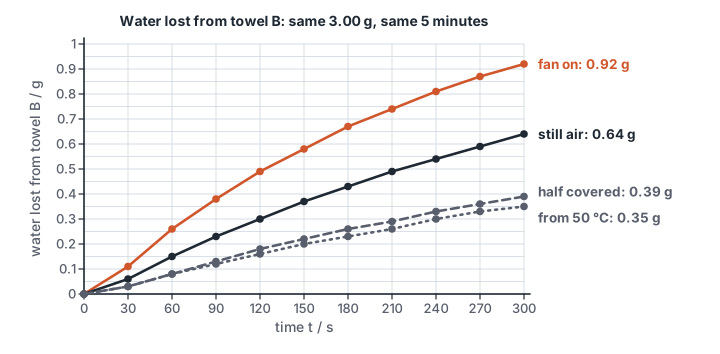
With the fan on, 0.92 g of water evaporated: 0.28 g more than the 0.64 g in still air. With half of the towel covered, only 0.39 g evaporated. That is less than in still air, though not exactly half of 0.64 g: with less water evaporating, the towel stayed warmer, and warmer water evaporates faster. From 50 °C, only 0.35 g evaporated, about half as much as from 70 °C.
 (enlarge)
Why compare the water lost on the balance, and not the cooling curves? Because a fan or a hotter tube also changes how fast energy leaves a tube in other ways. Look at tube A, which had no water on its towel at all: with the fan on, it fell by 19.0 °C instead of 11.0 °C. So a faster fall on tube B's thermometer does not, by itself, show faster evaporation. The balance measures the evaporation itself: the mass of water that went from the towel into the air.
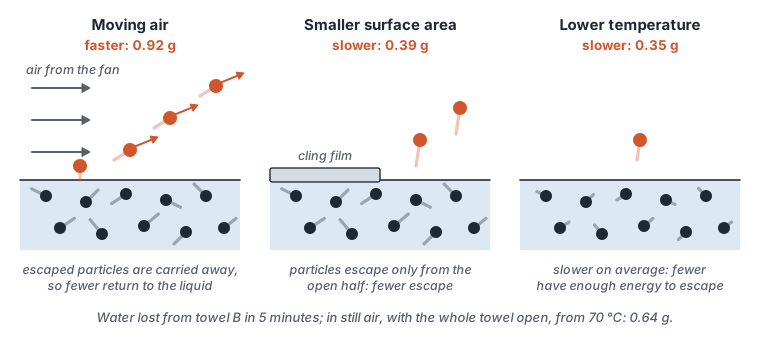
Through the magnifier, with the fan on, the escaped particles were swept away from the surface of the towel. With the film on, half of the surface was covered, and particles escaped only from the open half. At 50 °C, the particles moved more slowly on average, and fewer of them escaped.
Why the rate changes
Three things change how fast a liquid evaporates: the air movement over its surface, its surface area and its temperature. Each one changes how many particles escape each second, or how many of them come back.
 (enlarge)
Moving air. In still air, the escaped particles stay near the surface for a while as water vapour, and some of them wander back into the liquid. Air moving over the surface carries the escaped particles away, so fewer return to the liquid, and evaporation is faster. That is why the fan sped up evaporation from towel B, and why washing dries faster on a windy day.
Surface area. Particles can escape only from the surface. A smaller surface area has fewer particles at the surface, where they can escape, so fewer escape each second and evaporation is slower. Covering half of towel B kept only half of its surface open. A puddle spread thin over the ground dries much faster than the same water in a deep cup.
Temperature. At a lower temperature, the particles move more slowly on average, so fewer of them have enough energy to escape from the surface: evaporation is slower. At a higher temperature more of them do, and evaporation is faster. From 50 °C, towel B lost about half as much water as from 70 °C. The same idea explains why balance B fell more slowly near the end of every run: as the towel cooled, its water evaporated more slowly.
Trap: “The fan makes the water evaporate faster because it blows cold air on it.” The air from the fan is at room temperature, the same as the still air. It speeds up evaporation because it carries the escaped particles away from the surface, so fewer return to the liquid.
Trap: “A bigger surface area makes each particle more likely to escape.” Each particle at the surface has the same chance whatever the area. A bigger area simply has more particles at the surface, so more of them escape each second.
Worked example
The fan run
With the fan on, balance B fell from 81.23 g to 80.31 g in 5 minutes. (a) Calculate the mass of water that evaporated, and compare it with the 0.64 g in still air. (b) Explain the difference in terms of particles. (c) With the fan on, tube A, in the dry towel, fell by 19.0 °C instead of 11.0 °C. Explain why the rates of evaporation are compared using the balance, not the thermometers.
(a) 81.23 g − 80.31 g = 0.92 g evaporated. That is 0.92 g − 0.64 g = 0.28 g more than in still air, in the same 5 minutes, with the same 3.00 g of water on the towel. (b) In still air, some of the escaped water particles stay near the surface and wander back into the towel. The moving air carries the escaped particles away, so fewer return, and more water evaporates each second. (c) The fan cooled tube A faster too, and tube A had no water to evaporate: moving air also carries energy away from a warm tube in other ways. So a bigger fall in temperature does not, by itself, show more evaporation. The balance measures the mass of water that evaporated, which is the evaporation itself.
Boiling and evaporation
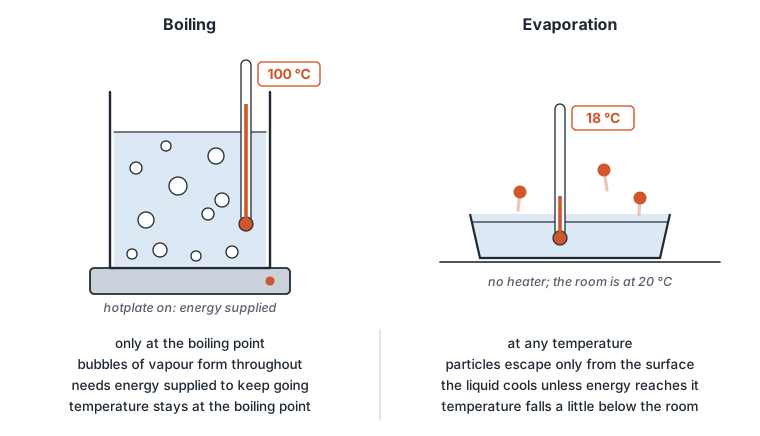
Heat a pan of water on a hob. Long before it boils, it is already evaporating: from the moment you switch on, some of the fastest particles at the surface escape. Once the water is hot, a mist rises above it, where the escaped water vapour meets cooler air and condenses into tiny drops. At 100 °C something different starts. Bubbles of water vapour form at the bottom of the pan and throughout the water, rise and burst. That is boiling. Both are a liquid turning into a gas, but they differ in four ways.
| boiling | evaporation | |
|---|---|---|
| when | only at the boiling point: 100 °C for water at standard atmospheric pressure | at any temperature |
| where | throughout the liquid: bubbles of vapour form inside it | only from the surface |
| energy | needs energy supplied all the time to keep going | needs no heater: the liquid cools unless energy reaches it from its surroundings |
| temperature | stays at the boiling point | the liquid cools, to a little below its surroundings if nothing warms it |
Evaporation happens at any temperature because, at any temperature, a few particles near the surface are fast enough to escape. It happens only from the surface because a particle deep in the liquid soon hits its neighbours. Boiling needs the boiling point, because only there can bubbles of vapour form inside the liquid and survive. To keep a liquid boiling, energy must be supplied to it, transferred to the liquid all the time: from a hob, a flame, or anything hotter than the liquid. Stop supplying energy and the boiling stops. While it boils, the temperature stays at the boiling point however much energy goes in, as in part 1.
 (enlarge)
Trap: “Water with mist rising from it must be boiling.” Hot water gives off mist long before 100 °C: it evaporates quickly from its surface, and the vapour condenses into tiny drops in the cooler air above. It is boiling only when bubbles of vapour form throughout the water, at the boiling point.
Trap: “Evaporation needs heating, like boiling.” A puddle evaporates with no heater at all. The energy the escaping particles carry away comes from the liquid itself, which is why an evaporating liquid cools.
Worked example
Boiling or evaporating?
Decide whether each is boiling or evaporation, and give a reason. (a) A puddle on a pavement shrinks on a day at 15 °C. (b) A pan of water on full heat at 100 °C has bubbles rising all through it. (c) A bowl of soup at 80 °C has mist rising from it, but no bubbles form in it.
(a) Evaporation: the water is far below its boiling point, its particles escape only from the surface, and nothing is heating it. (b) Boiling: the water is at its boiling point, bubbles of vapour form throughout the liquid, and the hob supplies energy all the time. (Water also evaporates from its surface while it boils.) (c) Evaporation: the soup is below its boiling point and no bubbles form inside it. The fastest particles escape quickly from its hot surface, and the mist forms where that water vapour condenses in the cooler air above. The evaporation also cools the soup.
Using evaporation to keep cool
Sweat. Sweat on the skin evaporates, so the sweat that stays is cooler, and energy passes into it from the warmer skin. It works best when the air is dry and moving: a breeze carries the escaped particles away, so fewer return. On a still, damp day the sweat evaporates slowly and drips off, and cools you much less.
 (enlarge)
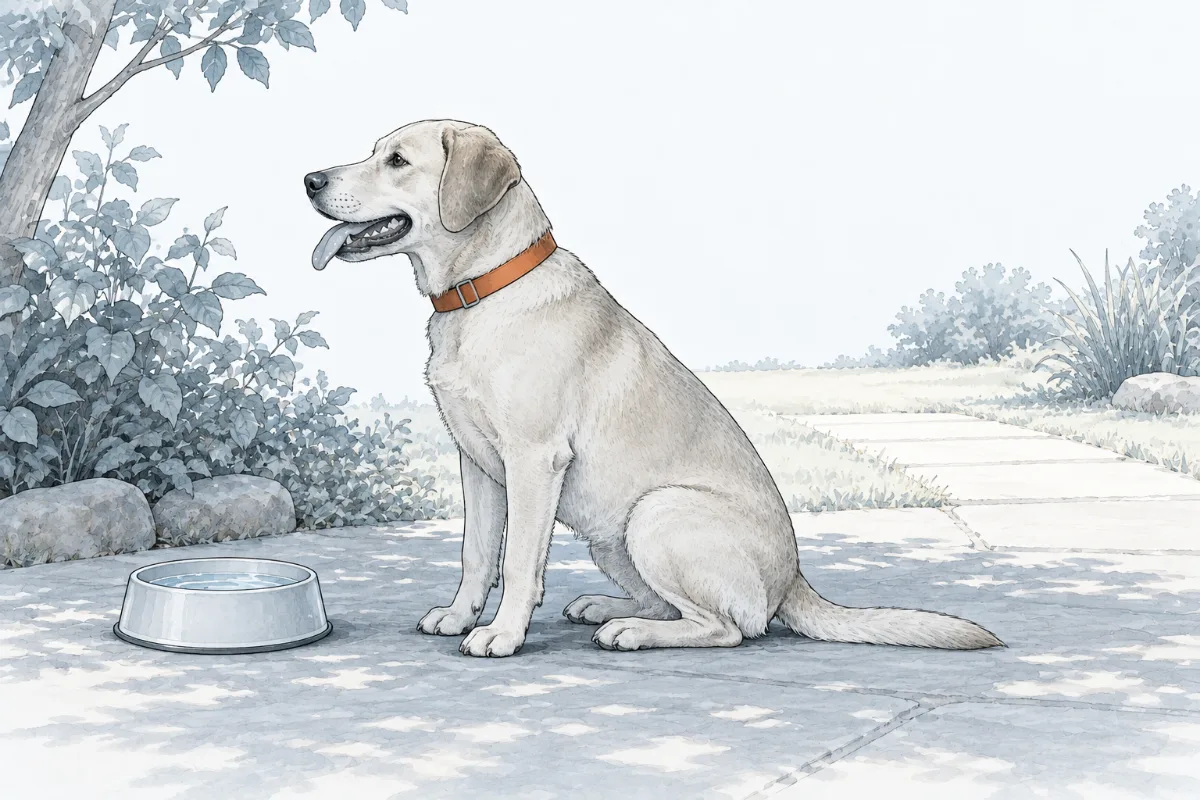
Panting. A dog sweats only through the pads of its paws, so it cannot cool itself by sweating all over. Instead, a hot dog pants: it breathes in and out quickly through its open mouth, over its wet tongue and the wet lining of its mouth. The moving air carries the escaped water particles away, so the water evaporates faster. The water that stays on the tongue is cooled, and energy passes into it from the tongue and the blood flowing through it.
 (enlarge)
A clay water pot. In many hot countries, drinking water is kept in an unglazed clay pot. The clay has tiny holes, so water seeps slowly through it and keeps the outside damp. That water evaporates from the large outside surface, faster where air moves past. As it evaporates it is cooled, and energy passes into it from the water inside the pot, through the clay. So the drinking water stays several degrees cooler than the room, without any electricity. It works best in dry air, in the shade, with a breeze.
Drying clothes. Washing dries fastest on a warm, windy day, hung spread out on a line, and slowest on a cold, still day, bunched up in a basket. All three factors are at work.
Trap: “Panting cools a dog because it breathes in cool air.” On a hot day the air is warm. Panting cools the dog because the moving air makes the water on its tongue evaporate faster, and the evaporating water takes energy from the tongue.
Worked example
Drying the washing
Explain, in terms of particles, why a wet towel dries faster on a warm, windy day, spread out on a line, than on a cold, still day, folded in a basket.
The water on the towel evaporates: its more energetic particles escape from the surface. On a warm day, the water particles move faster on average, so more of them have enough energy to escape each second. Spread out on a line, the towel has a much bigger surface area than when folded, so many more particles are at the surface, where they can escape. In the wind, moving air carries the escaped particles away from the towel, so fewer of them return to it. All three make evaporation faster, so the towel dries faster. Folded in a basket on a cold, still day, all three work the other way.
Case closed
Why does sweating cool you down? The sweat evaporates: its more energetic particles escape from its surface, the sweat that stays is cooler, and energy passes into it from the warmer skin. This part showed what makes that faster. In the experiment, with the same 3.00 g of water on the towel for the same 5 minutes, moving air raised the water lost from 0.64 g to 0.92 g; covering half of the surface cut it to 0.39 g; starting from 50 °C instead of 70 °C cut it to 0.35 g. So sweat cools you best on a dry, breezy day, spread over a large area of skin, and dogs, clay pots and washing lines use the same three factors. Evaporation is not boiling: it happens at any temperature, only from the surface, and cools the liquid, while boiling happens only at the boiling point, throughout the liquid, and needs energy supplied all the time.
About this model
The tubes, towels, balances and thermometers are the same simulation as in part 2. The fan makes the water on towel B evaporate faster, and it also makes both tubes lose energy to the room faster. The cling-film sleeve covers half of towel B, and water evaporates only from the open half; its own 0.35 g is part of balance B's reading. Each run starts again from fresh water and a towel topped back up to 3.00 g, so only one thing changes. The magnifier shows a model: a few particles, drawn far bigger than real, with their motion exaggerated. The pictures of the dog, the clay pot and the washing are illustrations, not part of the experiment. The boiling and evaporation drawing is a sketch: the 18 °C dish is a typical value for water evaporating in a 20 °C room.