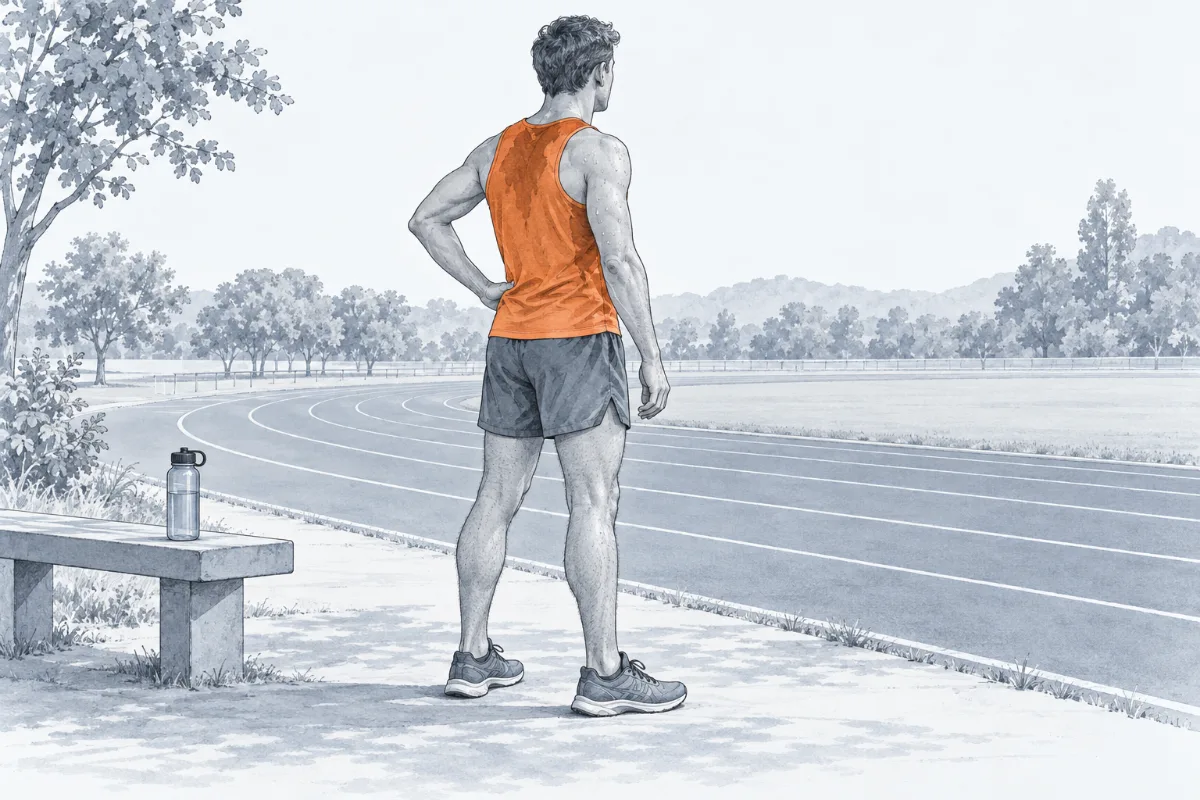
A runner has just finished a race on a warm afternoon. He is hot, and his skin is wet with sweat. His muscles warmed his body while he ran, but his body temperature must stay close to 37 °C. Sweating is one of the main ways his body keeps it there. But sweat comes out of the skin warm, at about body temperature, not cold. So how can warm water on the skin cool anyone down? In this part you wrap two hot tubes of water in paper towels, make one towel wet, and find out what the water on it does.
 (enlarge)
Evaporation: a liquid that disappears
Hang wet washing on a line and a few hours later it is dry. A puddle on the pavement shrinks and is gone by the afternoon, even on a cool day. A glass of water left on a windowsill for a week is lower than when you filled it. In each case liquid water has turned into a gas, without boiling and far below 100 °C. The gas is water vapour: water as a gas, mixed invisibly with the air. A liquid turning into a gas from its surface, below its boiling point, is called evaporation.
The white cloud you see above a boiling kettle is not the gas itself. It is a mist of tiny drops of liquid water that formed when the invisible gas met cooler air and condensed. Water vapour, like steam, is invisible.
Cool two tubes and measure
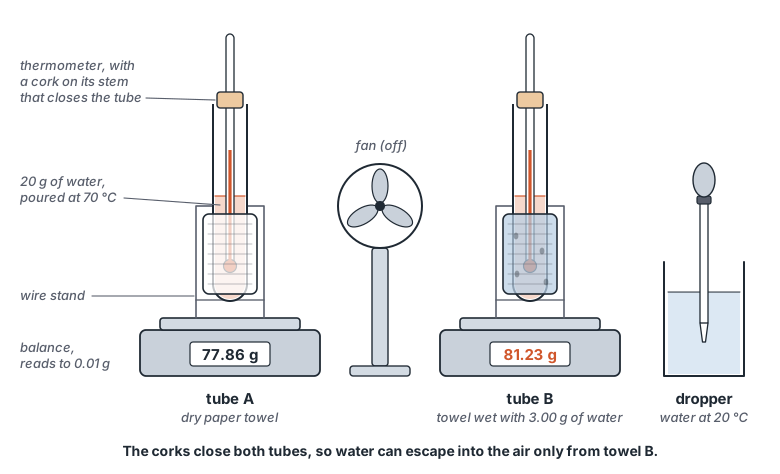
What is on the bench. Two matched boiling tubes, A and B, each standing in a wire stand on its own digital balance that reads to 0.01 g. Each tube is wrapped in the same kind of paper towel, and each has a thermometer, read to the nearest 0.5 °C, with a cork on its stem that closes the tube. At the side are a beaker of hot water at 70 °C, a beaker of warm water at 50 °C, a dropper in a small beaker of water at room temperature, and a small fan, switched off. The room is at 20 °C. A magnifier can show a model of the water particles at the surface of a towel.
What you do. With the dropper, put 3.00 g of room-temperature water onto towel B, and watch balance B. Towel B now stands for sweaty skin; tube A, in its dry towel, is the comparison. Predict first: will the water in tube B cool faster than in tube A, more slowly, or at the same rate? Then pour 20 g of water from the 70 °C beaker into each tube, close each with its thermometer and cork, and run for 5 minutes (shown sped up), reading both thermometers and balance B every 30 s. Work out how much water towel B lost, look through the magnifier, and explain what you saw.
 (enlarge)
What the experiment showed
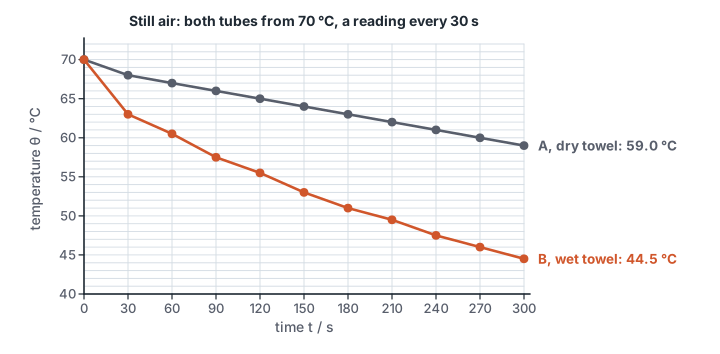
Do the experiment before you read on. Wetting towel B took balance B from 58.23 g to 61.23 g, so the towel held 3.00 g of water. Pouring in 20 g of hot water took it to 81.23 g. Then both tubes cooled for 5 minutes in still air. In the table, θ is the temperature of the water in each tube.
| t / s | tube A θ / °C (dry towel) | tube B θ / °C (wet towel) | balance B / g |
|---|---|---|---|
| 0 | 70.0 | 70.0 | 81.23 |
| 30 | 68.0 | 63.0 | 81.17 |
| 60 | 67.0 | 60.5 | 81.08 |
| 90 | 66.0 | 57.5 | 81.00 |
| 120 | 65.0 | 55.5 | 80.93 |
| 150 | 64.0 | 53.0 | 80.86 |
| 180 | 63.0 | 51.0 | 80.80 |
| 210 | 62.0 | 49.5 | 80.74 |
| 240 | 61.0 | 47.5 | 80.69 |
| 270 | 60.0 | 46.0 | 80.64 |
| 300 | 59.0 | 44.5 | 80.59 |
Balance A read 77.86 g all the way through: its towel was dry and the cork closed its tube, so no water escaped from it. Balance B fell from 81.23 g to 80.59 g, so 81.23 g − 80.59 g = 0.64 g of water went into the air, out of the 3.00 g on the towel. The cork closed tube B too, so that water came from the wet towel. It went into the air as water vapour: it evaporated. It went fastest at first: 0.15 g in the first minute, but only 0.10 g in the last minute, as the towel cooled.
Both tubes started at 70.0 °C. Tube A, in the dry towel, fell by 11.0 °C, to 59.0 °C. Tube B, in the wet towel, fell by 25.5 °C, to 44.5 °C: more than twice as much. The difference was biggest at the start. In the first 30 s, tube B fell by 7.0 °C and tube A by only 2.0 °C. After that, B kept cooling faster: from 30 s to 300 s it fell by 18.5 °C, and A by 9.0 °C.
 (enlarge)
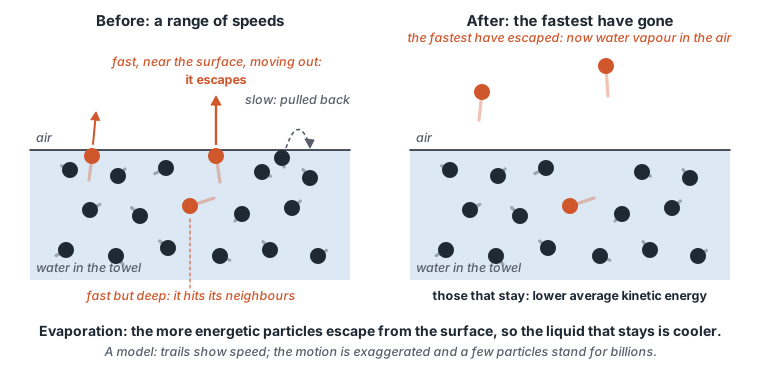
Through the magnifier, the water particles at the surface of towel B moved at a range of speeds. Now and then a fast one near the surface broke away into the air. Slow ones that reached the surface were pulled back into the liquid.
A fair comparison?
Tube A is there for comparison: the same kind of tube, the same 20 g of water at the same starting temperature, the same kind of towel, in the same room. Only the water on towel B is different. But it is a rough comparison, not a perfect one, for two reasons. A wet towel lets energy pass from the tube more easily than a dry one. And the 3.00 g of water on towel B started at room temperature, 20 °C, so in the first 30 s it took energy from the tube just by warming up. That is part of why B fell by 7.0 °C in the first 30 s while A fell by only 2.0 °C.
So the temperature curves show that the water in tube B cools faster, but on their own they cannot show why. The evidence that water evaporated is the balance: towel B lost 0.64 g of water in 5 minutes, and tube A lost none. The rest of this part explains how evaporation cools. The explanation is qualitative: it explains why tube B cools faster, but not by exactly how many degrees.
Trap: “The gap between the two curves must keep growing until tube B is cold.” The gap grew quickly at first and then more slowly. As tube B cools, its towel cools too, so the towel's water evaporates more slowly and energy passes into it more slowly. What the curves show is that B cools faster, most of all at first.
Why some particles escape
To see how a liquid can turn into a gas below its boiling point, look at its particles. In a liquid at any temperature, the particles move at a range of speeds. Most move at middling speeds, a few slowly, and a few very fast. They keep colliding, so each particle's speed keeps changing. The forces between the particles hold them together in the liquid.
A particle can escape from the liquid only from the surface, and only if it is moving outwards fast enough to break away from the forces of its neighbours. So it is the more energetic particles near the surface that escape. A fast particle deep in the liquid cannot escape: it soon hits its neighbours. A slow particle that reaches the surface is pulled back. That is what evaporation is, in terms of particles: the escape of more-energetic particles from the surface of a liquid.
 (enlarge)
The escaped particles are water vapour, mixed with the air. A few of them wander back into the liquid, but in a fairly dry room far more escape than return, so the liquid slowly disappears.
Trap: “Water evaporates only when it is hot.” A puddle dries on a cool day and washing dries in winter. At any temperature, some particles near the surface are fast enough to escape. A warmer liquid has more of them, so it evaporates faster, as part 3 shows.
Why evaporation cools the liquid
Which particles escape? The most energetic ones. Which stay in the liquid? The slower ones. So the particles that stay have a lower average kinetic energy than before. The temperature of a liquid is a measure of the average kinetic energy of its particles, so the liquid that stays cools. Evaporation causes cooling of a liquid. Collisions soon share the energy out again, so there are always a few fast particles near the surface, ready to escape next: the cooling goes on for as long as the evaporation does.
You can feel this. Put a drop of hand gel, which is mostly alcohol, on the back of your hand: it feels cold as it dries, because alcohol evaporates quickly. A thermometer whose bulb is wrapped in wet cloth, in a fairly dry room, reads a few degrees below the room temperature, for as long as the cloth stays wet.
On towel B, the water was being warmed by the hot tube all the time, so it never became as cold as the room. But evaporation kept taking its fastest particles, so it stayed cooler than it would otherwise have been, and cooler than the tube inside it.
Trap: “Evaporation cools a liquid because the particles that stay slow down.” No particle has to slow down. The fastest ones escape, so the average of the particles that stay is lower, just as a class's average height drops if its tallest pupils go out of the room.
Trap: “The escaping particles carry the cold away.” There is no “cold” to carry. The escaping particles carry energy away, more than their share of it, so the liquid that stays has less energy for each particle: a lower temperature.
Worked example
Five particles
A model liquid has just five particles. Their kinetic energies are 2, 4, 6, 8 and 10 units. The particle with 10 units is at the surface, moving outwards, and escapes. (a) Find the average kinetic energy before and after. (b) Explain why this means the liquid has cooled.
(a) Before: (2 + 4 + 6 + 8 + 10) ÷ 5 = 30 ÷ 5 = 6 units. After the particle with 10 units escapes: (2 + 4 + 6 + 8) ÷ 4 = 20 ÷ 4 = 5 units. (b) The average kinetic energy of the particles that stay has fallen from 6 units to 5 units. The temperature of a liquid is a measure of the average kinetic energy of its particles, so the liquid that stays is cooler. None of the four particles that stayed has slowed down: the average fell because the most energetic particle escaped. In a real liquid, billions of particles escape every second, and the energy is shared out again by collisions, so the cooling is steady.
Why the tube cools faster
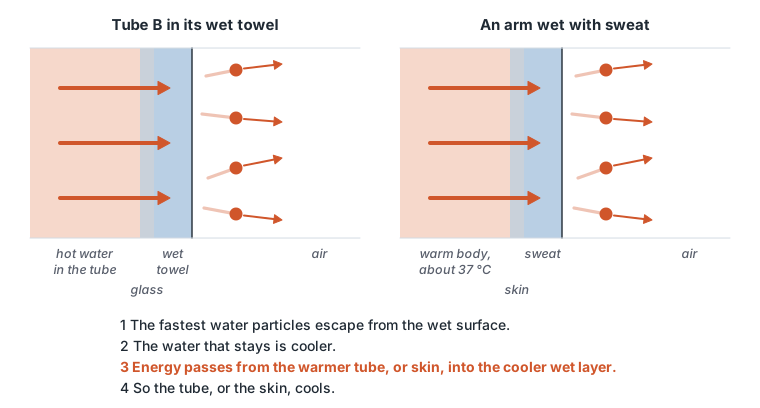
The water on towel B is in contact with the glass of tube B, wrapped right round it. Evaporation keeps the towel's water cooler than it would otherwise be. The hot water in the tube is warmer than the towel, and energy passes from the warmer tube into the cooler wet towel. The cooler the towel, the faster energy passes into it. So the water in tube B loses energy faster than the water in tube A, and its temperature falls faster.
- The more energetic water particles escape from the surface of the wet towel.
- The water that stays in the towel has a lower average kinetic energy: it is cooler.
- Energy passes from the warmer tube into the cooler wet towel.
- So the water in the tube cools faster.
The tube keeps warming the towel's water, so the fastest particles keep escaping, and the chain keeps going for as long as the towel is wet. Anything in contact with an evaporating liquid is cooled the same way: the liquid cools as it evaporates, and energy passes into it from the warmer object.
 (enlarge)
Worked example
Why did tube B cool faster?
In still air, tube B in the wet towel fell from 70.0 °C to 44.5 °C in 5 minutes, and tube A in the dry towel fell from 70.0 °C to 59.0 °C. Balance B fell from 81.23 g to 80.59 g; balance A did not change. Explain why the water in tube B cooled faster. Say which reading is the evidence for evaporation.
Balance B fell by 0.64 g, and the cork closed the tube, so 0.64 g of water evaporated from towel B; tube A lost nothing. As the towel's water evaporated, its more energetic particles escaped from the surface, so the particles that stayed had a lower average kinetic energy: the towel's water was cooled. Energy passed from the warmer tube into this cooler wet towel, so the water in tube B lost energy faster and cooled faster than the water in tube A. The evidence for evaporation is the fall on balance B. The dry towel is only a rough comparison: the wet towel also lets energy pass more easily, and its water started at room temperature and took energy at first just by warming up. That is why tube B fell 7.0 °C in the first 30 s, against 2.0 °C for tube A. But B kept cooling faster long after its towel had warmed up, while the balance showed water still evaporating.
Sweating
Your body works best with its inside at about 37 °C. When you exercise or the day is hot, glands in your skin pour sweat onto it. The sweat comes out at about the temperature of your skin, so it does not cool you by being cold. It cools you by evaporating. The most energetic water particles escape from the surface of the sweat, so the sweat that stays on your skin is cooler. Energy passes from your warmer skin into the cooler sweat, and the skin, and the blood flowing just under it, are cooled. Sweat on skin works just like the wet towel on tube B.
Sweat cools you only if it evaporates. On a hot, damp day the air already holds a lot of water vapour, so more of the escaped particles return to the sweat and evaporation is slow. The sweat drips off instead, and you feel hot and sticky. A breeze helps it evaporate, which is why a fan makes you feel cooler. The next part investigates what makes evaporation faster or slower.
Trap: “Sweat cools you because it is cold.” Sweat comes out of the skin warm. It cools the skin only as it evaporates: the most energetic particles escape, the sweat that stays is cooler, and energy passes into it from the warmer skin. Sweat that drips off without evaporating does almost nothing.
Case closed
Why does sweating cool you down? Because the sweat evaporates. Evaporation is the escape of the more energetic particles from the surface of a liquid. The particles that stay have a lower average kinetic energy, so the liquid is cooler, and energy passes into it from anything warmer that it touches, such as skin. In the experiment, 0.64 g of water evaporated from towel B in 5 minutes, measured on the balance, and tube B cooled by 25.5 °C while tube A, in its dry towel, cooled by 11.0 °C. The dry towel is only a rough comparison, so the curves show that B cooled faster, and the balance shows that water evaporated. The next part changes one thing at a time to find out what makes evaporation faster or slower, and compares evaporation with boiling.
About this model
The tubes, towels, balances and thermometers are simulated. Each tube and its towel exchange energy: energy passes from the hot tube into its towel, more easily through a wet towel than through a dry one, and from each towel to the room. Water evaporates from towel B at a rate set by its temperature, its open area and the air moving over it, and the water it loses takes energy from the towel. The room stays at 20 °C, and its air is fairly dry. Each towel is taken to be evenly wet, or dry, and at one temperature all through. Thermometers are read to the nearest 0.5 °C and balances to 0.01 g. The magnifier shows a model: a few particles, drawn far bigger than real, with their motion exaggerated so that it shows.