Independent final check
Explain without the key
state / determine / describe / explain
Final check
state: give a concise answer. determine: find the answer from the information given. describe: give the features or what happens. explain: give reasons and connect them to evidence.
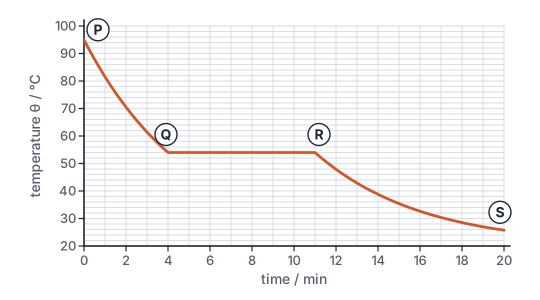
Liquid substance Z cools in a tube in a room. The graph shows its temperature. (a) State the freezing point of Z. (b) Determine how many minutes Z took to freeze. (c) Describe what happens to the particles of Z between Q and R. (d) Explain why the temperature stays the same between Q and R. (e) Solid Z is heated steadily from 20 °C until it is all liquid. Describe the shape of its heating curve, and explain what the energy does while Z melts. (f) A pupil says that Z is water. Use the graph to explain why Z is not pure water at standard atmospheric pressure. (g) Another pupil keeps a beaker of pure water boiling with a Bunsen burner, at standard atmospheric pressure, and reads its thermometer every minute. All ten readings are the same. State the reading, and explain why it does not rise although the burner supplies energy all the time. (h) In another experiment, steam passes along a glass tube with cold water flowing round the outside, and liquid water drips out of the far end. Describe, in terms of particles, what happens to the steam in the tube, and say where the energy goes.
 (enlarge)
Your saved work
Answers and earlier attempts stay in this browser. Export a copy to keep, to move to another device or to hand to your teacher. Importing a copy keeps your current answers and adds earlier attempts.
Scope and sources
Cambridge IGCSE Physics 0625 · 2026–2028 v2 · Original learning materials.
Melting and boiling, with the melting and boiling points of water at standard atmospheric pressure (2.2.3.1, 2.2.3.2); condensation and solidification in terms of particles (2.2.3.3); evaporation as the escape of more energetic particles from the surface of a liquid (2.2.3.4); how evaporation causes cooling of a liquid (2.2.3.5); the differences between boiling and evaporation (2.2.3.6); how temperature, surface area and air movement over a surface affect evaporation (2.2.3.7); how the cooling of an object in contact with an evaporating liquid happens (2.2.3.8). Specific heat capacity is in SHC01; conduction, convection and radiation are in TRANS01.
Apparatus, amounts and times in the experiment are illustrative. Real practical work follows a teacher-approved safety method.
Official Cambridge syllabus