Scope and sources
Cambridge IGCSE Physics 0625 · 2026–2028 v2 · Original learning materials.
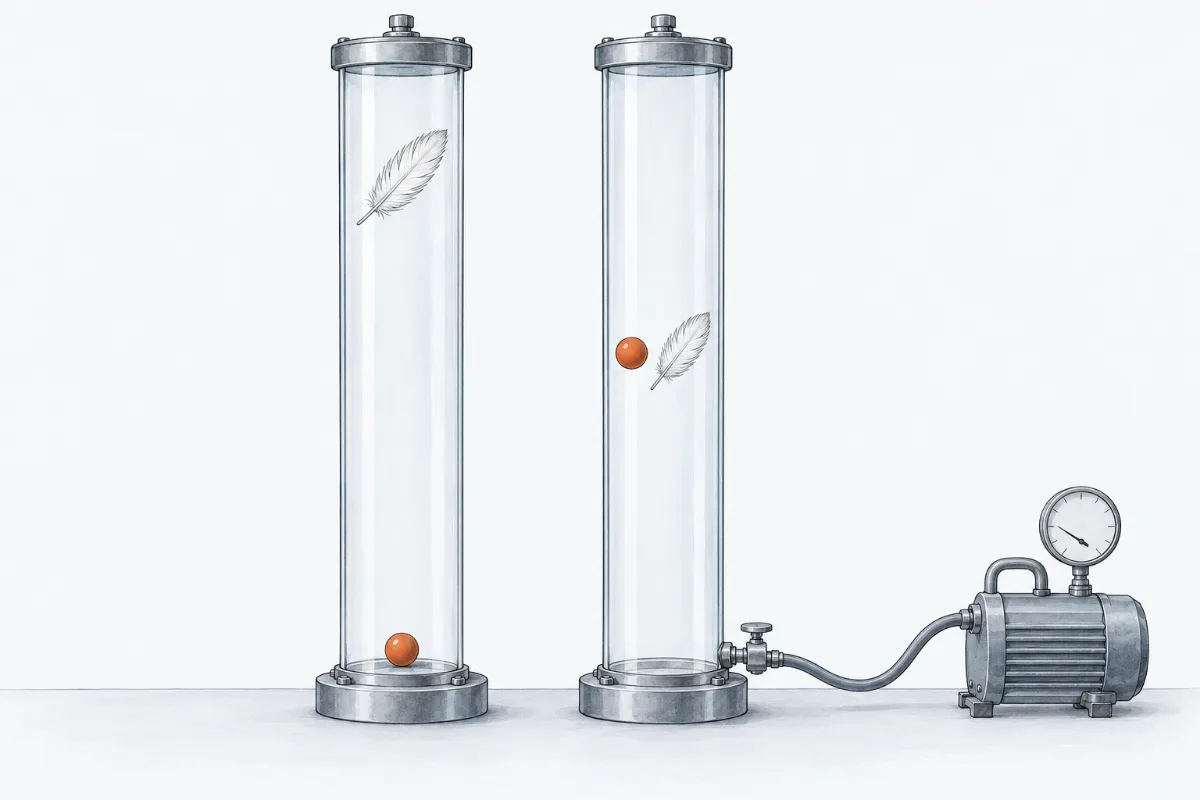
The acceleration of free fall g, approximately constant near the Earth and about 9.8 m/s² (1.2.8); acceleration as the change in velocity per unit time, a = Δv ÷ Δt (1.2.9); constant and changing acceleration from data and from a speed–time graph (1.2.10); acceleration from the gradient of a speed–time graph (1.2.11); deceleration as a negative acceleration (1.2.12); falling in a uniform gravitational field with and without air or liquid resistance, and terminal velocity (1.2.13); friction between solid surfaces, which impedes motion and causes heating (1.5.1.6); drag in liquids and air resistance in gases (1.5.1.7, 1.5.1.8). Resultant force, F = ma and Newton’s first law are in FORCE01.
Apparatus, amounts and times in the experiment are illustrative. Real practical work follows a teacher-approved safety method.
Official Cambridge syllabus