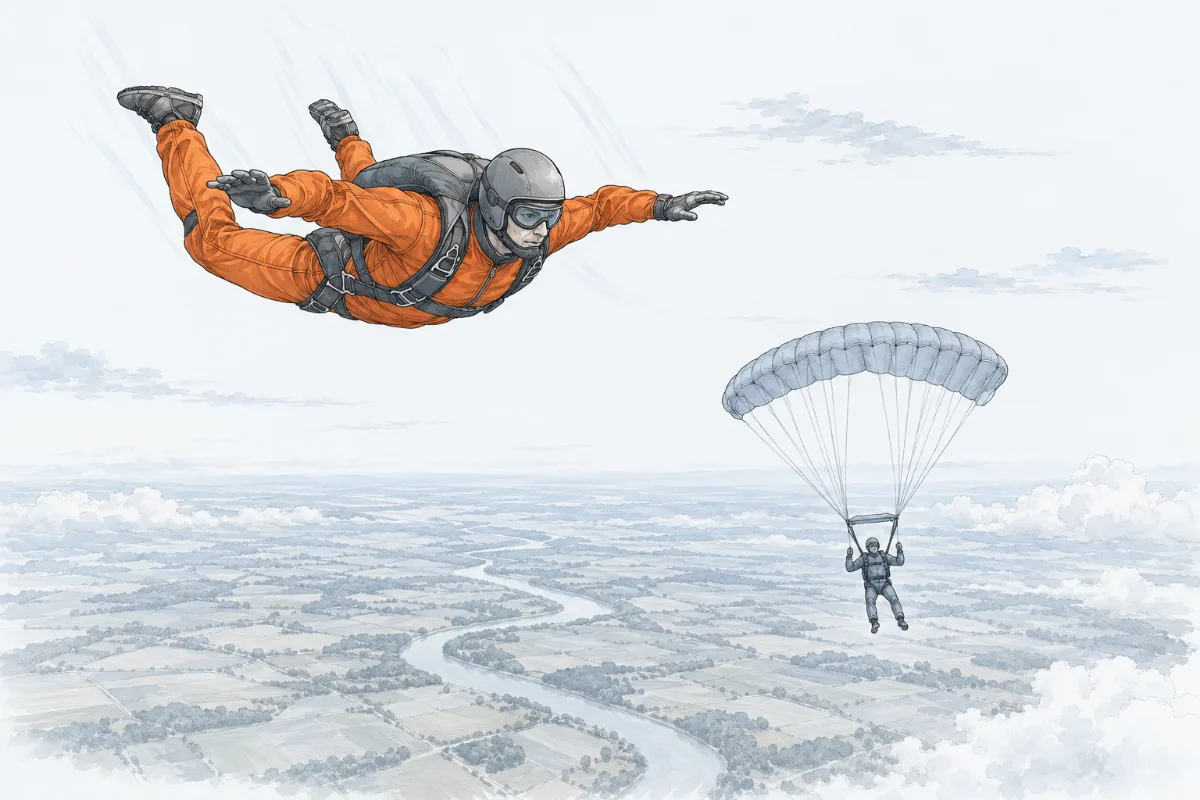
A skydiver steps out of an aeroplane high above the ground. For the first second or two she speeds up almost exactly like a stone in free fall, about 9.8 m/s faster every second. But she does not keep doing that. After about 15 seconds her speed has stopped growing at about 55 m/s, roughly 200 km/h, and it stays there until she opens her parachute. Gravity has not switched off: her weight, the pull of the Earth on her, still pulls her down as hard as ever. So why does she stop speeding up?
 (enlarge)
Drag: friction from a liquid or a gas
Put your hand out of the window of a moving car and you feel the air push it back. Wade into a swimming pool and the water holds your legs back. To move through a gas or a liquid, an object has to push it out of the way, and the gas or liquid pushes back on the object. This force is called drag. Like friction between solid surfaces, drag acts against the motion: it is the friction of a liquid or a gas. Drag in air is called air resistance.
Two things make drag bigger. The first is speed: the faster an object moves, the bigger the drag on it. A gentle walk into the wind is easy; cycling fast into the same wind is hard work. The second is the object's size and shape: a feather or an open parachute is big but light, so it pushes aside a lot of air compared with how heavy it is, and it meets a lot of drag; a small steel ball meets very little. Liquids are much thicker than air, so drag in a liquid such as water or oil is much bigger than drag in air at the same speed.
Trap: “Drag only acts in air.” Drag acts on anything moving through a liquid or a gas: a submarine in water, a ball sinking in oil, a cyclist in air. Air resistance is just the name for drag in air.
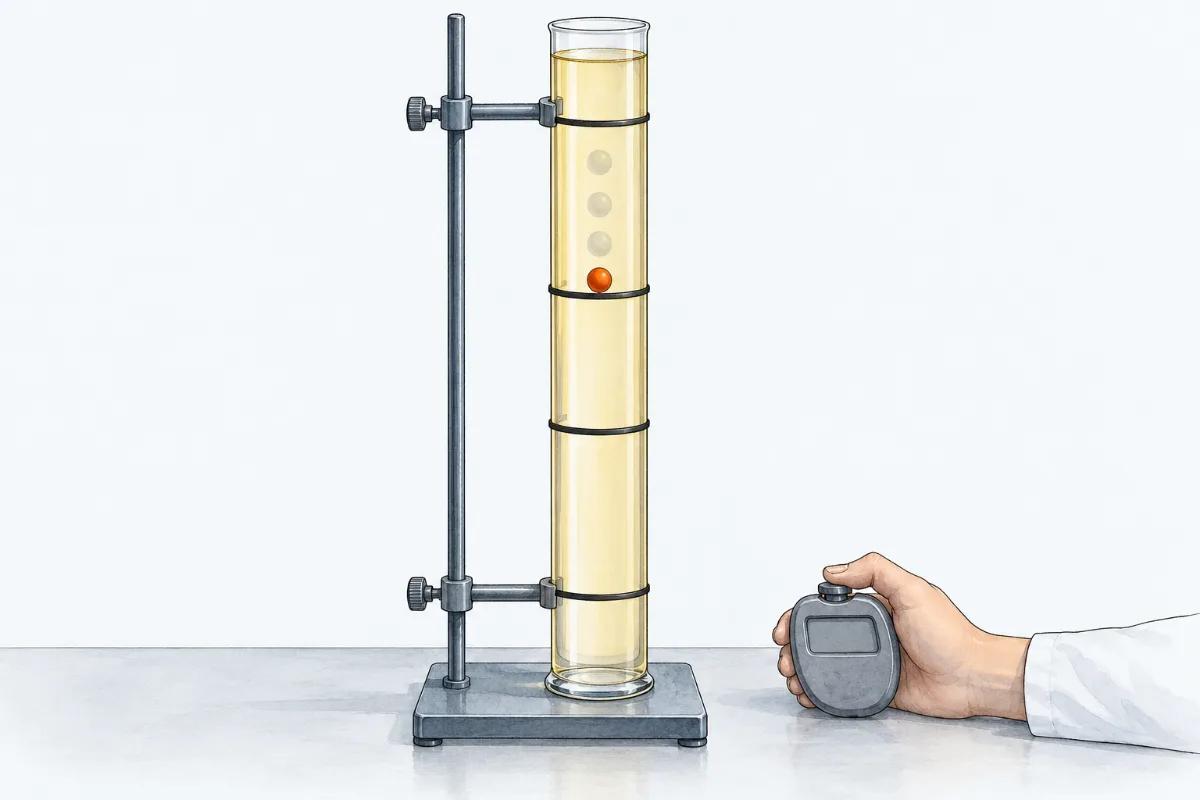
A ball sinking through glycerol
In a liquid, drag grows so quickly that a falling object soon stops speeding up. You can measure that. The experiment has a tall tube of glycerol, a thick clear liquid, with rubber bands round it 0.20 m apart. A small steel ball is let go at the surface, and you press a stop-clock as it passes each band. If the ball is still speeding up, each 0.20 m will take less time than the one before. First decide when to start timing. Then drop the ball, time it, and look at your times. Last, let the air back into the drop tube and predict the forces on the falling feather.
 (enlarge)
What the experiment showed
Do the experiment before you read on. Your times from band to band were nearly equal, close to 2.86 s for every 0.20 m. Equal distances in equal times mean a steady speed. The ball reached that speed less than a tenth of a second after entering the glycerol, a few millimetres below the surface, long before the first band. Then you looked at the feather falling in air: once it was moving at its steady speed, the air resistance on it had grown as big as its weight.
Worked example
Speed in the glycerol
A student times a steel ball sinking through glycerol. The bands are 0.20 m apart, and the times from band to band are 2.84 s, 2.88 s and 2.86 s. What does the data show, and what is the ball's speed?
The three times are almost the same, so the ball covers each 0.20 m in the same time: it is moving at a constant speed, not speeding up. Mean time = (2.84 + 2.88 + 2.86) s ÷ 3 = 2.86 s. Speed = distance ÷ time = 0.20 m ÷ 2.86 s = 0.070 m/s. You could also use the whole distance: 0.60 m ÷ 8.58 s = 0.070 m/s.
Terminal velocity
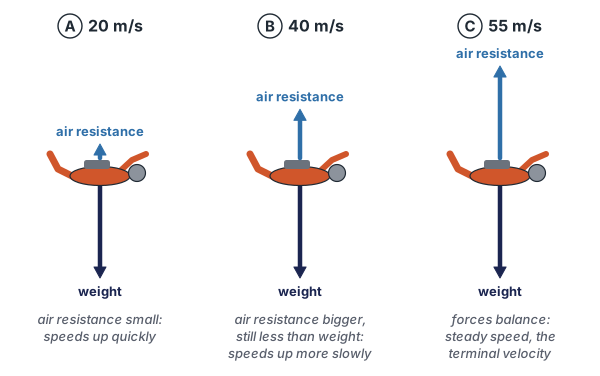
Now back to the skydiver. Two forces act on her as she falls: her weight, pulling down, and air resistance, pushing up. Her weight stays the same the whole time. The air resistance depends on her speed.
 (enlarge)
- Just after she jumps, her speed is small, so the air resistance is small. Almost nothing holds her back, and she speeds up with an acceleration close to g, 9.8 m/s².
- As she falls faster, the air resistance grows. It is still smaller than her weight, so she keeps speeding up, but by less each second: her acceleration is getting smaller.
- At about 55 m/s, the air resistance has grown as big as her weight. The two forces are equal and opposite, so they balance. Her speed stops changing, and she falls at a constant speed.
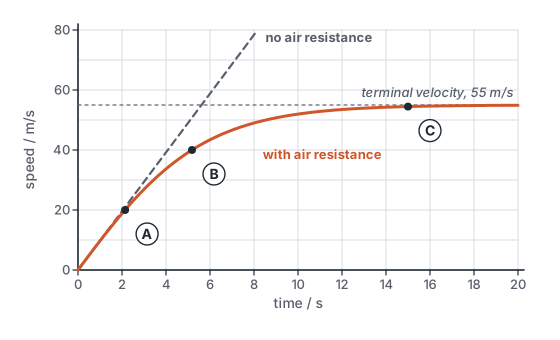
This steady speed is the terminal velocity. An object falling through a liquid or a gas reaches it when the drag on it has grown so much that the forces on it balance; after that, its speed stays the same. In air, the air resistance is then as big as the weight. On a speed–time graph, falling with air resistance gives a curve: steep at first, with a gradient close to 9.8 m/s², then flatter and flatter, until it is level at the terminal velocity. Without air resistance the speed would keep rising by 9.8 m/s every second, a straight line.
 (enlarge)
A light, spread-out object, such as the feather, needs only a small speed before the drag matches its weight, so its terminal velocity is low: 0.8 m/s. A compact, heavy object needs a much bigger speed, so its terminal velocity is high: the steel ball's terminal velocity in air is so high that it could never reach it in a 1 m tube. In the glycerol the drag is so large that even the steel ball's terminal velocity is only 0.070 m/s.
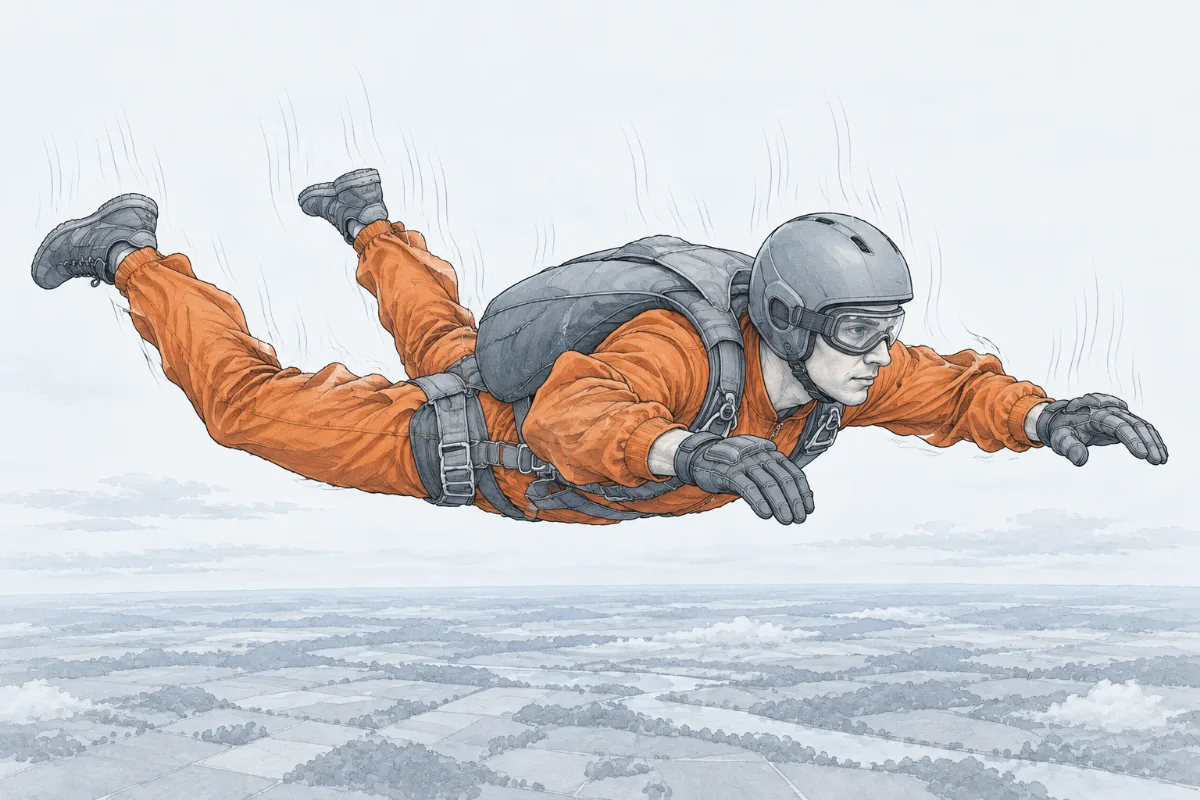 (enlarge)
Spreading out belly-down, as in the picture, makes her push aside more air at each speed, so her terminal velocity is lower than if she dived head first.
Trap: “At terminal velocity no forces act on her.” Both forces still act, and both are large: her weight and an equally large air resistance. They are balanced, so her speed does not change.
Opening the parachute
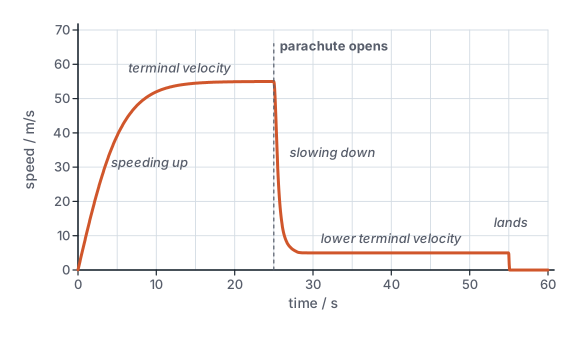
At 25 s the skydiver opens her parachute. The huge canopy pushes aside far more air at the same speed, so at 55 m/s the air resistance is suddenly much bigger than her weight. The forces no longer balance, and the bigger one, the air resistance, acts upwards, against her motion, so she slows down: a deceleration. She does not stop, and she does not go up. As she slows, the air resistance gets smaller, until once more it is as big as her weight. She reaches a new terminal velocity, much lower than before, about 5 m/s: slow enough to land safely.
 (enlarge)
Trap: “When the parachute opens, the skydiver shoots upwards.” In films the camera keeps falling fast, so the parachutist seems to leap up past it. In fact she keeps falling the whole time; she only slows down.
Worked example
Reading the skydive graph
Use the graph of the whole skydive. Describe her motion in each stage, and work out her average deceleration while the parachute opens, from 55 m/s to 5 m/s in about 3 s.
From 0 to about 15 s the line curves over: she speeds up with an acceleration that gets smaller as the air resistance grows. From 15 s to 25 s it is flat at 55 m/s: terminal velocity, with air resistance equal to her weight. From 25 s to about 28 s it falls steeply: the parachute makes the air resistance bigger than her weight, so she decelerates. Average acceleration = (5 − 55) m/s ÷ 3 s = −17 m/s², a deceleration of about 17 m/s². From 28 s to 55 s it is flat at 5 m/s: a new, lower terminal velocity. At 55 s she lands and stops.
Case closed
The skydiver stops speeding up because of drag. Drag is the friction that a liquid or a gas exerts on an object moving through it; in air it is called air resistance, and it grows as the speed grows. Without air resistance an object near the Earth keeps accelerating at 9.8 m/s², a straight speed–time line. With air resistance, the acceleration gets smaller as the drag grows, and when the drag has grown so much that the forces balance, the object falls at a constant speed: its terminal velocity. Opening a parachute makes the drag bigger than the weight, so the skydiver slows down to a new, lower terminal velocity. A ball in glycerol does the same, much more quickly, because drag in a liquid is much bigger.
About this model
The glycerol tube and the stop-clock are simulated. The 6 mm steel ball reaches its terminal velocity of 0.070 m/s within about 0.07 s; the glycerol also pushes up on the ball a little (upthrust), so at terminal velocity the drag and the upthrust together balance the weight. Your times come from your own presses, so they include your reaction time, as they would in a real laboratory. The skydive numbers are typical values, not one measured jump.