Independent final check
Explain without the key
calculate / state / explain / describe
Final check
calculate: work out the answer from the data. state: give a concise answer. explain: give reasons and connect them to evidence. describe: give the features or what happens.
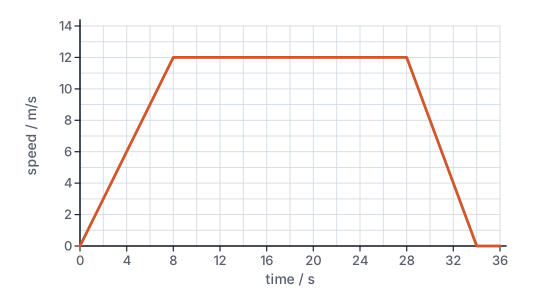
The graph shows a tram's speed between two stops. (a) Calculate its acceleration from 0 to 8 s. (b) State its acceleration from 8 s to 28 s, and explain how the graph shows it. (c) Calculate its acceleration from 28 s to 34 s, and state its deceleration. (d) The tram slows down when brake pads press on discs that turn with its wheels. Name the force between the pads and the discs, and give two things it does. (e) At a tram stop on a high bridge, a worker drops a small steel bolt from rest into the river. Ignore air resistance. Calculate its speed after 3.0 s, using g = 9.8 m/s². Would a heavier bolt be faster after 3.0 s? Explain.
 (enlarge)
Your saved work
Answers and earlier attempts stay in this browser. Export a copy to keep, to move to another device or to hand to your teacher. Importing a copy keeps your current answers and adds earlier attempts.
Scope and sources
Cambridge IGCSE Physics 0625 · 2026–2028 v2 · Original learning materials.
The acceleration of free fall g, approximately constant near the Earth and about 9.8 m/s² (1.2.8); acceleration as the change in velocity per unit time, a = Δv ÷ Δt (1.2.9); constant and changing acceleration from data and from a speed–time graph (1.2.10); acceleration from the gradient of a speed–time graph (1.2.11); deceleration as a negative acceleration (1.2.12); falling in a uniform gravitational field with and without air or liquid resistance, and terminal velocity (1.2.13); friction between solid surfaces, which impedes motion and causes heating (1.5.1.6); drag in liquids and air resistance in gases (1.5.1.7, 1.5.1.8). Resultant force, F = ma and Newton’s first law are in FORCE01.
Apparatus, amounts and times in the experiment are illustrative. Real practical work follows a teacher-approved safety method.
Official Cambridge syllabus