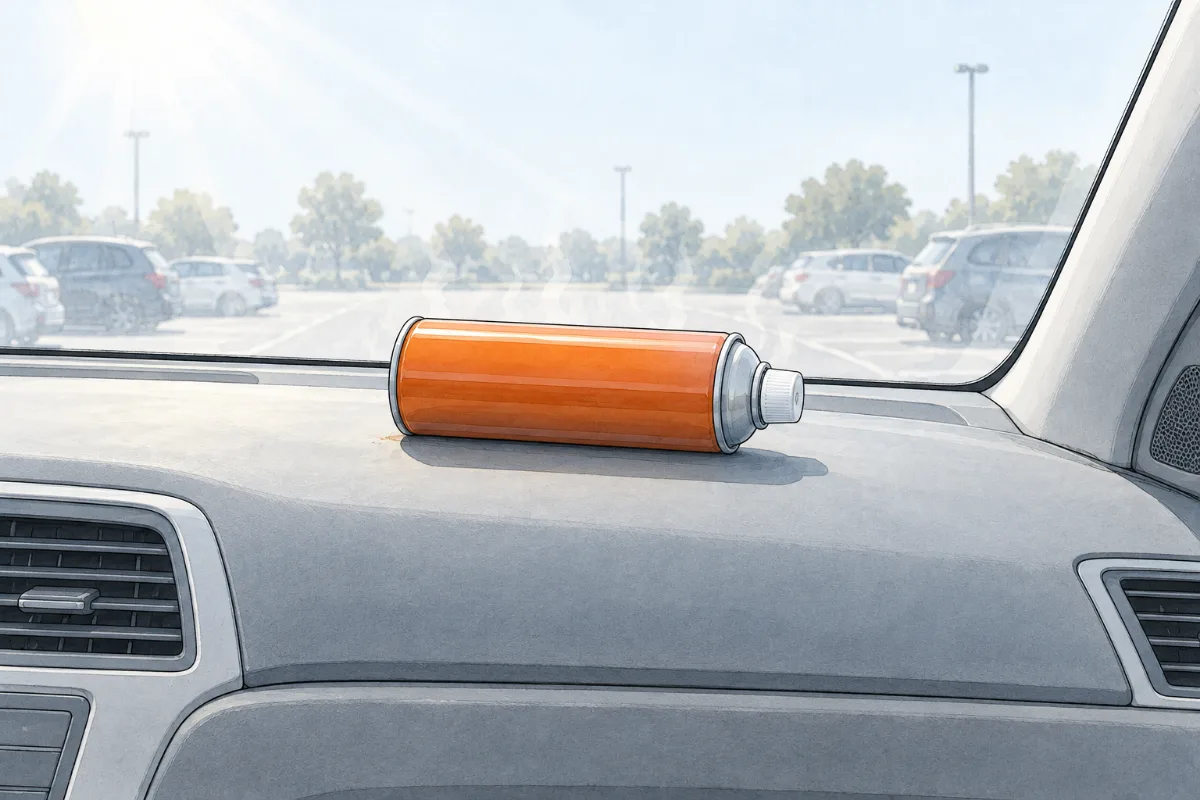
Look at the small print on a can of deodorant or spray paint: “Pressurised container: protect from sunlight and do not expose to temperatures above 50 °C.” On a sunny summer day the air inside a parked car can pass 60 °C, and a dashboard in direct sun gets hotter still. The can is sealed, so the gas inside cannot get out, and it is rigid, so the gas cannot spread into a bigger volume. Why is heat dangerous for it? In the last part you changed the volume of a gas and kept its temperature the same. Now you keep the volume the same and change the temperature.
 (enlarge)
Faster particles, harder and more often
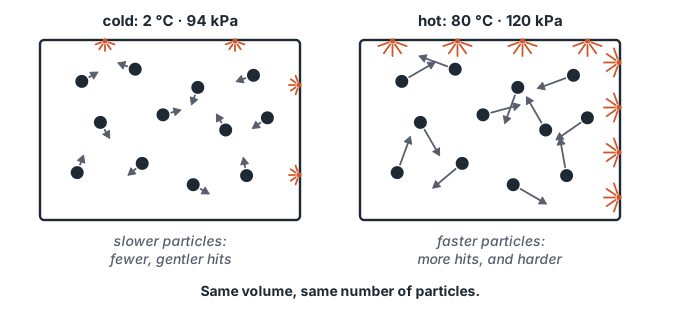
Warm a gas and its particles move faster: the higher the temperature, the faster they move on average. Faster particles change the hits on the walls in two ways. Each particle crosses the container in less time, so it reaches the walls more often. And each hit is harder, because a faster particle needs a bigger push to turn it round, so it pushes harder on the wall. Hits that are more often and harder both make the force on each unit of area bigger.
So when a fixed mass of gas is heated at a constant volume, its pressure rises. Cool the gas and the opposite happens: slower particles hit the walls less often and less hard, and the pressure falls. The number of particles and the space they move in stay the same; only their speed changes.
 (enlarge)
Trap: “When a gas is heated, its particles get bigger, or there are more of them.” The can is sealed, so the number of particles stays the same, and the particles themselves do not grow. Heating makes them move faster, and that alone raises the pressure.
Worked example
The can on the dashboard
A sealed metal can of gas is left on the dashboard of a car in the sun and warms from 20 °C to 70 °C. Explain, in terms of particles, why the pressure inside rises, and why this could make the can burst.
The can is sealed, so the mass of gas is fixed, and it is rigid, so the volume is fixed. As the gas warms, its particles move faster. They reach the walls more often, and each hit is harder, so the force on each unit of area of the walls, the pressure, rises. The can is made to hold its gas at the pressure it was filled to, with some to spare. If the gas gets hot enough, the force on each square centimetre of the walls becomes more than the metal can take, and the can splits open, or bursts. The answer is about speed, not size: the particles are no bigger and no more numerous than before.
Lock it and change the temperature
In the experiment the syringe from the first part is locked at 50 cm³: the lock on the stand stops the plunger moving, so the volume stays the same. Ice in the water cools the air to about 2 °C, and the hotplate warms it to 40, 60 and 80 °C. Predict first: will the reading rise or fall in the cold, and what will the gauge read at 80 °C? Record each reading once the needle has stopped. Then carry the line on the graph on to colder temperatures and see where it reaches zero pressure.
What the experiment showed
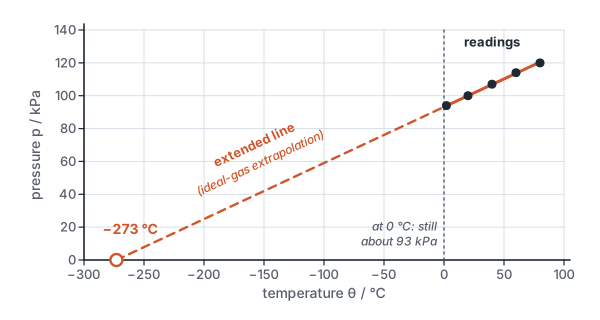
Do the experiment before you read on. With the plunger locked at 50 cm³, the gauge read 100 kPa at 20 °C. The ice cooled the water to 2 °C, and the pressure fell to 94 kPa. The hotplate warmed the water to 40, 60 and 80 °C, and the pressure rose to 107, 114 and 120 kPa.
| θ / °C | p / kPa |
|---|---|
| 2 | 94 |
| 20 | 100 |
| 40 | 107 |
| 60 | 114 |
| 80 | 120 |
Every 20 °C rise added about 7 kPa, so the points lie on a straight line. But the line does not go through the origin: at 0 °C the air still has a pressure of about 93 kPa. 0 °C is only the temperature at which water freezes. It is nothing special for a gas, whose particles are still moving fast.
Carry the line on to colder and colder temperatures, and it reaches zero pressure at about −273 °C. Zero pressure would mean no hits on the walls at all. Real air turns to liquid long before it gets that cold, at around −190 °C, so this end of the line was never measured. It is an ideal-gas extrapolation: it shows what a gas would do if it stayed a gas all the way down. Every gas gives a line that reaches zero pressure at the same temperature, about −273 °C.
 (enlarge)
Trap: “Doubling the temperature doubles the pressure: from 40 °C to 80 °C the pressure doubles.” It went from 107 kPa to 120 kPa, only 13 kPa more. The Celsius scale does not start where the pressure is zero, so doubling a temperature in °C does not double anything for a gas. Equal rises in temperature give equal rises in pressure.
The Kelvin scale
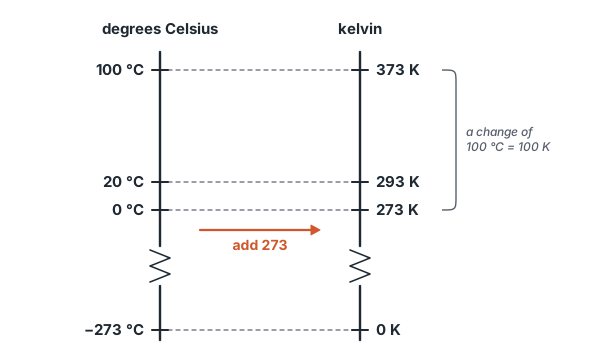
Because the pressure line of every gas reaches zero at −273 °C, scientists use a temperature scale that starts there: the Kelvin scale. Its unit is the kelvin, symbol K, written without a degree sign. One kelvin is exactly the same size as one degree Celsius; only the zero is different. 0 K is −273 °C, so a temperature in kelvin is always 273 more than the same temperature in degrees Celsius:
T (in K) = θ (in °C) + 273
To go the other way, subtract 273: θ = T − 273. Water freezes at 0 °C, which is 273 K, and boils at 100 °C, which is 373 K. A room at 20 °C is at 293 K. There are no negative temperatures on the Kelvin scale.
 (enlarge)
Trap: “To change kelvin into °C, add 273.” A temperature in kelvin is always the bigger number. 300 K is 300 − 273 = 27 °C, not 573 °C. From °C to K, add 273; from K to °C, subtract 273.
Because the two scales have steps of the same size, a change in temperature has the same number on both. Warming the water from 20 °C to 80 °C raised its temperature by 60 °C, which is a rise of 60 K, from 293 K to 353 K. Add 273 only to a temperature, never to a change in temperature.
Worked example
Kelvin both ways
(a) The air in the syringe was heated to 80 °C. What is this temperature in kelvin? (b) A freezer is at −18 °C. What is this in kelvin? (c) Liquid nitrogen boils at 77 K. What is this in °C? (d) The water in the experiment was cooled from 20 °C to 2 °C. By how many kelvin did its temperature fall?
(a) T = θ + 273 = 80 + 273 = 353 K. (b) T = −18 + 273 = 255 K: a temperature below 0 °C is still a positive number of kelvin. (c) θ = T − 273 = 77 − 273 = −196 °C. (d) The fall is 20 − 2 = 18 °C, which is a fall of 18 K, from 293 K to 275 K. A common slip in (c) is to add instead of subtract, giving 350 °C: liquid nitrogen is very cold, so the answer must be far below 0 °C.
Case closed
A sealed can must not be left in a hot car because its gas cannot escape and cannot spread out: a fixed mass at a fixed volume. As it warms, its particles move faster, hit the walls more often and harder, and the force on each unit of area of the walls, the pressure, rises. In the experiment, air heated from 20 °C to 80 °C went from 100 kPa to 120 kPa. A real aerosol can is worse than air alone: it also holds a liquid that turns into more gas as it warms, so its pressure climbs much faster, and in a very hot car it can get high enough to split the can. Temperatures on the Kelvin scale start from −273 °C, where the pressure line of a gas reaches zero: T (in K) = θ (in °C) + 273.
About this model
The plunger is locked, so the volume stays at 50 cm³. The readings follow the ideal-gas rule, and air at these temperatures behaves almost exactly like this. The magnifier shows 12 particles drawn far bigger than real, and how much faster they move when warmer is exaggerated four times, so that you can see it. The cooling and the heating are shown sped up: real water would take several minutes. The dashed end of the line, down to −273 °C, is an ideal-gas extrapolation: real air turns to liquid long before.