Independent final check
Explain without the key
explain / show / calculate / describe / state
Final check
explain: give reasons and connect them to evidence. show: use the given information. calculate: work out the answer from the data. describe: give the features or what happens. state: give a concise answer.
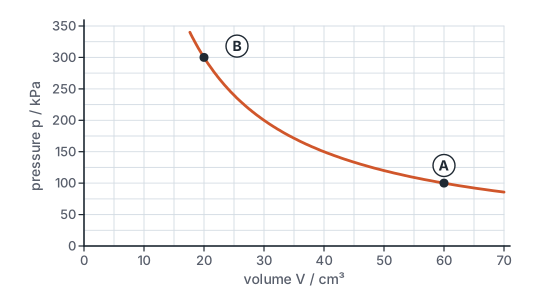
The graph shows how the pressure of the air in a sealed syringe changes with its volume, at a constant temperature. (a) Explain, in terms of particles and the force on each unit of area, why the pressure at B is higher than at A. (b) Use the values at A and B to show that pV is constant. (c) Calculate the volume of the air when its pressure is 150 kPa. (d) Describe the graph you would get by plotting p against 1/V for these readings. (e) State the two conditions needed for pV to stay constant.
 (enlarge)
Your saved work
Answers and earlier attempts stay in this browser. Export a copy to keep, to move to another device or to hand to your teacher. Importing a copy keeps your current answers and adds earlier attempts.
Scope and sources
Cambridge IGCSE Physics 0625 · 2026–2028 v2 · Original learning materials.
Gas pressure and changes in it from the motion of particles and their collisions with a surface (2.1.2.3), and pressure as the force of the collisions per unit area (2.1.2.7); the effect on the pressure of a fixed mass of gas of a change of temperature at constant volume and of a change of volume at constant temperature, in particle terms (2.1.3.1); converting between kelvin and degrees Celsius, T (in K) = θ (in °C) + 273 (2.1.3.2); pV = constant at constant temperature, with its graphs (2.1.3.3); thermal expansion of solids, liquids and gases at constant pressure, its uses and consequences, and why solids expand least and gases most (2.2.1.1–2.2.1.3). Absolute zero as the temperature of least particle motion and the particle model of matter are in PART01; pressure as force ÷ area and pressure in liquids are in PRES01.
Apparatus, amounts and times in the experiment are illustrative. Real practical work follows a teacher-approved safety method.
Official Cambridge syllabus