Independent final check
Explain without the key
determine / calculate / identify / describe / explain
Final check
determine: find the answer from the information given. calculate: work out the answer from the data. identify: name or select. describe: give the features or what happens. explain: give reasons and connect them to evidence.
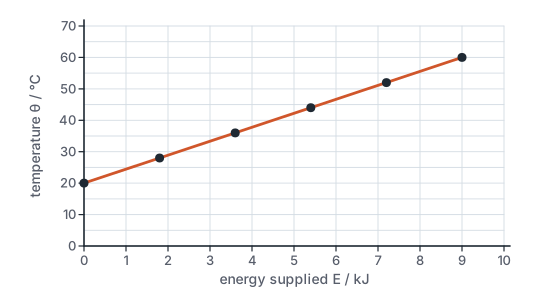
A 0.50 kg block of an unknown metal, in an insulating jacket, is heated from 20 °C. The graph shows how its temperature changes with the energy supplied. (a) Use the graph to find the rise in temperature when 9.0 kJ has been supplied. (b) Calculate the specific heat capacity of the metal. (c) Identify the metal, using these values: copper 390 J/(kg °C), iron 450 J/(kg °C), aluminium 900 J/(kg °C). (d) Describe what happens to the internal energy of the block and to its particles as it warms. (e) Describe how the shape of the graph would change if the block were heated without its jacket, and explain why.
 (enlarge)
Your saved work
Answers and earlier attempts stay in this browser. Export a copy to keep, to move to another device or to hand to your teacher. Importing a copy keeps your current answers and adds earlier attempts.
Scope and sources
Cambridge IGCSE Physics 0625 · 2026–2028 v2 · Original learning materials.
A rise in the temperature of an object increases its internal energy (2.2.2.1); the rise in temperature in terms of an increase in the average kinetic energy of its particles (2.2.2.2); specific heat capacity as the energy needed per unit mass per unit temperature increase, with c = ΔE ÷ (m Δθ) (2.2.2.3); experiments to measure the specific heat capacity of a solid and of a liquid (2.2.2.4). Changes of state, melting and boiling, are in MELT01; conduction, convection and radiation are in TRANS01.
Apparatus, amounts and times in the experiment are illustrative. Real practical work follows a teacher-approved safety method.
Official Cambridge syllabus