Pupil sheet · Cells under the microscope
Cells under the microscope — return questions
Name ______________________ Date ____________
Use one to two weeks after the lessons. Keep the notes and the lesson closed.
1. state
Fill the gaps. In every cell, the ___ controls what enters and leaves, and most chemical reactions happen in the ___. The ___ contains the genetic material. Only plant cells have a ___ made of cellulose. A bacterium has no nucleus: its genes are on a loop of ___ in the cytoplasm.
Controls what enters and leaves
Where most reactions happen
Contains the genetic material
Made of cellulose, plant cells only
A bacterium’s loop of genes
2. identify
The drawing shows a bacterial cell. Name the parts labelled A to E.
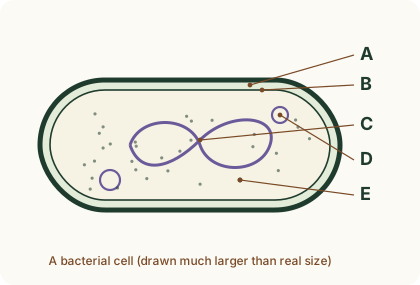
Write the number of the matching option.
- Cell wall
- Cell membrane
- Circular DNA
- Plasmid
- Ribosome
- Nucleus
- A: ______
- B: ______
- C: ______
- D: ______
- E: ______
3. state
Fill the gaps. New cells are produced by ___ of existing cells. A group of similar cells working together is a ___. Cells that carry electrical impulses are ___. Cells that move mucus in the airways have ___ on their surface. Sperm and egg cells are specialised for ___.
How new cells are made from existing cells
A group of similar cells working together
Cells that carry electrical impulses
Hair-like structures that move mucus
The job of sperm and egg cells
4. calculate
A cell is 120 mm long on a photograph magnified ×400. Calculate its actual length in micrometres.
Actual length: ______________ unit ________
5. calculate
A photograph was taken through a microscope set at ×400. On the photograph a bacterium is 36 mm long. The real bacterium is 4 µm long. Calculate the magnification of the photograph.
Magnification (no unit): ______________ unit ________