Pupil sheet · Cells under the microscope
Plant and animal cells — questions
Name ______________________ Date ____________
Try every question before you use a nudge. Write in full sentences where you are asked to explain.
1. state
Which part of a cell controls which substances enter and leave it?
Circle one answer.
- The cell wall
- The nucleus
- The cell membrane
- The vacuole
Nudge (only if you are stuck): Think of the layer around the cytoplasm of every cell, plant or animal. The cell wall is outside it.
2. state / describe
Match each cell structure to what it does.
Write the number of the matching option.
- Contains the genetic material that controls the cell
- Photosynthesis
- Aerobic respiration: releases energy
- Makes proteins
- Stores cell sap; keeps the cell firm
- Nucleus: ______
- Chloroplast: ______
- Mitochondrion: ______
- Ribosome: ______
- Large vacuole: ______
Nudge (only if you are stuck): Start with the two found only in plant cells: the chloroplast and the large vacuole.
3. state / describe
Match each part of a bacterial cell to what it does.
Write the number of the matching option.
- Keeps the cell’s shape and stops it bursting
- Controls what enters and leaves
- Carries the genes that control the cell
- Carries a few extra genes, such as one for surviving an antibiotic
- Makes proteins
- Cell wall: ______
- Cell membrane: ______
- Circular DNA: ______
- Plasmid: ______
- Ribosome: ______
Nudge (only if you are stuck): Three of these do the same job as in a plant cell. The two that are new are the big loop of DNA and the small rings.
4. identify
This drawn view shows cheek cells at ×400. Which structures can you see in it? Choose all that you can see.
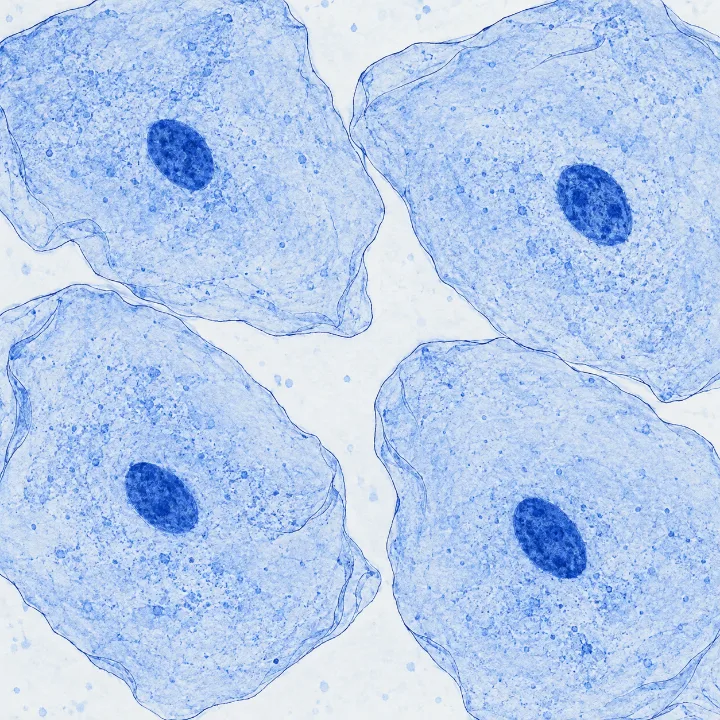
Tick every correct statement.
- Cell membrane
- Cell wall
- Nucleus
- Cytoplasm
- Large vacuole
- Chloroplasts
Nudge (only if you are stuck): Go round one cell from the outside in. Is its edge a firm wall, or only the thin outline of the cell itself? Then: what is the dark body, and what fills the rest?
5. compare
Compare the structure of a plant cell and an animal cell.
(a) Structures in both plant and animal cells
(b) Structures only in plant cells
Nudge (only if you are stuck): Make two lists: structures both cells have, and structures only plant cells have.
6. describe
Which statement about a bacterial cell is correct?
Circle one answer.
- It has a nucleus containing circular DNA.
- It has circular DNA in the cytoplasm and no nucleus.
- It has no cell wall and no cell membrane.
- It has chloroplasts but no ribosomes.
Nudge (only if you are stuck): Where is a bacterium’s DNA? Look at the labelled bacterial cell.
7. identify / explain
A student found three unknown cells. Cell X is 80 µm long, with a cell wall, a large vacuole and a nucleus, but no chloroplasts. Cell Y is 20 µm across, with a nucleus and a cell membrane but no cell wall. Cell Z is 2 µm long, with a cell wall and ribosomes but no nucleus. Decide whether each is a plant cell, an animal cell or a bacterium, and give one piece of evidence for each.
Cell X: kind of cell and evidence
Cell Y: kind of cell and evidence
Cell Z: kind of cell and evidence
Nudge (only if you are stuck): Start with the nucleus: which kind of cell has none? Then look for the features only plant cells have.